Showing posts with label Church administration. Show all posts

Tuesday, February 5, 2008

Anthon H. Lund--Skeletons in the Barn

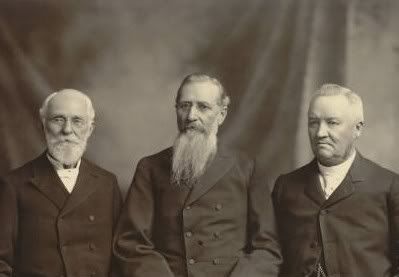
President Joseph F. Smith with counselors John R. Winder and Anthon H. Lund


Several observers have pointed out that Dieter Uchtdorf is not the first Apostle we have had who was born in a country outside of the U.S. One of the names being mentioned is that of the "Danish Apostle," Anthon H. Lund. This Apostle has always interested me because my maiden name is Lund. (Although my English Lunds are in no way connected to the Denmark Lunds.)

A few years ago a Lund descendant wrote an article about the skeleton in Grandpa Anthon H. Lund's barn. President Lund kept a prolific journal which unearthed more than one corresponding skeleton lurking in our Church history, and even in his own life. It is certainly interesting to look at LDS history as informed by the experiences of Anthon H. Lund.

Lund arrived in Utah at the age of 18 and worked as a teamster, a school teacher, and then a telegraph operator. He served in the Utah Territorial Legislature and is credited for starting USU because he introduced the legislation to start it. At the same time, he worked on the Utah Capitol Grounds Committee. Lund was used extensively by the Church in its foreign missions. He was the President of the Scandinavian Mission, President of the European Mission, and organized the Turkish Mission. He was ordained an apostle in 1889 and served in the First Presidency of the Church from 1901 until his death March 2, 1921.

Anthon H. Lund served as Counselor in the First Presidency under President Joseph F. Smith and under Heber J. Grant. He was always "just a bit different," and not only because of his nationality. At the time of his call the the Twelve, he was the only monogamist among the Apostles. He wasn't afraid to be different.

Lund was the one to give the first Conference Talk in 1899 emphasizing it was no longer Church policy to gather to Zion, but that Saints were to stay in their native lands and build up the Church there. I wonder how much influence he had in that decision.

Another example of Lund's disregard of convention occurred in 1903 when Benjamin Cluff, Jr., president of the Brigham Young Academy proposed to the Board that it change the name of the school to Brigham Young University, which had been his aim all fourteen years of his administration. There followed a vigorous dispute over this proposal. Thinking the school was not qualified to become a university, Anthon H. Lund of the First Presidency vigorously opposed it but was outvoted by his brethren. In his diary for the day President Lund recorded, "I hope their head will grow big enough for their hat."

In his diary Lund said that when President Joseph F. Smith nominated his son Hyrum in their meeting with the Twelve in October 1901 that there was talk of nepotism by some of the Twelve. A couple of the Twelve said Hyrum had not served in any major church calling and his qualifications weren't obvious. President Smith told them he didn't know why but the Lord revealed to him that his son was to be the next apostle but that was who the Lord wanted. Elder Lund spoke out in favor of Hyrum's calling saying if that was who the Prophet and the Lord both wanted then the other brethren should support the calling. A vote was called and the brethren voted to call Hyrum Mack Smith as an apostle.

Later when the Apostle Hyrum became ill, he refused medical treatment. Hyrum maintained that the Lord would protect him and he would be cured. His father the Prophet became worried and asked him to reconsider--that the family's personal physician could operate on him immediately. It took several hours to convince him but finally he did it for his father's sake. Peritonitis had set in. When the surgeon opened him up he died on the table from the infection on 23 January 1918.

Lund goes on to write that many general authorities expressed the opinion that Hyrum was taken early because he was needed in the Spirit World to work among the youth and that they said that mainly to try to soften the loss for President Smith. Lund stood up indignantly and opined that the needless tragedy would not have occurred had Hyrum been wise and gone to a doctor sooner.
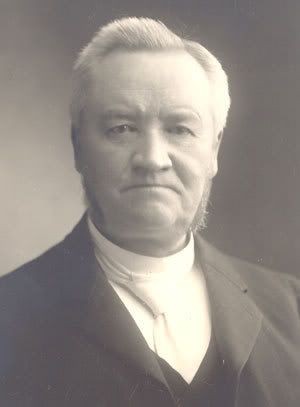
Lund's diaries cover his opinions on the tensions between Apostle Moses Thatcher and his colleagues; the rejection by the U.S. House of Representatives of Utah's Congressman, B. H. Roberts; his involvement in post-Manifesto polygamy and the stormy hearings over whether to seat LDS apostle Reed Smoot in the U.S. Senate. He was also a signer of the 1909 First Presidency statement on the origin of man and found himself in the thick of the 1911 evolution controversy at BYU.

Lund was known for not being a strict follower of the Word of Wisdom. Interestingly, it was directly following his death in 1921 that Church President Heber J. Grant made adherence to the proscriptions of the Word of Wisdom an absolute requirement for entering the temple.

Becoming a member of the First Presidency made Anthon H. Lund a part of a great deal of controversial Church history. I wonder what is in store for Dieter Uchtdorf?

Wednesday, November 14, 2007

Campaigning for a Calling

"In the service of the Lord, it is not where you serve but how." (J. Reuben Clark, Jr., CR, April 1951, 154)

"Sometimes men and women in the Church aspire for office. This is unfortunate. It becomes the very reason why they should not be granted such office." (Gordon B. Hinckley, Keep the Chain Unbroken, Talk given at BYU, 30 Nov. 1999)

"And, finding there was greater happiness and peace and rest for me, I sought for the blessings of the fathers, and the right whereunto I should be ordained to administer the same; having been myself a follower of righteousness, desiring also to be one who possessed great knowledge, and to be a greater follower of righteousness, and to possess a greater knowledge, and to be a father of many nations, a prince of peace, and desiring to receive instructions, and to keep the commandments of God, I became a rightful heir, a High Priest, holding the right belonging to the fathers... I sought for mine appointment unto the Priesthood according to the appointment of God unto the fathers concerning the seed." (Abraham 1:2,4)

I might use this collection of quotes to begin a post on women and the priesthood, but I will save that for another day. Today I'd like to talk about callings in the Church. Quite naturally, there are some positions in the Ward and Stake that will appeal to us more than others. Since we are both human and diverse, there are different reasons why this might be so. Perhaps our talents align closely to a particular talent, such as ward organist. Perhaps we enjoy working with one age group more than another. Maybe we yearn for a calling that will be challenging, such as Gospel Doctrine Teacher. Or conversely, we might desire something that takes little to no work (Sunday School President :) ) Some members enjoy power, high visibility, and leadership, while others prefer to build the Church behind the scenes.


As an LDS member, I enjoy teaching, public speaking, and scripture study and interpretation. My favorite age group is youth, and I enjoy being in the limelight. Therefore the callings I most earnestly desire are: Youth SS Teacher, Seminary Teacher, YW Advisor (teaching the Sunday lessons), and yes, I love the calling of Gospel Doctrine teacher also.

According to Gordon B. Hinckley, above and in other places, members should not aspire to callings. But the quote from Abraham can be read as a righteous aspiration for a priesthood office. Look at the things that Abraham desired as he sought for the High Priesthood:

1. the blessings of the fathers
2. ordination to administer blessings
3. great knowledge
4. to be a follower of righteousness
5. to be a father of nations
6. to be a prince of peace
7. to receive instructions
8. to keep the commandments of God

Some of these things sound very humble, and others sound, well, aspiring. Is it OK to seek a calling if one's motivations are as lofty as Abraham's? How should we seek for the appointment? Is it appropriate to pray for a calling? Shall we let the Bishop know what callings we most enjoy?


I'll be the first to admit that I have campaigned for callings. This has manifested itself in the following ways:

  • When moving into a ward and having my first interview with the Bishop I have mentioned the callings I have had in the past, telling him the ones I've enjoyed and conveniently neglecting to mention the ones I do not wish to repeat. (Except, sometimes I'll mention that I've been in the Nursery five times already.)
  • I've successfully been called to Gospel Doctrine teacher twice by letting the regular teacher know I am always available to substitute. I'll prepare the lesson each week and accept with alacrity even when asked 15 minutes before the Sunday meetings begin. I think this technique works for almost any calling. Just make the offer that you would be willing to "help out" any time you are needed. Then be sure you are Johnny-on-the-spot when someone else falls through.
  • Part of campaigning for a calling is not appearing too anxious to step into the calling. A deep show of humility and just a touch of hesitation is essential. Don't step on anyone's toes!
  • Several years ago, DH reached the age where he was uncomfortable remaining in the Elders' Quorum. He hesitated to aspire for the calling of High Priest, but I read him the above quote by Abraham, and encouraged him to fast and pray for it. Not long after, he was called to be the HP Group Leader.

Where do you stand on campaigning for callings?

--It is completely wrong to aspire to any calling. You should be totally open to the Lord's will in the matter, and accept the callings extended to you.

--It is acceptable to desire or seek for a calling, as long as you do it with humility and a desire to build the kingdom, learn, grow, and serve.

--Everyone has callings they are better suited for, and there is nothing wrong in making your desires known to the leadership and/or placing yourself in a position advantageous to be noticed for these callings.

What types of "campaigning" are kosher?


--Praying

--Fasting

--Volunteering

--Hinting

--Asking

--Other

Wednesday, August 1, 2007

Postmodern Ideas for the LDS Church


Recently, Christian bloggers have been discussing the effects of postmodernism on their congregations. (Hat Tip: DMI Dave) For example, this article notes that our society is undergoing a shift to a completely different way of thinking--from left-brained, logical, analytical patterns to whole-brained or bi-lateral thinking. This type of thinking includes and embraces the right-brain intuitive and creative influences. The postmodern generation has been trained in the classroom to use the right brain in their learning activities. Schools have increasingly incorporated the inquiry approach to problems and have engaged in cooperative learning paradigms.

As they encounter the Church as adults, these 18 to 30 year-olds use postmodern thinking in solving difficulties and ambiguities. I believe that as this generation takes its place in local Church leadership, there will be more creative problem-solving at the grass-roots level and less reliance upon tradition. Rather than memorizing and quoting from the Church Handbook of Instructions, these leaders will increasingly use their right brain and intuitive powers.

An example of this type of thinking in the LDS Church can be found in a recent post at Mormon Rhetoric. Here Natalie makes some interesting suggestions on the subject of ward boundaries. Not being part of the postmodern generation, I had never even considered that ward boundaries could be formulated using criteria other than geography. But she makes a great case for approaching problems such as transient communities and weak youth programs. In other areas of the Church, one can see Ward Councils using cooperative principles rather than rigid hierarchical structures. (Warning: Sometimes this attempt may resemble the cartoon above!) Nonetheless, this is an exciting development.

The evangelical churches have concluded that in order to stay vital they must learn how to think postmodernly without sacrificing key principles.

Do you see that the LDS Church could benefit from postmodern thinking? What do you identify as key principles that should not be sacrificed if the Church begins to take a more right-brained or bi-lateral approach?