This isn't reflective of me, really; except I'm a little blue, I have a lot of friends who are breaking up, and I heard a whale song today. It's the most mournful sound I can imagine. It really pricked my heart, so I wrote this:
Wednesday, January 5, 2011
Whale Sounds are so Sad
Wednesday, October 6, 2010
Nearsighted
When I put these glasses on,
There are blades of grass
That before I could not see,
And petals when I pass.
I see each point of starry light
Away up in the sky--
Shapes and shadows not discerned
with my imperfect eye.
O might I put some glasses on,
The face of God to see?
Or little indications that
He lives and loveth me?
For now, my vision's darkened, and
The world is cold and gray:
The blurry gloom that comes at night
When He is far away.
Wednesday, March 17, 2010
Knight of Swords Tarot Randomizer #1
Overarching canyons and clouds,
Framing mountains and mornings--
That clears the confusion in sinus-blocked nostrils
A breath of freshness
To the unbalanced wanderer.
There's something about a Utah day--
Manifesting seedlings and springtime,
Teasing flowers with flurries--
That promises newness, fresh starts, and cleansing
Purging the old and ungainly
In the jaded heart.
There's something about a Utah ward--
Bustling with baby blessings and boundaries,
Tangling holiness and hypocrisy--
That slices the errant knight to the heart
Focusing sword-bright censure
Upon the unanchored soul.
This post a response to John R's Tarot Randomizer group creativity experiment, and a reaction to my visit to the Salt Lake/Provo area, where I am visiting for a couple of weeks.
Friday, December 25, 2009
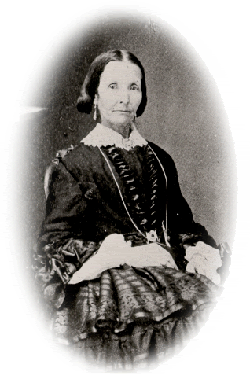
Eliza R. Snow Believed in Santa Claus
Remember your time-honor'd laws,
Kind master of the merry glee:
Prepare your gifts, good Santa Claus,
And hang them on the Christmas tree.
Thursday, December 10, 2009
Poetry While Waiting in the Car
poetry while waiting in the car
and drumming your fingers on the steering wheel
because you are waiting for your son
or daughter
or you are afraid to go in to the hospital
or you are dropping off a friend
Wednesday, October 14, 2009
Friday, June 12, 2009
Dear John
The table where I grew up
eating breakfast and lunch and Thanksgiving dinner
was always large enough
for one more.
Monday, April 20, 2009
In Honor of the 400th Anniversary of Shakespeare's Sonnets
On April 20, 1609, a publisher called Thomas Thorpe entered in the Stationers' Register his right to publish “a booke called Shakespeares sonnettes”. The Shakespearean sonnet is one of my favorite forms of poetry with its rhyme scheme of abab cdcd efef gg. In honor of the day I am sharing one of my original sonnets with you. It's inspired by my sojourn in Saudi Arabia and my impending 50th birthday! I invite you to write a sonnet of your own or share one of your favorites below in the comments!
Saturday, April 11, 2009
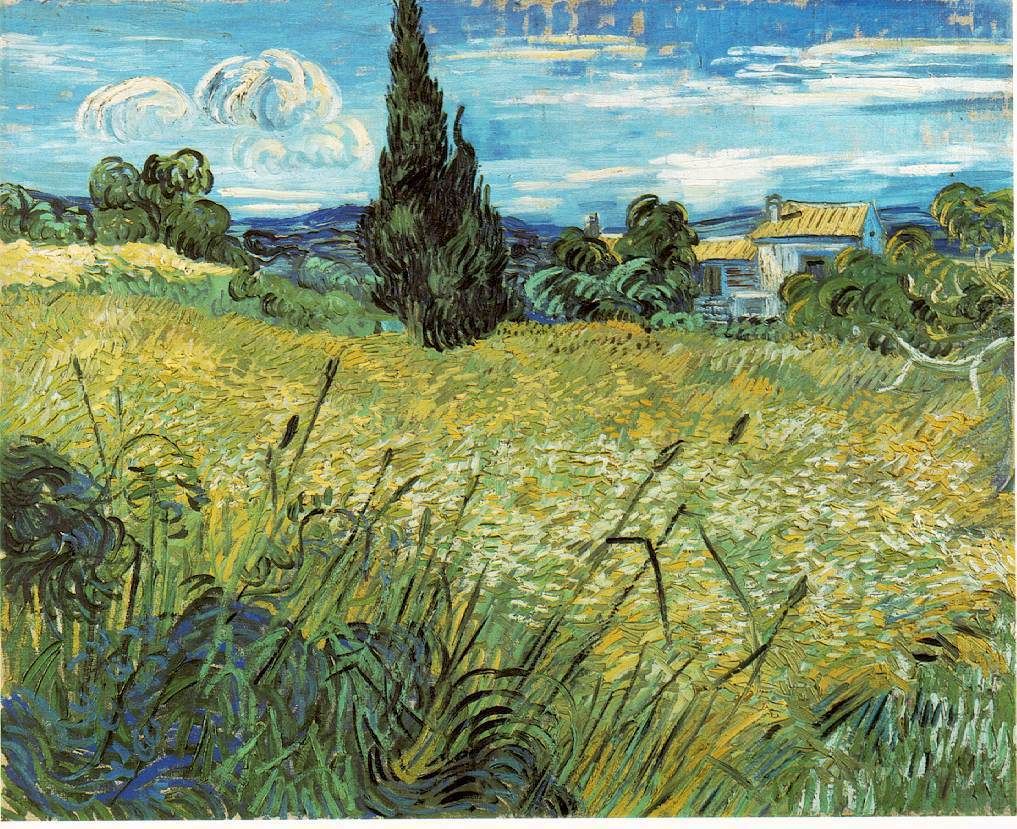
Like Wheat Arising Green
Now the green blade rises from the buried grain,
Wheat that in dark earth many days has lain;
Love lives again, that with the dead has been;
Love is come again like wheat arising green.
Saturday, January 31, 2009
Walking Forward in that Light
When I am depressed I tend to invest every little thing that I encounter with an exaggerated, symbolic meaning relating to myself. You know how this works, any of you? Trees, with their scant winter limbs reaching out to the sky represent your bare naked soul thrust up to the iron-gray heaven of an unresponsive God. Or you will be eating almonds and, holding one in your salty fingers, you contemplate the hardness and brittleness you have been manifesting to your children.
Friday, May 23, 2008
This Is Just To Say Meme
The "This is Just to Say" Meme takes its inspiration from Kacy's post at Light Refreshments Served blog. Read it! She has written some hysterical spoofs of the William Carlos Williams poem, This is Just to Say. Do you remember it from high school?
This is Just to Say
I have eaten the plums
that were in the icebox
and which
you were probably saving
for breakfast
Forgive me
They were delicious
so sweet
and so cold
Instructions: copy this post and replace my spoof with your own. Then tag five people. Here's mine:
This is Just to Say
I already left for Church
without you
leaving you to
press your shirt
change the baby's diaper
And braid five heads of hair
Forgive me
while I sit in the driveway
and gleefully honk
the horn
I tag DH, Faux, Chanson, Kalola, and Maraiya.
Sunday, February 24, 2008
5 LDS Interpretations of the Isaiah Passages that Should Not be Perpetuated
I promised some posts on upcoming Book of Mormon Sunday School lessons. But I have to warn you, I've been in a blue funk lately. So I suspect my thoughts are neither inspiring nor fit for Sunday School consumption. But maybe it will help you know what not to say.
LDS Sunday School students will soon take a quick leap through 13 chapters of Isaiah which are quoted by Nephi in 2nd Nephi chapters 12-24. All too often, some uniquely Mormon interpretations are given to these chapters which merit a critical analysis. In this post I present five Mormonisms which I believe hinder a deeper and more accurate understanding of Isaiah's writings.
1. 2 Nephi 12:2,3 Popular LDS commentary on this verse identifies it as Isaiah's vision of people from many lands coming to Salt Lake City, Utah.
Many prophecies of Isaiah are dual and can be applied to more than one time, situation or people. I am aware that latter-day prophets and apostles have related this verse to the Salt Lake temple or even to the Conference Center from which the word of the Lord is issuing forth in these days. However, if we insist too strongly on this Mormon-centric view, we can miss the primary application which this verse has to the millennial reign of the Messiah. The word "mountain" as used in the Bible is a metaphor for "nation," "government," or "political system." In verses 2 and 3 Isaiah is speaking of the millennial condition when Christ shall establish the political Kingdom of God upon the earth. This will be established "in the top of the mountains," or in other words "as the head of the nations."
2. 2 Nephi 12:3 Isaiah wrote that the word of the Lord will come from Jerusalem, and the law will come from Zion, the New Jerusalem, located in Jackson County, Missouri. There will be two distinct centers of influence for God's people.
This may be, but verse 3 should not be used as a proof-text. Here we have a synonymous chiastic parallel where
the Law = the Word of the Lord, and
Zion = Jerusalem (one and the same)
The chiastic structure of this phrase indicates that Isaiah equated Zion with Jerusalem (the one located in Israel!) If we accept this, we will be able to learn more about Zion as it relates to the ancient City of David.
3. 2 Nephi 12:9 In the Book of Mormon, verse 9 is clarified by adding the word "not" to the following statement: "And the mean man boweth [not] down and the great man humbleth himself [not], therefore forgive him not."
This verse actually makes much more sense in its original context, without the extra "not" added in the Book of Mormon version. Verse 8 speaks of idols which are found throughout the land. And the mean (common) man and the great (important) man boweth down (to these idols). This version makes more sense coming as it does right after the description of people worshipping idols, the work of their own hands.
4. 2 Nephi 12:13-17 Some Mormons still insist that this passage is an example of the restoration in the Book of Mormon of passages that were lost in the Old Testament. As noted in footnote 16a, “The Greek (Septuagint) has ‘ships of the sea.’ The Hebrew has ‘ships of Tarshish.’ The Book of Mormon has both, showing that the brass plates had lost neither phrase.”
Pike and Seely have shown the challenges of accepting this interpretation. I love the poetry of the passage and find that the addition of the extra phrase and other interjected words spoils the beauty of the chiastic tripled bicola. Isaiah used poetic conventions frequently to emphasize his points. The Book of Mormon addition does not enhance the poetic structure of the passage, but instead inhibits it. The Greek "ships of the sea" and the Hebrew "ships of Tarshish" are probably different translations of one original phrase and it is not necessary or preferable to include both. Observe the perfection of the Masoretic text with the pattern of w- (conjunction) + al (preposition "upon") followed by kol- ("all/every") and then two words (here in English translation):
For the day of the LORD of hosts shall be
upon every one that is proud and lofty,
and upon every one that is lifted up; and he shall be brought low:
and upon all the cedars of Lebanon, that are high and lifted up,
and upon all the oaks of Bashan,
and upon all the high mountains,
and upon all the hills that are lifted up,
and upon every high tower,
and upon every fenced wall,
and upon all the ships of Tarshish,
and upon all pleasant pictures (fine craft)
and the loftiness of man shall be bowed down,
and the haughtiness of men shall be made low;
and the LORD alone shall be exalted in that day.
(if all this fascinates you, there is a well-reasoned apologetic view here. But I stand by my opinion.)
5. 2 Nephi 14:1 The Mormon speculation on this verse goes as follows: With so many men killed in war, righteous single priesthood holders are in short supply. Thus, plural marriage is reinstituted, with many women stating they will support themselves in order to receive priesthood covenant protection.
My examination of the Hebrew of this verse makes me confident in translating "one man" as "a certain man." The verse thus teaches that in the latter day seven women (symbolic number of completeness, denotes the covenant people) shall take hold of a certain man (guess who that would be?) and ask him "let us be called by thy name," which will take away their reproach (effects of atonement). In my view this verse is Messianic and has nothing whatsoever to do with polygamy.
Update: Our SS teacher gave 2 of these very interpretations while presenting the lesson! How about yours??
*
Tuesday, February 12, 2008
Valentine's Day 2008, A Silver Stud
I hope DH doesn't feel offended, but I found someone to make my heart go "pitty-pat" this Valentine's Day. It's Poet Laureate and Pulitzer Prize winner Ted Kooser. (hat tip: Amelia) Some of you young male bloggers can pick up a few tips from this guy! Kooser admits that he started writing poetry as a young man with the goal of gaining female attention. In those years," he said, "I desperately needed some sort of a gimmick, for I was thin and pimply, my palms sweated, and my breath was sour from smoking the Chesterfields that despite the claims of magazine advertising had failed to make me irresistible. I got the idea that being a poet might make me attractive. It didn't occur to me for a long time that in order to earn the title of 'poet,' I ought to have written at least one poem. Being a poet was looking the part.
Oh, Mariachi Me
All my life I have wanted nothing so much
as the love of women. For them I have fashioned
the myth of myself, the singing troubador
with the flashing eyes. Always for them
my black sombrero with its swinging tassels,
this vest embroidered with hearts, these trousers
with silver studs down the seams. Oh, I am
Mariachi me, as I had intended. I am success
and the price of success, now old and dusty
at the edge of the dance floor, still smiling,
heavy with hope, clutching my dead guitar.
Ted Kooser, Valentine's Day 2006
He seems to have learned a lot since his early days! Now, he gives Valentine advice such as this: "Any kind of handwritten message to anyone else is a plus, even if it isn't a great work of art. Love letters are a wonderful gift, even when poorly written." BiV can only heartily agree. (Are you still reading, DH?) Kooser said men, in particular, fall back on the old standards: a dozen roses and a box of chocolates.
"That's OK, but my guess is a handwritten letter would convey a lot more. But I wouldn't want to deprive women of roses and chocolates." That Kooser understands the secret longings and fears women experience is obvious from this tidbit:
If you feel sorry for yourself
this Valentine's Day, think of
the dozens of little paper poppies
left in the box when the last
of the candy is gone, how they
must feel, dried out and brown
in their sad old heart-shaped box...
(Excerpt of Ted Kooser poem "If You Feel Sorry")
February 14th became a special day for this romantic soul, and in 1986, Kooser mailed one of his efforts, "Pocket Poem" to 50 female friends for Valentine's Day. Kooser continued the tradition (approved by his wife), and did it for the next 21 years. He spent time and money tenderly applying little red hearts to the cards, boxing them up and sending them to a different post office just so they could be postmarked from Valentine, Neb. Isn't that just too sweet for words?? Eventually, over 2,500 women received a yearly poem from the Nebraska poet.
If this comes creased and creased again and soiled
as if I'd opened it a thousand times
to see if what I'd written here was right,
it's all because I looked too long for you
to put it in your pocket. Midnight says
the little gifts of loneliness come wrapped
by nervous fingers. What I wanted this
to say was that I want to be so close
that when you find it, it is warm from me.
Ted Kooser, "Pocket Poem," Valentine's Day 1986
What I love most about Kooser's poems is that although he is a romantic, he appreciates depth and variety in women. The woman he describes in the poem "Selecting a Reader" is priceless, and she demonstrates that his definition of beauty is nuanced:
First, I would have her be beautiful,
and walking carefully up on my poetry
at the loneliest moment of an afternoon,
her hair still damp at the neck
from washing it. She should be wearing
a raincoat, an old one, dirty
from not having money enough for the cleaners.
She will take out her glasses, and there
in the bookstore, she will thumb
over my poems, then put the book back
up on its shelf. She will say to herself,
"For that kind of money, I can get
my raincoat cleaned." And she will.
Kooser's poems avoid over-sentimentality and often have unexpected twists. There's a dark, seductive, almost ravenous side to the poem "Barn Owl" that will give you the shivers...
High in the chaffy
Taffy colored haze of the hayloft,
Up under the starry nail-hole twinkle of the old tin roof
There in a nest of straw and bailing twine
I have hidden my valentine for you
A white heart woven of snowy feathers
In which wide eyes are welcome
Open to you as you climb the rickety ladder to my love
Behind those eyes lies a boudoir of intimate darkness, darling
The silks of oblivion
And set like a jewel dead center in the heart
Is a golden hook the size of a finger ring
To hold you always
Plumpest sweetheart mouse of mine.
(Here he is reading the poem aloud, in his adorable, self-deprecating manner: (KooserBarnOwl)
And yet, although Kooser has now passed the landmark of 60 years old, he retains the sweet shyness of youth, as evidenced in the poem, "Tracks:"
Using a cobbler’s shoe last
I found one summer at a yard sale,
and the heavy leather uppers
from cast-off boots, a jigsaw,
some wood, an awl and thread,
and a few evenings sitting alone
thinking of you, I have fashioned
a pair of red valentine shoes
with heart-shaped wooden heels.
Look for my tracks on your doorstep
where I stood with sore feet
through the evening, too timid to knock.
Kooser's Valentine postcards are now available to all in the form of his newly published book, "Valentines." A review describes it thus, "Kooser's valentine poems encompass all the facets of the holiday: the traditional hearts and candy, the brilliance and purity of love, the quiet beauty of friendship, and the bittersweetness of longing." I just can't get enough of these love poems. Will you read just one more?
After YearsToday, from a distance, I saw you
walking away, and without a sound
the glittering face of a glacier
slid into the sea. An ancient oak
fell in the Cumberlands, holding only
a handful of leaves, and an old woman
scattering corn to her chickens looked up
for an instant. At the other side
of the galaxy, a star thirty-five times
the size of our own sun exploded
and vanished, leaving a small green spot
on the astronomer’s retina
as he stood on the great open dome
of my heart with no one to tell.
So, guys, if you haven't already bought a diamond bracelet or box of chocolates, hie thyself to the nearest bookstore and pick up a copy of Kooser's book. Write your own ditty, be it ever so humble, and tuck it among the pages, where it will be cherished in years to come. And in the best of Kooser tradition, get an extra copy and send it to that older lady you home teach.
Monday, February 4, 2008
Eliza, Adam, and the Heavenly Mother
Eliza R. Snow holds a unique position in Mormon history. She never had children or a husband of her "own," though she was married to the first two LDS Prophets. Eliza became extremely influential in the early Church for a variety of reasons. Her situation with less family responsibility gave her free time to pursue her interests. Her calling as General Relief Society President saw her travelling among the Saints and gave her an authoritative position. Her proximity to Church leadership put her in firsthand touch with Church doctrine as it was developed. Finally, her considerable talent in writing gave her a voice among men and women alike.
We are all aware of Eliza's contribution to LDS belief through her poem, "The Eternal Father and Mother," which became the popular hymn "O My Father." The poem was frequently reprinted, put to a number of musical settings, and sung at formal as well as informal Church settings. Eliza popularized the concept of a mother God to such an extent that by 1873 Wilford Woodruff credited her poem as the source of the doctrine, identifying it as "a revelation, though it was given unto us by a woman--Sister Snow." [1]
The female bard Eliza treated many other principles of the Church in her poetry. One of her lesser-known poems, "The Ultimatum of a Human Life" [2] is of interest because it speaks of the Adam-God doctrine, once furiously debated, and now repudiated in the modern Church. "The Ultimatum" begins in a familiar LDS setting. The author is musing at twilight when a spirit guide appears to instruct her. This scene vividly recalls Lehi's dream in the Book of Mormon. Lehi's son Nephi likewise had the experience of entertaining an angel who had come to instruct him in religious principles. To a Mormon audience, this poetic convention gives the later instruction a powerful endorsement.
"What would'st thou me?" the seraph gently said:
"Tell me, and wherefore hast thou sought my aid?"
The author asks her spirit guide to explain the cause of suffering upon this earth and what will be the end result of human life--"its ultimatum in Eternity." The angel tells her that it is not necessary for her to know the secrets of the worlds on high, the Councils, decrees, organizations, laws formed by the Gods on high. These took place before her great Father came forth from their great courts to tread upon this new world and stand as it's royal head. Instead, the angel explains to her the ordeal and purpose of life. But in various places in the poem we learn more about this behind-the-scenes view of Eternity:
Adam, your God, like you on earth, has been
Subject to sorrow in a world of sin:
Through long gradation he arose to be
Cloth'd with the Godhead's might and majesty...
By his obedience he obtain'd the place
Of God and Father of this human race.
A second poem written by Eliza, "We Believe in Our God," was also included in the LDS collection of hymns until the year 1912. This poem described God as the "prince of his race," and identified him simultaneously as Adam, the Ancient of Days, and Michael the archangel.
We believe in our God, the Prince of his race,
The archangel Michael, the Ancient of Days
Our own Father Adam, earth's Lord as is plain,
Who'll counsel and fight for His children again.
We believe in His Son, Jesus Christ who in love
To His brothers and sisters came down from above,
To die, to redeem them from death, and to teach
To mortals and spirits the gospel we preach. [3]
In another poem, titled "To Mrs. ___ ," Eliza combines Adam-God with the couplet theology of godhood originated by her brother Lorenzo Snow:
...But now I’m but a child of dust;
Thanks, thanks to Him, in whom I trust,
I’m not without his wise direction,
His smiles, his guidance and protection.
Adam, our father--Eve, our mother,
And Jesus Christ, our elder brother,
Are to my understanding shown:
My heart responds, they are my own.
Perfection lifts them far from me,
But what they are, we yet may be,
If we, tho’ slowly, follow on,
We’ll reach the point to which they’ve gone. [4]
Clearly Eliza R. Snow agreed with and sought to promote the Adam-God doctrine preached by Brigham Young. Because acceptance of Adam as our Father and God implies Eve as our Heavenly Mother, some have connected this theory with the equally speculative Mother in Heaven axiom. [5] Why was the Heavenly Mother so readily absorbed into Mormon thought while Adam-God has died an ignomonious death? Joseph Smith and Brigham Young defended the concept of speculation, pondering, theorizing, and seeking the mysteries far more than is common today. Thus there were several speculative ideas preached by early Church leaders which were later refined or rejected outright by their successors. Van Hale has pointed out that Brigham Young said that his views were not official doctrine, nor mandatory for the Saints to believe. [6] Brigham and his prime supporter on Adam-God, Wilford Woodruff, experienced great opposition among their colleagues in the Twelve concerning the idea. [7] On the other hand, the Heavenly Mother idea was comforting, non-threatening and widely accepted. Every latter-day prophet has reaffirmed the existence of a Mother in Heaven. Indeed, the teaching has probably been challenged more in the past 5 years than in the 163 years since it was penned.
____________________________________________
[1] Wilford Woodruff quoted in Jill Mulvay Derr, "The Significance of 'O My Father' in the Personal Journey of Eliza R. Snow," BYU Studies 36:85-126.
[2] "Poems, Religious, Historical, and Political by Eliza R(oxy) Snow. Vol. II, Compiled by the Author," Latter-day Saints' Printing and Publishing Establishment, 1877, 5-10; http://www.celestial-orb.com/ultimatum.htm .
[3] Sacred Hymns and Spiritual Songs for the Church of Jesus Christ of Latter-day Saints, 11th Edition, revised in Liverpool, 1856, by Franklin D. Richards, Apostle; p. 375. See also the 25th edition, 1912.
[4] citation needed
[5] Blake Ostler has opined, "I view the notion of the mother in heaven as originating in a cultural overbelief (a mere ball that got rolling with a misunderstanding of an authoritative statement), was first elucidated as part of BY’s and Eliza’s Adam God doctrine, and then got baptized by Joseph F. Smith." Comment #10 at New Cool Thang blog. http://www.newcoolthang.com/index.php/2006/06/spirit-birth/258/
[6] "[The] subject ... does not immediately concern yours or my welfare ... I do not pretend to say that the items of doctrine and ideas I shall advance are necessary for the people to know." (Brigham Young, Historical Department of the Church [HDC], Oct 8, 1854). See this and other statements in "What About the Adam-God Theory?" by Van Hale at http://www.lightplanet.com/response/adam-god.htm
[7] Including, most notably, Orson Pratt. Brigham allowed Orson his judgment on the matter and gave him the freedom to express his opinions publicly without sanction or punishment.
Tuesday, March 6, 2007
Another "I Put on Black"
This poem, written by Rebecca del Rio-Ruso is a stirring protest of war using the same imagery I used in my poem "I Put on Black."
DE LUTO
El dÃa que lanzaron el bombardeo (digo ellos,
porque nosotros no tenemos bombas,)
me vestà de luto.
Doble y metà en un pliegue el rojo, el amarillo, la ira y puse
La esperanza en su lugar. Almacené el verde, el azul, la anticipación,
Y el deseo en un rinconcito lindo.
El dÃa que lanzaron el bombardeo (digo ellos,
Porque nosotros no tenemos bombas,)
apilé el verde oliva, el marrón,
La serenidad y el reposo en el tocador
Y me vestà de luto.
El dÃa que se lanzaron el bombardeo (digo ellos,
Porque nosotros no tenemos bombas,)
me fijé mientras el naranja estalló
en estrellas espectaculares, como chispas de
Una hoguera del desierto. Almacene mis bufandas, mis pulseras,
Los amuletos y la risa.
Y me vestà de luto.
El dÃa que se lanzaron el bombardeo
(digo ellos,
Porque nosotros no tenemos bombas,)
me absorbió del pecho
El aire en tragos tremendos,
tragos turquesa, fucsia,
De doloridos tonos morado.
Lo sentà cuando el aire giraba encima y
Me vestà de luto.
El dÃa que lanzamos el bombardeo
(digo nosotros porque
Por mas que me rehusé lo hicieron en mi nombre)
Doblé la alegrÃa como doblarÃa una tienda de campaña de los Bedoin,
Una carpa reluciente, de flequillo,
que ondula en la brisa del desierto
Y me vestà de luto.
Rebecca del Rio-Ruso
-------------------------------
IN BLACK
The day they started bombing (they, not we
Because we do not have bombs), I put on black.
I folded away red, yellow, rage, and
Hope. I tucked greens, blues, anticipation
And desire in a neat corner
And I put on black.
The day they started bombing (they, not we
Because we do not have bombs) I stacked olive, tan,
Quietude and rest in the cabinet.
And I put on black.
The day they started bombing (they, not we
Because we do not have bombs) I watched orange
Shower up in spectacular sparks like
A desert bonfire. I put away my scarves, silver bracelets,
Amulets and laughter.
And I put on black.
The day they started bombing (they, not we
Because we do not have bombs,) I felt
The air being sucked out of me
In great gulps of teal, fuchsia, pained
Shades of purple. I felt the air wheeling over as
I put on black.
The day we started bombing (we because no matter
How I refused, they used my name anyway)
I folded up joy, like a Bedouin's tent, bright,
Fringed and billowing and put on black.
Rebecca del Rio-Ruso
Wednesday, February 7, 2007
feeding the rss
and now my rss takes my words to a place where they are
not wanted
scorned, mocked, analyzed
shreds of my soul
shaken and stepped on by heavy feet
found wanting i am
breathing bearing bleeding
and now i write knowing all is judged and
scathed scalded i clutch keyboard
holding the words
girdled to my chest
but they pour forth wildly
seeking
what is not there
and now again come words of sharpness
slicing searing spears
i cower
in the day
i cover pain with clothes
and smiles
work nurture serve
my mouth makes sounds
in the night
my skin must match my
inner wounds i press
the blade close
breathing bleeding blessed
Tuesday, November 28, 2006
I Put on Black
I put on black,
My head I bow.
You like me now.
You like me now.
I put away my chartreuse scarf,
And colored things I used to wear.
My second piercings now are bare,
I gel down my unruly hair.
I do not have a lot to say.
My makeup now is quite subdued.
I seem to cook a lot of food,
I don’t go swimming in the nude.
I nod and murmur when I should,
I shut my mouth, my thoughts I still,
My questions and my quirks I kill--
My secret longings none can fill.
The ward is suddenly so kind.
I’m not as different now, you see!
A call has been extended me
To teach Relief Society.
Sedately I walk down the aisle,
The Bishop’s wife sits by my side,
She nods at me; you smile with pride,
I feel a tearing deep inside.
I clean the toilets and the hall,
Read stories to my sweet sunbeams.
We never argue now, it seems.
I wonder where I put my dreams.
Your temple marriage now is safe,
You hold my hand that wears the ring.
I never dance, I never sing,
You would not notice such a thing.
I’m all in black,
I’ve kept my vow,
You like me now,
You like me now.
But this is what
You do not see:
I don’t like me,
I don’t like me.
Friday, September 8, 2006
Wherein You Tell Me Who I Am
Who am I?
I do not know
My heart beats fast,
Your heart beats slow--
You tell me that it isn't so
I nod my head, away I go.
Who am I?
You tell me then.
You tell me what,
You tell me when--
Though knowing is beyond your ken
That's why I've gone away again.
It is a strange anomaly
I keep your words inside of me
Although they only cause me hurt
And keep that true self in the dirt
That must be me, all veiled in black.
I wish that I could call me back.
Tuesday, August 29, 2006
A Day of Reckoning
One long, sharp needle
Of pine, assaulted by storm
Falls, to pierce the ground.
One sad, sharp tear
Of pain, I the assaulted,
You who pierce my heart.