A Church News article published this weekend instructs Church teachers to stick to official sources in preparing their lessons. "Everything you need — and more — is in your manual," it proclaims. This type of emphasis concerns me greatly.
Sunday, January 10, 2010
Everything You Need is in the Manual
Tuesday, March 11, 2008
Making Women's History Today
cross-posted at Feminist Mormon Housewives
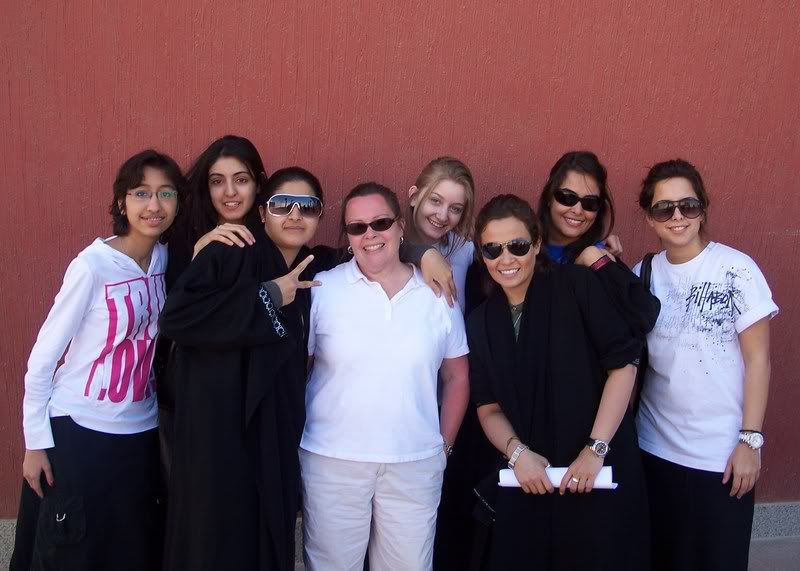
Young women who live in Saudi Arabia today are increasingly being exposed to the influence of the outside world. There are those who are sheltered from television, music, and the media, but most college-aged girls now own ipods, cell phones, and jeans. Many of these young women are pursuing their education to the university level at institutions which have opened up separate and close-to-equal college programs for females. These are the girls with whom I have had the pleasure of associating during my stay here in the Kingdom. When DH accepted a job at a university in Riyadh, I was fortunate to find employment with the same institution in their women’s college as a health and physical education instructor.
When I arrived here in August, I discovered that the program was dismal. In the public schools, physical education is strictly forbidden for girls, and in the private schools the PE programs are rudimentary. At the university level, the girls attended 4 semesters of HPE. The classes consisted of one hour per week of theory (health & nutrition, first aid, anatomy, and pregnancy & childbirth) and one hour of practical exercise. I was placed over the prac courses. At the time I arrived these were one hour of aerobic exercise given to classes of 30-40 girls in a small dance studio--without music. There I was, jumping up and down, trying to get these beautiful veiled princesses to put on pants, move around during their periods, and elevate the heart rate with no space and no beat other than me singing out, “1-2-3-4!” The first month I was there, I attempted to get approval for music with no success. I then focused my efforts on facilities.
I learned from the girls themselves that it was counterproductive to fight against the local culture. I must work within the system if I wanted to see change. In particular, our student body president is a young woman who believes that Arabic women can accomplish much within the limitations that are imposed. She began to work toward the possibility of a women’s basketball team. Our HPE faculty began to point out to our supervisors how much better the facilities were at other colleges. We were lagging behind those schools which had full gymnasiums for their women’s programs! Soon, we were given the use of 2 outdoor basketball courts formerly used by the men’s side. We had to wait until the courts were completely walled in so that the girls could not be seen while exercising. These courts were finished in January, and we quickly added basketball, volleyball, badminton and soccer to our program. The first day that we went out on the courts, one of the girls confessed to me that she had never in her life exercised out of doors.
Some of the young women at our university had received education in the US, in other countries, or in private schools, and were excited about the changes. Early in February, I read that the Arab News had published an article about the first-ever women’s football (soccer) match in Saudi Arabia. It was held Jan. 22, 2008 in Dammam between Prince Muhammad ibn Fahd University and the Al-Yamamah Women’s College of Riyadh. Though the match was open to women spectators only, the team members broke social expectations that women must be lady-like and demure at all times. I knew the time was right for our basketball team.
I am not a basketball coach, nor do I have much experience with the game. In my Nike Air Max I barely stand five feet tall. But our student body president collected more than 150 names of girls interested in coming out for our team. Someone had to step up. I am thankful that I live in the day of the internet so I was able to go online for rules, training techniques, fun drills and other aspects of coaching basketball. For weeks now, I’ve been dribbling a ball around and practicing my shooting so I won’t be too embarrassed in front of the girls. And I can now report that in this Women’s History Month of 2008 I am a little part of making history in this area of the world as our girls start their practices! We plan to compete with Al-Yamamah later in the semester. The interior design department is hard at work designing outfits for our team in which we will be able to move, yet which fit the stringent standards for women’s wear. Our games won’t be filmed by camera crews, and the spectators will be only a few of the mothers and sisters who wish us well. But to me, this semester in Riyadh has been as important as walking on the moon. One small step for womankind.
Thursday, January 10, 2008
Lament of the Lost Judges
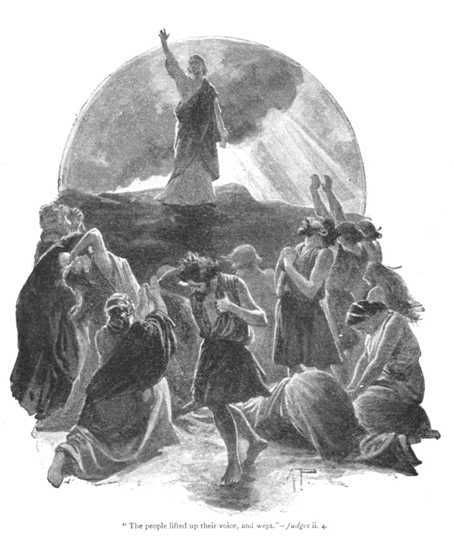
This week in Seminary I am teaching the Book of Judges. As is customary in our OT year, the students are asked to read selected chapters from the books we are studying. The chapters they read in Judges are: 2, 3, 6, 7, 8, 13, 14, 15, 16. Does anyone see a problem with this selection? Out of 13 judges in Israel there are 6 of whom we have a substantial(?) account. Our Seminary chapters cover Othniel, Ehud, Gideon, and Samson, but leave out Deborah and Jephthah.
I was annoyed, but somehow not surprised to see that Deborah was basically ignored in the lesson materials. After many hours of studying the account of Jephthah, I must also include this story in my "Lament of the Lost Judges."
The stories of Deborah and Jephthah are problematic for LDS teachers. The student manual skims over Deborah by noting:Judges 4–5 tells about how Israel was delivered from the bondage of their enemies under the direction of a woman named Deborah, who was both a judge and a prophetess. She prophesied that a woman would destroy the enemy’s leaders. The prophecy was fulfilled when a non-Israelite woman named Jael killed the leader of the enemy army. The people learned that if they trusted the Lord, He could deliver them. Judges 5 contains the words of a song the Israelites sang about this important event. Music can be a powerful way of praising God (see also D&C 25:12).
A sidebar in the Student Manual also includes a list of judges in which Deborah and her military commander, Barak, are listed together, erroneously creating the impression that they were some sort of co-judges. The teachers manual merely suggests: "Assign students to report on the following leaders and describe how they were unlikely heroes: Ehud, Deborah, Jael, Gideon, Jephthah." Thus, the Seminary manual allows perhaps 2-5 minutes for a student presentation on Deborah and Jephthah and no commentary whatsoever for the teacher. Compare this with a section suggested to last 15-20 minutes on the fact that Samson's parents were childless. Here the manual departs radically from the Old Testament text and preaches that the plan of happiness would be affected if Satan could influence people to stop having children.
This dearth of information leaves the LDS teacher of youth with little instruction on how to present these fascinating Biblical judges, both of whom are of especial interest to women. Most will choose to simply pass over them. Considering the prominence of these stories in the scriptural record, it would be helpful if LDS lesson materials would deal with some of the following issues:
Deborah
- What is the Old Testament definition of a prophet and a prophetess? How does this differ and fit in with our understanding of modern prophets?
- In what way did a woman judge add to our understanding of the period of Biblical judges?
- What special abilities did Deborah bring to her ministry?
- Why was Deborah's authority over a military commander and her authority to provide judgment in the people's affairs unusual for her day? How did she attain such prominence?
- In what ways were Deborah and Jael (the other important woman in the story) called of God and in what ways did they simply step up to fulfill a need that they saw?
- What importance does the Song of Deborah have in the scriptural record?
- How is Deborah a role model for both men and women?
- What types of Christ do we see in Deborah's story?
'Deborah Under The Palm Tree', Adriene Cruz
Thursday, October 18, 2007
Why Everyone in the World Speaks English
When my family first considered moving, I was concerned that we didn't speak a word of Arabic. "Don't worry," I was told. "Everyone there speaks English." And in fact, wherever one roams throughout the wide world, they will find that it isn't that hard to get along. For many, many people of all nations speak English. In fact, I've noticed that Americans can get quite cocky about that fact. Our pride tells us that we are the leaders of the free world and that people of other countries speak our language because they know of our great influence. Or perhaps because they admire us so much! Well, I have finally realized why it is that so many people speak English. Americans' influence doesn't originate in Washington, D.C., or in New York. No, it all comes from Hollywood.
The people of the world learn English so they can watch American T.V.!I've long been ashamed of Americans' attitude toward language. In European countries, people rub shoulders with others of different nationalities and languages frequently. Because the countries are small and the borders are porous, everyone learns to speak competently in several languages. Even here where it's more difficult to enter the country, people speak Arabic, English, French, and often another language or two. I watch people on the bus greet each other, and finding they don't speak the same language, switch back and forth until they find a language they have in common.
In the United States there has lately been a fervor over immigrants learning to speak English. "If they want to live here, they should learn to speak English," you'll hear stridently proclaimed. Well, yes. They will. And their children will. But learning a language doesn't come in two weeks. I've been working on my Arabic for over a month now, concentratedly. And I have an aptitude for languages. And I still don't know much more than greetings, counting to ten, and part of the alphabet. How much more human we would be if we all learned as much of other languages as we could. For those who live in the US: how many of us speak adequate Spanish? The likelihood of encountering a Spanish-speaker is great at this period in our history. Do we know how to ask someone their name, to show them how to fill out a form, to give basic directions in the Spanish language?
I love the way that many Mormons all over the world can speak foreign languages because they served missions. On missions, we actively meet people, we have a message to share, we have a motivation to learn the language. But in our daily life we have little motivation to learn so that we can communicate with the world's people.
How would our motivation change if all television programs came into our homes in different languages?
Saturday, August 4, 2007
Calling You Out
It's a new meme by Johnny who is supposed to be studying, but instead is taking frequent breaks to comment on people's blogs and bother those who should be packing.
Here are the rules:
(1) Explain an issue that you are most passionate about.
(2) Why should all others (ignoramuses that disagree with you) accept your position?
(3) Why do the rest of us (ignoramuses who disagree with you) just not get it?
Well, everyone who blogs knows that I am passionate about pacifism and Mormon feminism. But I think I'll respond on a different issue today. I am passionate about gifted education. Because of all our moves, my children have attended a combined total of 15 different schools plus about 5 years of home schooling. We have seen a wide range of programs for gifted children. (BTW all 8 of my children have tested gifted, no big surprise with their family background.) We've encountered four different types of gifted education:
1. The children are divided according to ability and the gifted classes work ahead of their grade level.
2. The gifted children are identified and placed in magnet schools
3. The children attend regular classes and are pulled out of class a few hours a week to attend supplementary programs.
4. There is no gifted program--the children are mainstreamed and enjoy a maximum interaction with their peers of all abilities.
For some reason there are ignoramuses who believe that the gifted children should remain in the regular classroom as examples for the rest of the students, helping them with their homework, tutoring them, running errands for the teacher and otherwise frittering away their public education time. These children learn to do the work, which is way too easy for them, quickly and with a minimum of effort. They seldom have homework or work up to their potential.
My position is that children should be allowed to work at the highest level they are capable of attaining. In a public school situation this is best achieved by putting them with others of the same capabilities, either in a self-contained classroom or a magnet school. Yes, this is segregation according to ability. I have seen amazing results with such classes.
You should accept this position because if Americans wish to be competitive in the worldwide arena we need to give our gifted students every opportunity to advance in their studies. This is not possible in a crowded classroom of 30 students at different levels. The teacher must spend most of the time on those who do not understand and need to be brought up to grade level.
Many of you just do not get it. You want the money spent on education to go to your mediocre or special needs student. You want my well-behaved child in the classroom to influence others for good. The gifted children have parents who disproportionately help in the schools and in the classrooms. You would like to spread this assistance around.
My focus is the best education for the gifted child because my children are gifted. Would my ideas change if my children were not in this demographic? Probably not. Separating the children by ability makes better teaching possible for all.
I tag J G-W, JohnR, M&M, Téa , and Amelia.