General Conference, Saturday morning. In a talk by Elder D. Todd Christofferson the everlasting covenant was mentioned, and I wondered what you all thought about this topic.



Booknotes 5.25
3 days ago
General Conference, Saturday morning. In a talk by Elder D. Todd Christofferson the everlasting covenant was mentioned, and I wondered what you all thought about this topic.
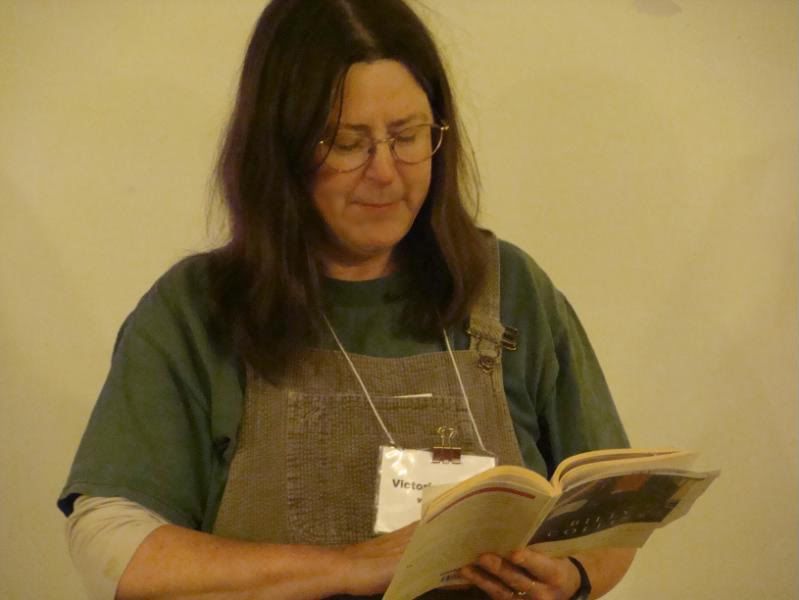
The Bretton Woods agreement of was an attempt to stabilize money. After the Great Depression, developed countries met together to plan a post-war economic order. The United States wanted to make the dollar the standard in a world economy. In exchange for this, we agreed that foreign countries could exchange their dollars at a fixed rate for gold. This worked for a number of years. In 1971 in response to the Vietnam War and accelerated inflation, Nixon abolished the gold standard. Thus the dollar became unrestricted. U.S. debt has gone up dramatically since then, until we now have a deficit of over 9 trillion dollars. (Please follow this link to better understand just how much a trillion dollars is!) Victoria convinced us all that every civilization that has faced this type of situation has responded by inflating currency (devaluing the dollar). Societies can go through depression, she warned, but do not survive hyperinflation.
In addition to these problems, Victoria addressed the issue of finite resources. Peak oil is the rate at which oil producers can extract oil at the maximum level possible. U.S. oil production reached a peak in 1970. Some people believe that world oil production peaked in 2005. From now on, there will be less oil available for an increasing population. Victoria briefly covered each of the remaining options (Ethanol, Coal, Hydrogen, Nuclear, Solar, Wind, Animal energy, Firewood, and others) and why each of these will soon be exhausted or are not feasible at the present time.
This may all seem like doom and gloom to you. But Victoria actually presented this very matter-of-factly and with the idea that the decline of the U.S. was a foregone conclusion. After all, from 1900 to 1970, we had all the oil, and that was why we had all the power. Now our position is not so secure. It actually made me feel better to just accept that we are in for a depression. Now we can decide how to handle things spiritually and physically.
Victoria's conclusion is that the seeds of our present decline began in the early 1800's. This is when population began to grow exponentially, when we began to rely on industrialization, and when humans began to be the only species on earth who are a detriment to the planet. She sees the Restoration as the Lord's answer to how to navigate the problems that await us. The disasters will come slowly, a bit at a time, and we have time to learn how to conserve, to grow things, to form networks, to learn how to produce commodities.
As an illustration of her suggestions for us, she told of her family and a group of her neighbors who got together to buy an oil press from Europe. It fits in someone's barn, and the group plans to grow canola and rapeseed and make oils out of the plants. Right now these oils are mostly imported. By starting this business they will have a commodity to trade when the economy fails and a necessary food product made locally.
I appreciate Victoria's concise and valuable history lesson and her leadership in showing us how to be wise stewards and to navigate the Anthropocene epoch.
Last week I had a marvelous time visiting my sister in Boston and then attending the Exponent II retreat. I just got back this evening but I thought I'd share some of my pictures of the event. I intend to blog about some of the workshops, so check back!


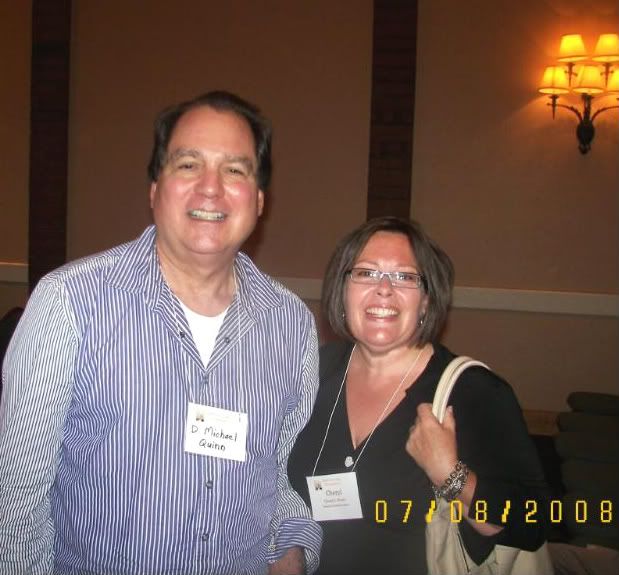

Susan (In my reports of Sunstone, I'm going to use the first names of all the presenters, just to be consistent, and because there is a great feeling of comeraderie here) began her workshop with a short devotional. She played a recording of a song with words by St. Francis of Assisi, lit some candles, had a prayer, gave a short sermonette on Jesus and social change, and ended with a rousing hymn complete with clapping and swaying. Little did we know as she was leading us in the devotional, that she was modeling four types of spirituality about which she would instruct us. There are
I probably need to get over my aversion to these talks that have come along lately about making your home into a miniature temple, or Missionary Training Center. I need to channel those days as a newly married Molly, when I had uncontrollable urges to paint my bedroom all in off-white and gold, with vases on little tables and an oversized crystal chandelier above the bed.
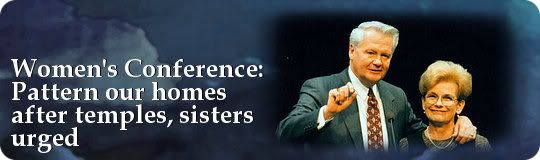
The talk that set off my latest rant is the Thursday afternoon general session of the annual Women's Conference at Brigham Young University, given by Merrill J. Bateman of the Quorum of the Seventy and his wife Marilyn.
Elder Bateman suggested that our homes resemble the temple by speaking in soft, quiet voices, training children in their responsibilities like shifts of temple workers, beginning shifts with prayer, and keeping orderliness and cleanliness paramount.
Why do I think these talks are especially unhelpful for LDS mothers to hear? I can recognize the symbolism that connects the two. Homes and temples are both places of love and service. In both places, as Sister Bateman said, "we are engaged in the salvation of others." I agree, but at the same time I would like to immortalize the words of Chandelle who wrote in a comment at FMH:
"...a temple is tidy because it’s not populated by children who like to fingerpaint with their poop. because the ten-thousand people who go in and out of a temple do not eat three meals a day there. because dogs and their muddy paws are not allowed. because there are no beds to be made. because nobody goes there to study or read or sew or do pottery or play scrabble. because everybody comes in and leaves in the same clothing so there is no laundry. the temple is tidy because nobody lives there."
 In her talk, Sister Bateman revealed that "Spiritual truths are not revealed to doubters. Faith is required to move forward." So, what is the spiritual truth behind the comparison between the home and the temple? How can we express this in a way that will be uplifting to families (especially women) rather than depressing? Those of you with more faith than I, help me out!
I have some things I want to say about BYU Women's Conference. But I'm too tired to really think them out yet, so first I'll just tell a little story about my very first BYU Women's Conference. I think it was 1982. I was just off my mission and going to the Y and I was really full of myself. You know the type. I had purchased my ticket and had a little nametag and was trying to attend the most spirichal sessions I could--taking notes in a little spiral-bound book. Well, one of the sessions I wanted to attend was in a building with which I wasn't familiar, and I was a little late, and I couldn't find the room. So I asked one of those volunteer ladies who were standing around if she could help me find the session. I'm afraid I wasn't all that polite. In fact, as I recall, I treated her sort of like a maid, minion or lesser being. She was there to serve the patrons, wasn't she? But she was so dang nice. She told me she would walk me to the room, and the whole way she chatted with me, asking how I was enjoying the Conference, and if I liked so-and-so's talk and was truly interested in me-me-me. So I deigned to talk to her as we progressed down the corridor. And when we reached the door, I said Thanks, and I turned to go in, and as I did out of the corner of my eye I saw her name tag.
And it said, "PATRICIA HOLLAND."
Yup.
It was THE Pat Holland, wife of the then-President of BYU Jeffrey R. Holland.
An amazing woman, smart, capable, charismatic, attractive, and kind. A woman I had admired from afar (because obviously I'd never seen her close-up before!)
It's probably the first time in my life I can remember feeling truly humble.
I admit it, I'm really not a very humble person. I don't get humble when I get a new calling, because honestly, I know I can do a fairly good job at any calling I get. While I don't feel overly talented in any one area, I am blessed enough to be able to do most things without embarrassing myself. But this experience floored me. I realized that any peon I met on the street could very well be someone IMPORTANT. Someone really important. Like one of those Warriors of the Pre-existence or a Member of the Council in Heaven or Shakespeare's muse--and I wouldn't even know it.
Anyway, I don't have the notes I took at that BYU Women's Conference. I don't remember any of the speakers I heard. I'm not even sure what year it was. But I do remember what I learned from Pat Holland, who was nice and walked me down the hall to a classroom. Now, I often chat with the cashier at the checkout line in WalMart. I learn the names of the custodians at the University where I work. I'm polite to the taxi driver.
You just never know, maybe everyone is important.

Stake Conference in our Stake is a bit different than in other places in the world. Because the units are spread out over a vast area, the stake leaders bring the conference to each ward. Members are warned several weeks before the Conference that it will be their chance to obtain a temple recommend. Interviews with the Bishop are held, and the Stake President is available after the meetings to conduct interviews. It is perhaps the only time members will see Stake leaders for 6 months or a year. Because of the difficulties in traveling and in women getting around, the wives of the Stake Presidency are called to be the Stake RS President, Stake YW President, and Stake Primary President.
I enjoyed meeting our Stake leaders, and I had a chance to talk personally with each of the women leaders. They were very nice, and I enjoyed our conversations. They are about my age, and I think I could be good friends with each one of them. However, I cannot contain my opinion of their talks. As I've said before, women leaders have a great opportunity when they speak in Conferences. It is their opportunity to have a voice in the administration of the Church. It is one of a very few times that they can appropriately give counsel and instruction to the general membership of the Church, including men, women, and children. Not surprisingly, I was looking forward to hearing what these women would say during our General Session and also during our Adult Session.
So what did I hear from our illustrious women leaders? None other than RECYCLED CONFERENCE TALKS!! It's the biggest Sabbath-day thorn in my side there is. I don't like when anyone gives recycled Conference Talks. I'm fine with themes are given to speakers, but I feel they should be developed by the speakers themselves, with personal experiences and relevant scripture stories chosen according to personal guidance of the Spirit. This way both speaker and listeners are enriched. A Conference Talk summarized again and again in Sacrament and other meetings loses its immediacy and power that it had when the message was received and given by the General Authorities. I and many other members of the Church read our Conference Ensigns and are quite familiar with the talks. Hearing them summarized in Church is boring.
None of the men speakers at our Stake Conference gave recycled Conference Talks. Every woman who spoke summarized a Conference Talk. None of the women even went so far as to include a personal experience or opinion on the topic. I'm extremely disappointed. By doing this, we women are diluting what little authority and influence we do have. For shame.

In her opening remarks of that infamous Conference talk, Julie B. Beck quotes 2000 stripling warriors as saying, "Our mothers knew it." To find out what it was that the mothers knew, we must go back to the story in Alma 56, which concludes in verses 47 and 48:
Now they never had fought, yet they did not fear death; and they did think more upon the liberty of their fathers than they did upon their lives; yea, they had been taught by their mothers, that if they did not doubt, God would deliver them.
And they rehearsed unto me the words of their mothers, saying: We do not doubt our mothers knew it.
 I believe that where I have taken offense with this talk is that I mistakenly took her remarks to imply that women whose paths might vary from those described here are not mothers, or even women, who "know." This, of course, is not true. The testimonies of several bloggers witness to the alternate choices of women who were able to develop an abiding faith and raise righteous and productive families.
  But the spirit was there and we enjoyed and loved each other. As I look back on my experience growing up, I don’t look back wishing Mom had spent more time worrying about the house. I’m almost certain that’s not something she would change, either." Jana Remy wrote of her mother, a Stake RS President and mother of 5 who "kept her teaching credential active in each state where we lived, often taking night classes or taking re-certification exams. By the time her youngest child was in the upper-grades of elementary school, she worked full-time as a teacher and was earning her master's degree." After her husband died of cancer, this remarkable woman was able to
 childless. instead, look me in the eye and see me for who and what i am: a woman of god who is using the gifts she's been given to make as much beauty and goodness as she can."
 party line of having as many children as possible and staying at home and placing all of my energies there.
Today, Mary N. Cook of the YW Presidency spoke to the youth of the Church about what an influence they could be in their families and in the world. Now it's your chance. If you were a female and had the opportunity to speak at General Conference, what would you choose as your topic? Who would you address? What would you try to accomplish?
Because women seem to gather some criticism about their talks, what they wear, their hairstyle, etc, I've become curious about how others would handle this challenge. Additionally, I wonder how we would handle the high-profile women's callings in general. If you were RS President, what would your focus be? What would be your considerations in calling counselors or a RS board? What would you do first? How would you spend the majority of your time?
I have many ideas on the above questions, but I want to hear from some readers first. Feel free to send the readers of your blogs over, too. I really want to hear from some LDS women!
This was another session I attended at Sunstone Symposium. It was given by Michael Farnsworth, EdD, an educational psychologist who recently retired from the marriage and family relations dept. at BYU Idaho.
The words "fantasy bonds" were, in my opinion, a little misleading in this presentation. Michael was using the terminology given by Robert Firestone to roleplays that husbands and wives develop in their marriages. Fantasy bonds are culturally defined duties that people begin to act out in their marriages. They can eventually become bonds which hold the couple back from intimacy.
Michael said that intimacy is an acquired taste--many cannot stand the passion that true intimacy brings. When we fear our own and others' energies, we can form fantasy bonds as a psychological defense to marital distress. Mormon women have a great tendency to slip into this role-playing behavior. Once a young wife enters into the pattern, all her decisions are made for her. She will have many children, she will not work outside the home, she will hold Church callings, etc. Michael warns of three dangers to this reaction, and I have observed these myself.
1. The relationship can become superficial
2. The marriage partners are embroiled in continual conflict
3. One of the partners surrenders their voice
Thus, Michael suggested that personal identity has to be established before relationship identity can be formed.
The respondent to this talk was Ronda Callister, PhD and professor of organizational behavior at Utah State. She presented the point of view that developing a resilient identity is the work of a lifetime. She said that had she waited until personal identity was established before she was married, it would have been a very long time! Then she shared some steps she had taken in developing a resilient identity and encouraging intimacy in her marriage.
I enjoyed this presentation but I found it very difficult to listen to, since I neither see myself as having a very well-developed sense of identity nor much intimacy within my marriage.
Blake Ostler's presentation at the Sunstone Symposium went a lot different than I thought it would. I didn't expect Blake to be as understandable, down-to-earth, and personal as he was. Blake spoke about LDS testimony and spiritual experiences--and he wasn't dry at all. In fact, 
Blake's presentation seemed to generate a great deal of controversy among the audience. The respondent, Bill Heersink from Salt Lake Theological Seminary, praised Blake for his "holistic view of humans that doesn't try to divorce the mind and soul," but nevertheless disagreed with his definition of spiritual experience. Several of the questions at the end likewise asked for further clarification. One young man in particular questioned Blake's view of spiritual experience. The young man told of an experience of his own in the MTC. He prayed to know his status regarding a girlfriend and was given a strong confirmation that he would marry the girl. When she later "Dear Johnned" him, it was devastating.
I was quite surprised to hear Blake respond that the young man's experience was not a valid one, since it had later been proved to be false. I thought Blake's answer went against his explanation of "radical inclusivism" earlier in his talk. Blake saw his own experience in high school to be valid since the girl was actually thinking of suicide, but the young man's experience was different since he did not end up marrying his girlfriend.
I believe this is a problematic way of looking at spiritual experience. Encounters with the Divine tend to be nebulous and not easily interpreted. I would be much more willing to see the young missionary's experience as a real manifestation of the Holy Spirit, sent for comfort and aid at a difficult time. Perhaps the interpretation was in error, but the experience was undeniable.
I appreciated and agreed with the points in Blake's presentation. I found it comforting to hear such an erudite and intellectual assertion that we can "know with a surety" the reality of the Spirit in our lives. However, I was quite put off by the application of his own principles in his response to the young returned missionary. I would like to see a greater acceptance of spiritual experience within and among religions.
I finally have internet access again (!)and Snarker be damned, I am going to post my little heart out about how wonderful and spiritual it was. I believe that the types of talks and panels at Sunstone have the power to touch the questioning and questing among us in a way that speaks to our souls.
On Thursday, the Mormon Women's Forum presented a panel titled "Image and Reality: The Many Faces of Mormon Women. Janice Allred led the panel and explained that the concept of face invites us to consider several contrasting pairs that define face: appearance vs. reality, public vs. private, open vs. hidden, engaged vs. withdrawn, present vs. past, and ideal vs. real. Each of the panelists addressed how Mormon women negotiate the tension between the ideal and the reality of their own lives. Since I was one of the panelists, I'll post my remarks here for your edification!
These can all be wonderful influences. They tend to produce women who have lived clean, decent lives; who have not mired themselves in addictions. These women are trained and prepared to keep clean and organized homes and to raise upstanding families. Are they missing anything from never having had a room of their own?
I think our strength as a culture is that we tend to develop the public face of our people superbly. As a young wife, I had learned how to present that face to the ward and to the world. I was well-spoken, well-groomed, energetic. I had the skills to run a Parent-Teacher Organization or to speak in public. This picture shows 6 of my eventually 8 children. As you can see, I sewed matching dresses for these girls. I did it three times a year: Christmas, Easter, and Pioneer Day.
But the public appearance was very different from the private reality.
At times I found friends I could share the tough realities of my life with. But in my experience, the Mormon world was not conducive to such confidences. As a Latter-day Saint, I felt compelled to put on a good face for the world. To my non-member friends and neighbors, I felt that I needed to show them how happy being a member of the Church made me. I couldn’t reveal any marital problems, for that would put a bad light on our “eternal family” rhetoric. I didn’t feel free to complain about the pressures of having 8 children, because it might invalidate my reasons for having such a huge family. Among the other LDS women, I felt some competition and equal pressure to maintain the image of perfection. Especially when I was a young mother, I didn’t realize that other Mormon women might also be struggling.
Putting forth a good face is also an inherited trait in my family. To illustrate this, I’d like to share a story my mother wrote in her family history. She tells of going to see a Broadway musical review with her sisters. Since they knew someone in the production, they were invited to go backstage. They left their seats during the final number and were ushered back behind the curtains to watch the chorus line finale. They saw the dancers with big, bright smiles upon their faces while they faced the audience. But when they turned their backs on the crowd, the girls’ faces would relax into a frown or a scowl of concentration. By the time they turned back around, they had their smiles pasted back on. My mother compared this chorus line to her family. She said that in public, they always had to have their smiles on.
I wrote a poem (some of my blog readers will remember this!) which expresses the liminality I have felt as I have attempted to please my family, my Church, and especially my husband without being able to fully celebrate the nontraditional parts of myself. It’s called, “I Put on Black.”
I put on black,
My head I bow.
You like me now.
You like me now.
I put away my chartreuse scarf,
And colored things I used to wear.
My second piercings now are bare,
I gel down my unruly hair.
I do not have a lot to say.
My makeup now is quite subdued.
I seem to cook a lot of food,
I don’t go swimming in the nude.
I nod and murmur when I should,
I shut my mouth, my thoughts I still,
My questions and my quirks I kill--
My secret longings none can fill.
The ward is suddenly so kind.
I’m not as different now, you see!
A call has been extended me
To teach Relief Society.
Sedately I walk down the aisle,
The Bishop’s wife sits by my side,
She nods at me; you smile with pride,
I feel a tearing deep inside.
I clean the toilets and the hall,
Read stories to my sweet sunbeams.
We never argue now, it seems.
I wonder where I put my dreams.
Your temple marriage now is safe,
You hold my hand that wears the ring.
I never dance, I never sing,
You would not notice such a thing.
I’m all in black,
I’ve kept my vow,
You like me now,
You like me now.
But this is what
You do not see:
I don’t like me,
I don’t like me.
When my family moved to the small, provincial town of Vernal, Utah two years ago, I discovered blogging. I felt I had found “A room of my own,” where I could present my innermost thoughts and feelings, ideas I’ve long held, but didn’t always align with the perfect Mormon woman. On my blog, I call myself “Bored in Vernal,” a feminist, pacifist, disgruntled, yet fully active Latter-day Saint. I’ve found the cyberworld to be a place where I can explore the real me among those with a Mormon background. I’ve found that I can’t leave the Church behind. It is a deep and inextricable part of me. Yet there are some policies, procedures and doctrines that, in order to be authentic, I must take exception to. Even at the ripe old age of 47, I’m still trying to find myself. Right now, it’s almost like I live a double life. I find myself saying things at Church, then saying the polar opposite on my blog. Which do I really believe? At the time I say these things, I feel I am representing myself accurately. I’m so confused. What are my true feelings? Who am I?
One of the objectives of this panel was to explore how Mormon women negotiate the tension between the roles and expectations of Mormon culture and the reality of their own lives. I pondered this as I read a recent novel entitled “Snow Flower and the Secret Fan.” The book is about nineteenth-century China and a group of women in Jiangyong, a far flung area in the rural countryside. These traditional Chinese females experienced the binding of the feet at age 7, early marriage, and a secluded life thereafter. While embracing the expectations of their culture, the women of this community developed practices which enabled them to survive. To meet their needs for community, the women contracted with other females—either “sworn sisters” or “old sames.” The novel is based on factual evidence that these women developed a secret system of writing by which they could communicate. It was called “nu shu,” and was kept secret for over a thousand years.
I believe that women such as myself who find tension between traditional Mormon roles and their own personal paradigms must find some way to relieve the strain. What practices will they develop which will enable them to survive and flourish? Will it be online communities such as blogging, or email groups? As wards become more accepting of diversity, will they find kindred spirits within the ward with whom they can commiserate? Or will these women find fulfillment in jobs outside the home, retaining their cultural roles only while at home and at Church?
Through the Proclamation on the Family, the Church has shown its commitment to traditional roles for women. Within our illustrious history, though, there have been some few opportunities for women, even within this type of culture, to find “a room of their own.” I’m thinking of women such as Ellis Shipp, who was sent back East by Brigham Young to obtain a medical degree. She practiced and taught medicine in Utah while bearing ten children. Women like Minerva Teichert, who went to Chicago to take art lessons as a “set apart” missionary of the LDS church. She married, raised a family, cooked and helped with the ranch while painting prolifically throughout her life. I’m thinking of Relief Society sisters who collected grain for humanitarian service, wrote their own manuals, maintained their own budgets and buildings. I urge that we continue to draw upon these, and many other examples of women who embraced their cultural roles within Mormonism yet broadened the definition of womanhood to find a room of their own from which to reach out and touch the world.
Stay tuned! I'll be posting much more of my experiences from Sunstone.
 One of the most interesting things discussed last weekend was that of singleness in the Church. Suzette and Julie, our speakers at the Retreat, are both returned missionaries in their late 30's. Several topics were brought up that I thought were pertinent. Foremost in my mind was the comment that a single person lacks legitimacy in a married Church. We do have a coming-of-age ritual in the form of a mission. But even after serving a mission, in the Mormon society one is not fully grown and a member of the "adult" class until they have been married. This results in strange behaviors, such as speakers who will come into singles wards and talk down to them as a group, though several of his audience may actually be older than he.
In our discussion, one woman mentioned that she has noticed that married couples without children also struggle with lack of legitimacy.
Singles in married wards are often treated like teenagers, and seldom receive leadership callings. They are sometimes asked to babysit instead of joining in the activities that married couples are attending without their children. Julie spoke of some notable exceptions she has seen, such as a Boston singles ward which was given much responsibility in the Temple. They also were called upon to organize and lead a Youth Conference. In addition, Julie had two single Relief Society Presidents in her family ward in Northern Utah. These things lift the entire Church as we utilize the now-dormant strengths of many additional adult members.
I know that Sister Barbara Thompson, newly called Second Counselor of the General RS Presidency is a single woman. I wonder if she will have an influence in being a role model for women or effect any change in the status quo for singles. I don't hold my breath, since our last General RS had quite a low visibility in the Church.
Suzette said that marrieds might have an image of singles as having a wild and crazy social life, playing Ultimate Frisbee every afternoon with a group of cute guys. This makes them reluctant to invite singles to socialize or join them in their comparatively boring activities. "I'm in my late 30's, and I like to do things that other people my age do," she pointed out. Unfortunately, there is usually a "Great Divide" among the single and married members of a ward. Suzette observed that since the predominant culture in the Church is a "family," it is incumbent upon the married members to open a way to integrate the singles.
Our two presenters gave married members several suggestions to help integrate singles into the culture. One of the most poignant was their plea not to try to "fix" singles as if something were broken. Many church members feel a vast discomfort with single members and sense the ambiguity with our doctrine which necessitates marriage for progression and Godhood. They try to probe the psyche and discover what is wrong. The single member must be gay, or too picky, or too intimidating.
In what ways have you seen the Church making efforts to integrate singles? Where do you stand on the "Singles Wards versus Married Wards" controversy? If you've experienced time as an adult single member of the Church, please share any insights you have gained.

The first DAM Women were the Denver Area Mormon Women (no relation to the DAMU), who 15 years ago started a Retreat in the mountains of Colorado. This year about 40 women gathered to congregate, share their stories, and learn about Mormon women bloggers. FMH Lisa gave a fabulous presentation on blogging and women's issues, and graciously showed everyone around the Bloggernacle. Several women bloggers attended the Retreat, including one of the DAM founders, Paula of the Cultural Hall and several email groups; myself (Bored in Vernal); IdahoSpud; Amelia, Caroline, and Brooke of Exponent Blog; and Lisa and Emily of Feminist Mormon Housewives.
Male Bloggers whose names were used in vain at the Retreat were John Dehlin (we're waiting on your pink Stories!) John Remy (collective sighs all around, and inspection and approval of your pic!) DMI Dave (tour of your blog) and The Snarker (sorry, no sighs, pics, or tour of your blog.)
Also featured on the Retreat Program were a panel of women with "Unequally Yoked" stories based on last year's Sunstone Panel "For Better, For Worse," and two presenters speaking to a "married Church" culture on integrating Singles.
I have several blog posts worth of material from my weekend away, but I need to recover a little first. I hate to miss anything, so I'm always the last to go to bed and the first to rise. For some reason I felt compelled to prove that a woman of a certain age could still do the splits. I was nervous at meeting so many new people, so I was way too animated, shrill, and consumed too much chocolate and Diet Dr. Pepper. Thus the five hour drive home was rough, and I'm going to go crash now. Here are some pictures to pique your interest. Check back for more fascinating updates!


The most difficult and poignant session at the Counterpoint Conference dealt with the question: “Is there a place for our gay brothers and sisters in the eternal family?” Though it wasn’t mentioned at the conference, Carol Lynn Pearson’s recent book “No More Goodbyes: Circling the Wagons Around Our Gay Loved Ones” was on my mind. I had just read the press release announcing the book with this quote by Rabbi Harold Kushner:
“Thank you, Carol Lynn Pearson, for reminding us that the task of any religion is to teach us whom we’re required to love, not whom we’re entitled to hate.”
I wish all of you could have met these eminently lovable children of God who addressed us at the conference.
Tina Hatch intelligently and emotionally described her attempt to integrate Mind/Body/Spirit. She explained that truth production in Western thought is centered on white, male, middle-class, institutional point of view. Differences are misunderstood and feared. She has found through much struggle and spiritual confirmation that happiness is possible outside of the traditional hetero experience. Said Tina, “I am whole the way I am. God created me and told me I am good.”
Hugo Olaiz spoke about the position of the LDS Church on homosexuality. He claimed that the position they have taken in the Proclamation is very recent. He said that it is not based on the teachings of Joseph Smith, but rather a tactical effort to combat homosexuality. Hugo nonetheless believes that leaders are more willing to admit there are genetic factors. He says there is no need to rewrite our theology, but calls for the following actions:
1. Call them what they are.
2. Stop endorsing support groups promoting changing orientation
3. Stop condemning same-sex families.
Kathryn Steffensen, the mother of a gay man, found little support when her son came out as gay. “When he came out of the closet, we went into the closet.” Kathryn says that there need to be more positive gay role models. She founded Family Fellowship to meet a need for support. She decided in her journey never to overtly challenge the institutional Church—they have the power to keep people out of the Church. Instead she vows: “we’re going to make the world better for you.”
LeGrand Olsen bore a powerful testimony of his spiritual convictions. He discovered he was gay in spite of his strong witness of the Church. “There is no peaceful dealing with this,” he lamented.
Another Speaker gave a personal account of her experiences as a lesbian in the Church. She and her partner have been excluded from many family events. They have made a place at their table for all who desire friendship. She sees no similar inclusion for gays in the Mormon Church.
I am glad to see a few slow changes in policy toward gay members of the Church. No longer do leaders excommunicate members who come out as gay simply for their orientation. Some few gay members hold callings in their wards. I realize that change has been very slow. I wonder if Carol Lynn Pearson’s new book will be as widely read as Goodbye I Love You, and if it will stimulate the changes that she hopes it will.
I never finished blogging about the Counterpoint Conference—life got in the way—but I intend to finish. It just won’t be as fresh news as it could have been. One portion of the Conference that stirred me was the keynote speaker, Gay Blanchard. Gay was awarded the “Eve Award,” a recognition by the organizers of the Mormon Women’s Forum which honors those who have made contributions to enrich the lives of Mormon women that may not be noticed by the community as a whole.
Gay, a sweet white haired woman in her eighties, stay-at-home mom, wife, musician and playwright, began at midlife to diverge doctrinally with her local leaders on the subject of the Atonement. As I’ve been following along with some of the discussions lately occurring on Atonement Theory, I realize that the Mormon Church does not teach a comprehensive Atonement Theory. In fact, there has been considerable latitude in the doctrine that LDS leaders have espoused along these lines. Apparently, Gay began to reject a salvation by works paradigm.
From some of her writings available on the internet, I obtained this quote by Gay: “the whole purpose of the Law of Obedience is to convince us that we can't keep all the contradictory rules required of us by religious leaders over the centuries. Trying to do so is truly an education. We grow in our understanding of ourselves and of others; we assume responsibilities; we learn about the gospel. If we are awake, we learn painfully our many limitations. We work and work and work at trying to perfect ourselves one thing at a time, at trying to make ourselves worthy, at trying to work out our salvation. But we do not progress into higher law.” Gay says that for most Mormons “their journey stops here: working at trying to be obedient to the whole letter of the law.” Once we discover that we are unable to keep all of the commandments, we become open to experience a mighty change of heart and begin to rely on the grace of Christ to save us. This sounds not so different than some recent LDS authors, notably Steven Robinson. However, several decades ago, these thoughts were not so acceptable.
Because of Gay’s teachings on this subject, she was excommunicated from the Church. The decision was later appealed and changed to a disfellowshipping. However, much damage has been done to Gay and her family through this action. Of a large family, only one of her children continues to be active in the Church.
Lavina Fielding Anderson and I discussed this briefly in the hallway after Gay’s speech. “It might be easy for me to remain active in the Church after an excommunication,” she said. “But it’s different for the children. I don’t think I could stand a Church that did that to my mother.”
I grew up in a church that did not excommunicate or disfellowship its members. I find it a difficult policy to accept. Why does our Church feel the need to cut off members who continue to desire to belong? Even if there is sin, or doctrinal misunderstanding, it seems to me that these things would be corrected more easily from within than from without. I would prefer to leave it as the Lord’s prerogative to cut the sinner off from his presence.
I would love to hear some of my readers’ thoughts on excommunication.
This is for any of the curious who were not able to attend the Counterpoint Conference sponsored by the Mormon Women’s Forum at the U of U on Saturday. I’d like to give some of my perceptions on the talks. But first, I must laud and honor the amazing presenters who gave speeches at this event. Months ago, I volunteered to “help in any way” with this conference, and was promptly assigned a spot on the program. But as I discovered Saturday, I was very, very outclassed, and I think next year I will ask if I can help set up the chairs. The first group of women who spoke were so striking and articulate that I never recovered from a case of severe intimidation. Although I have warned my children many times never to begin a talk with an apology, I had to bite my tongue hard not to start my speech by blabbing how much my knees were shaking, I wasn’t prepared, I had a cold, I’d only received the assignment two hours ago…
Anyway, my notes won’t do them credit, but here’s a taste of what was said in the first session.
On the topic “How well does the LDS Church support real mothers?”
Jennifer Moore, senior attorney with US Securities & Exchange, was married to a gay man. On 9/11/2001 her world came crashing down and her divorce became final. She spoke on the difficulties of having her circumstances define her in the Church. She feels that though the Church does a good job of supporting most mothers, it does not support all mothers. For her, Church became a place where she felt an acute personality crisis. She was equally uncomfortable in a family ward and a singles ward (which she named “the Church’s answer to a bar.” She now laments segregation in the Church according to marital status. Through telling her story, Jennifer called for the Church to “build a structure that supports me instead of who I wish I could have been if things had been different.”
Kristy Finlayson, pharmaceutical representative, grew up hearing beautiful words of the prophets honoring motherhood. She developed the desire to be a mother and have this type of influence on the world. In time she came to discover that a pedestal, like any prison, is a confined space. She spoke of her budding feminism and realization that she had been trained to defer to male authority instead of develop her own spirit. Kristy discussed the lack of importance of women in eternity. She herself would never willing be cut off from the lives of her children, and wonders why this seems to be the case with a Heavenly Mother. In view of statements by Pres. Kimball—pattern and role of mother prescribed before foundation of the world—and Pres. Woodruff—motherhood can only be done by mothers—Kristy firmly believes that a mother will still claim this divine role in the eternities. She does not believe the Heavenly Mother could be as uninvolved in our mortal lives as our theology reflects. Because of this exclusion, women are left without a clear vision of what we may become.
Sarah Ray Allred, a postdoctorate neurobiologist and stay-at-home mother of 2, discussed how Church rhetoric compares with actions. She noted that support of mothers varies with each ward. How does the Church characterize value? Motherhood would seem to have more value than anything else, offering more opportunity to develop Christlike attributes. Sarah offered several suggestions to enhance the Church’s support of mothers:
Stop pairing motherhood/priesthood. The current juxtaposition of motherhood with priesthood is unnatural.
Create callings to support mothers such as mothers group coordinators
More reaching out by individual women.
Marguerite Dreissen, former professor of law at BYU, spoke of the ambiguity she has encountered in the church as a result of her race and compared it with what we face as women. There has never been a time in all of history when people actually lived what was taught. There is much angst over the grand chasm between the promise of what can be and where we are. Jefferson stated that all men are created equal, but at the time the phrase “all men” only included free white property-holding males. Our understanding of those words have expanded with time. So will our understanding of woman’s place in the Church. The seeds are there.
After listening to this session I was left with the impression that the women who spoke basically saw the existing Church structure as being supportive of women. Our organization and underlying doctrine contain potential to strengthen mothers. Several problems which may exist:
1. Difficulty in reaching out to and socializing with those with perceived differences. There is still a void in the socialization of married and single mothers, and employed/nonemployed mothers. Isn’t this something that can be ameliorated by the efforts of individuals? Is there indeed any organizational change the Church could make that could make a difference here?
2. Lack of clear doctrine and teachings on the Heavenly Mother. There still exists an unwillingness to strive for revelation more aligned to the concerns of women and mothers, though the seeds for these teachings are there. Individuals can do little to effect change in this area, since we are strictured in our very relationship with the Divine Feminine. For example, we are asked not to pray to her, write about her, or theologize on her nature.
3. The motherhood/priesthood juxtaposition. Most people I have heard express opinions on this agree that motherhood coincides with fatherhood and priesthood with priestesshood. I believe that as Church leaders put more thought into this, they will gradually discontinue the practice of equating motherhood and priesthood.
More to come…I’ll continue later with my thoughts on the Keynote Speaker and the other two sessions in this Conference.


 Posts
All Comments
Posts
All Comments


