Originally posted at FPR
Bart Ehrman has pointed out that the popular view of Paul and his conversion makes it difficult for historians to evaluate what actually happened to make him "turn around." In the scriptural record Paul does not present himself as a guilt-ridden legalist whose realization that the law was impossible to keep led him to find forgiveness in Christ and motivated him to bring the good news of release to those burdened with guilt complexes like his own. Ehrman calls this view "fiction" and "widespread misperception" and instead directs us to Paul's own accounts found in Acts chapters 9, 22, and 26. The problem is that these accounts are difficult to harmonize; as they differ in several details. Paul's recounting of the event is suspect because he is remembering the event long afterward and reflecting upon it in light of his later experiences. Such a conundrum finds a parallel in our own Mormon foundation narrative of Joseph Smith's first vision. In Joseph's case, he leaves at least seven narratives, each a bit different, each a bit contradictory of the others.
Thursday, September 30, 2010
The Truth of Personal Narrative
Wednesday, July 15, 2009
Harry Potter, The Supernatural, and Modern Mormonism
I've got a bunch of excited kids around tonight, wearing their homemade stenciled "HP" shirts and getting ready to go to the midnight showing of Harry Potter. And it's got me thinking about the role of fantasy and the magic world view in the lives of Mormons.
Tuesday, March 3, 2009
Bounding out of the Wilderness
My mind has been captured by a phrase attributed to Joseph Smith in at least two of his sermons--that of John the Baptist "bounding out of the wilderness" to preach the gospel of repentance.
On the 23rd of July 1843, in Nauvoo, a sermon was delivered by Joseph Smith to the assembled Saints. At least 5 different men mentioned or took notes on this talk. In the James Burgess Notebook we have this description of John the Baptist:
Thursday, December 11, 2008
Why I Would Totally Have Slept With Joseph Smith
My Dear and beloved companion of my bosom, in tribulation, and affliction,...I have a great anxiety about you, and my lovely children...If I do not meet you again in this life, may God grant that we may meet in heaven. I cannot express my feelings. My heart is full...oh my kind and affectionate Emma, I am yours forever your husband and true friend. Joseph Smith, Jr.
Sure, Joseph wrote love notes like these to his wife Emma. But to convince Miss Nancy Rigdon to join him in plural marriage he also wrote such doctrinal gems as this:
Monday, December 1, 2008
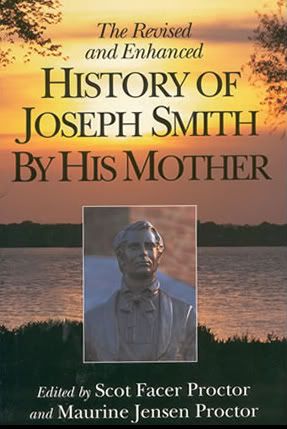
History of Joseph Smith by his Mother
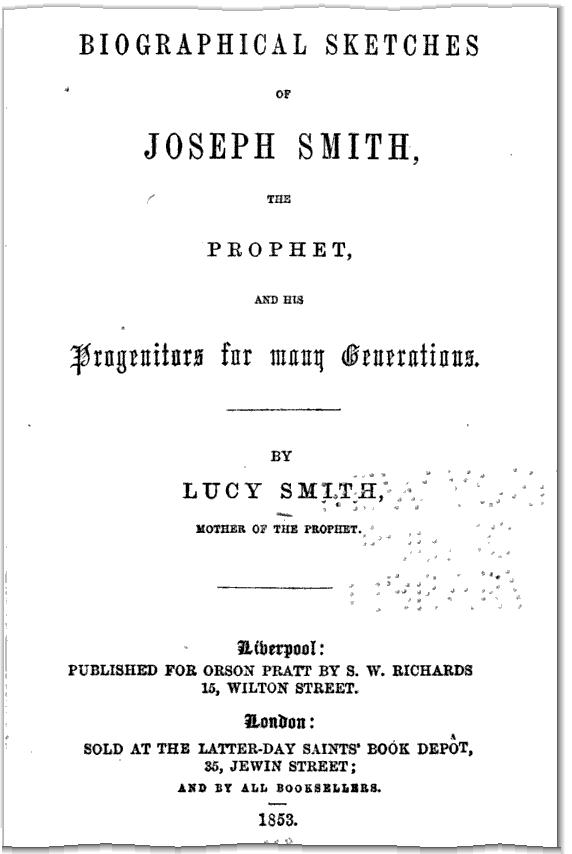
In the early winter of 1844, shortly after the death of her son Joseph, Lucy Mack Smith sat down to write the history of the Restoration from the point of view of the mother of the Prophet. She had been approached by Church historian Willard Richards and the Council of the Twelve to provide details for the official History of the Church, and by others who were curious. As she told her son, William, she was tired of answering questions on the particulars of the coming forth of the Book of Mormon and other details of Joseph's life and she had “almost destroyed her lungs giving recitals about these things.” She “now concluded to write down every particular.” For this purpose, she engaged the services of Martha Jane Knowlton Coray to be her scribe. The result was a handwritten dictation of Lucy's reflections which survives today as the "Preliminary Manuscript.
Lucy's memoirs have gone through several versions as follows:
- Preliminary Manuscript 1845
- Coray revision 1845 ("fair copy")
- Orson Pratt Edition 1853
- RLDS Versions
- Improvement Era Edition (serial, 1902)
- Preston Nibley Edition 1954
- Proctor Edition 1996
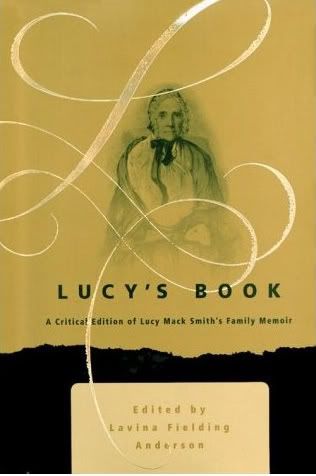
- Lucy's Book, Lavina Fielding Anderson 2001
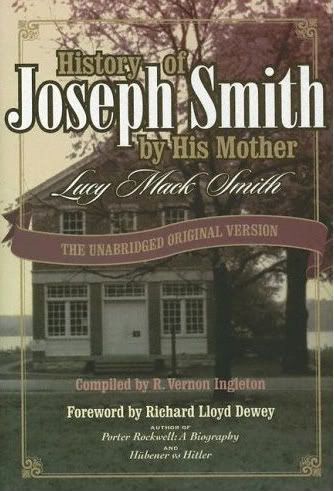
- Ingleton Edition 2005
The history of each of these editions is fascinating. I'd like to recap some of the events in the publication of each. I have discovered that each of these reissuings of Lucy's story is unique and individual.
Preliminary Manuscript
In this raw, unedited manuscript, Lucy wrote a personal family history. Throughout its pages, she shares her feelings, includes intimate details, and often soliloquizes. Perhaps there are too many extraneous trivialities in the narrative. But the value of this manuscript is that it preserves Lucy's voice in a way that many of the later editions do not.
Coray Revision
Later in 1845, Martha Jane and her husband Howard, who had been one of Joseph Smith's clerks, worked to revise Lucy Mack Smith's manuscript. It has been suggested that “about one-fourth of the revised manuscript is not in the preliminary draft, while approximately ten percent of the earlier manuscript is omitted from the revised manuscript.” For example, Joseph Smith’s own version of the First Vision and Moroni’s first visit were included. Extracts from the "History of Joseph Smith" in the Times and Seasons were also used. The revised manuscript was commissioned and paid for by the Quorum of the Twelve. It was titled "History of Lucy Smith, Mother of the Prophet." A copy of this revision was given to Lucy and to the Quorum of the Twelve. Because of difficulties and persecution in Nauvoo, the manuscript was not published right then, but was taken along as Church leaders made their way West.
The value of this revision is that it gives an official history of the Church as sanctioned both by the mother of the Prophet Joseph Smith and the governing body of the Church at the time.
Orson Pratt Edition
"Most of the historical items and occurrences related have never before been published. They will therefore be exceedingly interesting to all Saints, and sincere inquirers after the truth, affording them the privilege of becoming more extensively acquainted with the private life and character of one of the greatest prophets that ever lived upon the earth."
A number of Orson Pratt's statements in the preface contained errors, primarily a statement that the book was written in the lifetime of the Joseph Smith and that he had read it with approval. Brigham Young opposed publication of Lucy's reminiscences, stating in the Millennial Star in 1855:
"There are many mistakes in the work… I have had a written copy of those sketches in my possession for several years, and it contains much of the history of the Prophet Joseph. Should it ever be deemed best to publish these sketches, it will not be done until after they are carefully corrected."
He also reportedly called it a "tissue of lies." But the book was very popular among the British Saints, and had already become available in Salt Lake City. Questions about the book were raised by Church historian and Lucy's nephew George A. Smith, who felt she had "considerably mixed up" the events she described. He and assistant historian Wilford Woodruff began writing inquiries to check the details of the book for accuracy.
In 1865, Brigham Young in a rather dramatic gesture orchestrated a recall of all the books which had been printed. The office of the First Presidency directed:
“We wish those who have these books to either hand them to their Bishops for them to be conveyed to the President’s or Historian’s Office or send them themselves, that they may be disposed of.”
In the Encyclopedia of Mormonism, Richard Lloyd Anderson describes this event in a rather more restrained fashion:
The first edition of Lucy's memoirs was recalled by Brigham Young. However, his goal was accuracy, not suppression, since he initiated a second edition. According to Wilford Woodruff's journal, the President charged the careful Woodruff and two Smith family members to "correct the errors in the History of Joseph Smith as published by Mother Smith, and then let it be published to the world."
A reproduction of the 1853 first edition was issued by Modern Microfilm Co., Salt Lake City, in 1965 with an introduction by Jerald and Sandra Tanner, and a printing by Arno Press and the New York Times was published in 1969.
RLDS Versions
A preface to the RLDS version tells the story of how the 1880 publication was made possible after Brigham Young ordered the recall of the printed books:
"Under this order large numbers were destroyed, few being preserved, some of which fell into the hands of those now with the Reorganization. For this destruction we see no adequate reason; unless it be found in the fear that a plain story told by the mother of the first president of the church, might possibly convey views to the minds of its readers, opposed to the then ruling powers.
The present impracticability of giving a more extended and satisfactory history of Joseph Smith, under the supervision of the Reorganized Church; in connection with the fact that Elder E. W. Tullidge's work, "Life of Joseph, the Prophet," has been put upon sale, have determined the Board to publish this work without change in the text."
Thus the RLDS version is essentially the same as the Orson Pratt version, "with such additions as are deemed necessary, made by marks of reference and foot-notes. Nor do we vouch for the correctness of the statements made in the body of the work, being contented to let it pass with the statement that it is believed to be in the main correct." The RLDS version can be found online here.
Improvement Era Edition
After the recall of the 1853 publication, George A. Smith and Elias Smith were given the task of revising the history. In a journal entry, Wilford Woodruff said that Brigham Young "wished us to take up that work and revise it, correct it; that it belonged to the Historian to attend to it; that there was many false statements made in it, and he wished them to be left out, and all other statements which we did not know to be true, and give the reason why they are left out." As the historians worked on the manuscript, they realized that Lucy Smith's recollections were more accurate than they had thought. Names and events were found to be very reliable, and dates, when mistaken, were generally within a year or two of the precise time. Only a small amount of material was changed. Dates in the genealogical portion were corrected, grammar was improved, and statements that seemed unfavorable to the image of Joseph Smith or the Church were omitted. No indication was made where the text had been altered nor the reason.
The corrected version languished until 1901 when the Improvement Era received permission to publish Lucy Mack Smith's story in serial form. In November 1901 publication began, with an introduction by the new prophet and Lucy's grandson Joseph F. Smith. The series continued throughout 1902.
Preston Nibley Edition
The Nibley version made Lucy Mack Smith's history available to large numbers of readers for the first time. The dates had been corrected and the history correlated well with established historical events.
Proctor Edition
The 1853 version was used in this book to supply structure and chapter divisions, and the Preliminary Manuscript was used to add a major source of text. The Proctors explain that in their edition, Lucy’s voice is heard more clearly and her sentiments and perceptions are explored more openly than ever before, because the Preliminary Manuscript is the foundation of the text.
"Where Lucy is incorrect in dates or names, corrections have been made in the text and the changes often footnoted. No attempt has been made to restate her sentences in more polished prose or improve her vocabulary. She stands well on her own and thus the edits are light. Where transitions or explanations are necessary and not available in the Preliminary Manuscript, the 1853 text has been used. However, to save the text from becoming tedious, every shift between the Preliminary Manuscript and the 1853 edition has not been noted. The motivation was to find Lucy buried in the material, be true to her voice, and at the same time create a book that was accessible and inviting to a wide audience."
In this vein, spelling and punctuation have been standardized to facilitate readability. Photographs of the places Lucy describes as they appear today are included to add a visual dimension to the story. In addition, maps have been added to give the reader a sense of location and proximity.
The Proctor edition will probably appeal to the general LDS reader because of its modern style and historical accuracy in an editorialized reading narrative. It preserves much of the essence of Lucy's conversational style and spiritual tone.
Lucy's Book
Anderson is critical of how the church hierarchy treated Lucy and her book. She writes:
"Overreaction is perhaps the most charitable way to characterize the rather obvious discrepancy between the staggering official denunciation and the relatively minor and infrequent errors (if indeed they are genuine errors) that Lucy actually makes... It is distressing to see the president of the church slander the mental competence of a seventy-year-old woman when the documentary record...shows otherwise. It is unpleasant to hear a man revered as a prophet sneer at the faithful mother of twelve...dismissing her as a sensation seeker and novelist. And it is particularly disappointing to hear him justify these behaviors by accusations that the book is a 'tissue of falsehoods,' an accusation that, on close inspection, is itself a falsehood."
Of this edition, reviewer Gary Topping wrote:
"As important as this text is for Mormon history, the editor rightly emphasizes its equal importance as a spiritual autobiography and as a primary source on women's domestic and larger cultural roles during the early republic."
The scholarly nature of the Anderson edition makes for more difficult reading. It is better suited for intense periods of study. This edition is of great interest to historians and useful for in-depth study of both the memoir itself and the wider Church history it encompasses.
Ingleton Edition
R. Vernon Ingleton has done a commendable job of putting all the elements together to allow Lucy to tell her story in its entirety in an easy-to-read format. This edition is vital for those who are interested in comparing the differences in various versions without the many extra historical details and analysis that is evident in Anderson's version.
Lucy Mack Smith's memoir is a valuable part of Latter-day Saint history. It is a fascinating endeavor to trace its path over the last 165 years. Each revision and edition reveals the concerns and values of Church members and leaders. Lucy herself wished to make public many particulars of the restoration and her family to which she alone was privy. The Corays and the Quorum of the Twelve at the time of Joseph's death wished to expand the manuscript to include a more detailed history of the Church while minimizing personal family details deemed unimportant to the broader history. Orson Pratt was eager to acquaint as many Saints as possible with the private life and character of Joseph, the Prophet of the Restoration. Brigham Young was concerned with succession issues. He feared that Lucy's emphasis on lineal priesthood might undermine the Utah Church's authority. The RLDS, on the other hand, were eager to perpetuate such a record.
George A. Smith and Wilford Woodruff, and later Preston Nibley, were concerned with the historic accuracy of Lucy's record, and worked to correlate it with early Church history, especially regarding particular dates. But in modern times, the original words of Lucy Mack Smith were considered much more valuable than they had been in the past. Authors and readers began to value a competent and strong female voice and her perception of the Restoration. These modern versions have vied with each other in balancing readability with historical analysis. The Proctors have produced a popular synthesis of Lucy's history, Lavina Fielding Anderson has provided historical depth, and Vernon Ingleton has presented a way to compare and contrast the century and a half of the Smith memoir.
I write this post with the hope that it will assist in navigating among the different editions to help you choose which one will best suit your study of this vital female perception of our history.
Monday, September 22, 2008
Sampling the School of the Prophets
Today I wrote a post for Mormon Matters discussing the School of the Prophets in the time of Joseph Smith and how different our religious education is today. For many years now I have tired of the same 4-year round of scripture pablum which is offered in our Sunday Schools.
Learning the Bible in the original languages is a pastime which has intrigued me and which I have attempted on my own. I've often wished we could include some Hebrew and Greek studies into our Sunday School classes. Lest any think that doing this might prove too hard for the average member, I want to present an example of what this might look like, and get your opinion on whether you think a run-of-the-mill Gospel Doctrine teacher could handle teaching such material. The following comes from Jeff A. Benner's Biblical Hebrew E-Magazine, September 2008, Issue #046.
Biblical Word of the Month - Eleph אלף
The oxen likewise and the young asses that till the ground shall eat savory provender, which hath been winnowed with the shovel and with the fork. (ASV, Isaiah 30:24)
In the verse above is the Hebrew noun אלף (eleph, Strong's #504) meaning oxen. Oxen are the largest of the Ancient Hebrews' livestock and were most frequently used for plowing the fields, usually in pairs. An older ox would be yoked to a younger one in order for the older one to teach the younger through association. This same noun is also found in Judges 6:15 where it is translated as "family." In a family, the children learn from the parents, in the same manner as the oxen, through association.
The verbal root of this word is אלף (A.L.Ph, Strong's #502) and means "learn," but more literally, to learn through association, as can be seen in the following verse.
Make no friendship with a man that is given to anger; And with a wrathful man thou shalt not go: Lest thou learn this ways, And get a snare to thy soul. (ASV, Proverbs 22:25)
As oxen are "very large" animals, the word אלף (eleph) is also used for a "thousand," a "very large" number. (While this is the same word discussed previously, Strong's dictionary has assigned this word the number 505 when used for a "thousand.") From this aspect of the noun, a second verb is formed. Normally, Hebrew nouns are derived out of verbs, however on occasion, a verb is derived out of a noun, this verb is called a demonstrative verb. The demonstrative verb formed out of אלף (eleph) is אלף (A.L.Ph, Strong's #503) meaning to "give a thousand." In summary, the Hebrew word אלף can be;
One other note about the word eleph, it may be the origin of the word elephant, a "very large" beast.
________________________________
(If you are a Latter-day Saint who does not know what the "Strong's numbers" above refer to, shame on you! Or shame on your religious educators who have not taught you about such a valuable learning tool in gospel study!)
I can picture a very engaging lesson from the previous information, including unique Latter-day Saint teachings such as the importance of the family and the need for good associations. I can also imagine facilitating some interesting discussion on the large numbers of "thousands" of people in the Bible and the Book of Mormon and what the Hebrew meaning of this word might suggest.
I think these are the kinds of things Brother Joseph and his compatriots in the School of the Prophets were learning when they hired Joshua Seixas to teach them Hebrew for ten weeks--two hours a day and five times a week. Just learning the one word "Berosheit" inspired Joseph to redefine the nature of God and the creation account.
What do you think? Could learning a few Hebrew words inspire a bit of prophecy in your ward? Or do we need to go over the importance of the keystone in an arch one more time?
Wednesday, September 17, 2008
Mother Eve Was A Large Woman
While researching Church history for my last post over at Mormon Matters, I came across an interesting tidbit regarding our Mother Eve.
Early Church member Zebedee Coltrin tells a story about an experience he had with the Prophet Joseph while traveling to a conference in New Portage, Ohio. At one point, Joseph, with a far off look in his eyes, took Brother Coltrin and Oliver Cowdery by the arms and set out on a stroll. Coming to a scenic spot, Joseph suggested, "Let us pray." After each prayed in turn they lay down on their backs, the two men leaning against Joseph's outstretched arms. "Now brethren, we will see some visions," Joseph promised.
"The heavens gradually opened, and they saw a golden throne, on a circular foundation, something like a light house, and on the throne were two aged personages, having white hair, and clothed in white garments. They were the two most beautiful and perfect specimens of mankind he ever saw. Joseph said, "They are our first parents, Adam and Eve." Adam was a large, broad-shouldered man, and Eve as a woman, was as large in proportion." (Minutes, Salt Lake City School of the Prophets, October 11, 1883.)
For some strange reason, I just get a kick out of Eve being described as "large." And she was the most beautiful and perfect specimen of a woman he had ever seen. In our society we women are always trying to be small, small, small! We exercise and diet zealously, but not in an effort to be strong--we want to be skinny and tiny.
In this post I decided to include some paintings of Adam and Eve from the great masters of the late 1400's and early 1500's to illustrate their conceptions of a proportional Eve. (They are nude, so I included them after the break. If you don't want to see them, don't scroll down!) It's interesting to see that Eve is not a small woman in these works. In many of the paintings, she is the same height as Adam. And you can easily see that she would wear a larger jeans size than he!
Sunday, August 10, 2008
Gods in Embryo
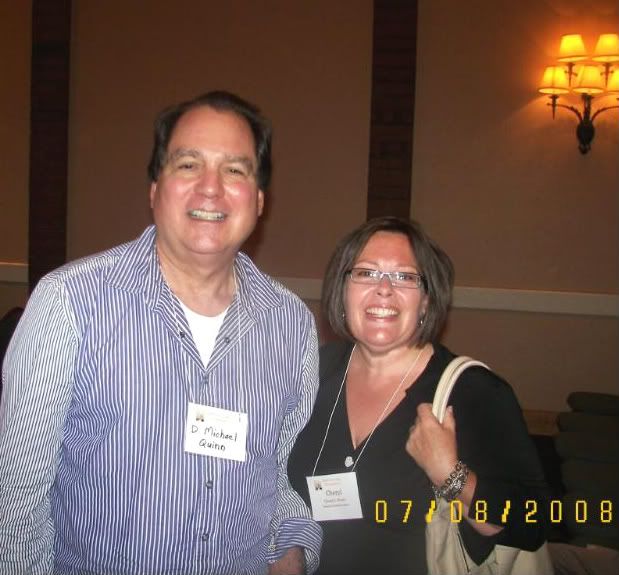
Hugo impressed me from the start with his presence when he realized that both the moderator and the respondent for his session, the illustrious Michael Quinn were not present. He began his own session and launched right in to his talk, which was brilliant. At the risk of vastly simplifying what he had to say, I'd like to just give you a few of my impressions and then urge you to order the full talk if you are interested in this topic.
Hugo explained that human deification (as expressed by the couplet "As man is now, God once was; as God is now, man may become) contains two distinct concepts, one that God has progressed and perhaps may still be progressing from some human form to a divine state; and the other that man may reach this state also. We often call this "eternal progression," but in this talk Hugo preferred to use the more specific term "deification." His paper discussed the observation that, although early Mormon thinkers had vigorously debated and elaborated upon this doctrine, there is a distinct change in how we approach it today. The first half of the couplet, the one dealing with the progression of God, has become nearly invisible, and while we retain the possibility of deification for man, it is reimaged as "eternal progression," with its bolder implications being tamed.
For those who have been in the Church as long as I have, this shift is remarkably clear. I remember the days when deification was actively taught in our church meetings. To me the shift to a doctrine more compatible with evangelical Christianity is quite clear.
After concluding his talk, Hugo opened the session to questions, then with just fifteen minutes left, Michael Quinn came sailing up the aisle, panting heavily. Although Hugo's talk was cogent and engaging, and would have stood quite well on its own, Michael's addition added emotion and drama to the proceedings. Michael referred to the history of Christianity and showed how early Christianity defended its doctrine of monotheism against outside threats with violence and bloodshed. He said that if we did not understand this history, we would not have a clear view of where the modern Christian world stood regarding polytheism. Now we have our LDS leaders and theologians seeking to ally themselves with the Christian movement and to deemphasize our early teachings. If we do this, Michael dramatically warned, we are trading our birthright for a mess of pottage.
Michael's speech was so stirring, it made me want to leap to my feet and applaud. Later, during the Q&A, he added to the defense of Joseph Smith's early teachings on deification by giving a beautiful word picture of Joseph opening window after window in a large room, bringing light flooding in, and leaving a legacy for later generations to formulate into unified doctrines.
So, what do you stand, readers? Are you comfortable with a milder form of our doctrine which aligns more closely with Christian thought? Or do you identify with Joseph and his bold but perhaps discomfiting proclamations on the nature of God and man?
BiV with Michael Quinn
Sunday, March 30, 2008
Perplexities of the Preferred Account
Part 7 of a series on Martin Harris and the Anthon Transcript
(for the whole series, click here)
I lied--this is not going to be my last post in the series. I sure hope this isn't becoming my Gospel Hobby! But I just read Chanson's post Why "Reformed Egyptian" at Latter-day Main Street and I was intrigued by another aspect of the Anthon Affair.
I have belabored the fact that the stories of Martin Harris and Charles Anthon differ in particulars. Isn't it interesting that if we give credence to the official version of Harris' story, a problem is raised that is not present if we accept Anthon's claims:
JS-H Account--Harris brought the transcript to Anthon to have the characters verified. Anthon identified them as Egyptian characters (perhaps comparing them to books he had in his possession.) Anthon provided a certificate to the effect, but ripped it up when Harris told him how Joseph Smith had obtained the characters.
This version opens up the possibility that when the suggestion that the characters resembled Egyptian made it back to Joseph Smith, he then introduced the idea that the plates were written in "reformed Egyptian" into the Book of Mormon text. (see John Hamer's comments #7 and #9 here.)
Anthon Account--Anthon insisted that he did not identify the characters as resembling Egyptian. In his letters, he writes: "The whole story about my having pronounced the Mormonite inscription to be 'reformed Egyptian hieroglyphics' is perfectly false." and "I am thus particular as to the contents of the paper, inasmuch as I have frequently conversed with my friends on the subject, since the Mormonite excitement began, and well remember that the paper contained any thing else but 'Egyptian Hieroglyphics.'"
Part 6 of this series postulated that Anthon's version of events fits better with the prophecy in Isaiah 29. Here I would like to add that Anthon's version protects Joseph from claims that parts of the Book of Mormon text came from ideas he got from the Professor's examination of the transcript. It seems that apologists should be pleased that we have Anthon's side of the story!
Wednesday, March 19, 2008
Letters From a Learned Man
Part 4 of a series on Martin Harris and the Anthon Transcript
(For the whole series, click here)
It seems like I've taken a long time just to say that Martin Harris was in possession of a copy of some of the characters from the Book of Mormon and that he consulted some of the leading candidates of the day who might have been able to authenticate them. Now the time has come to more fully examine Professor Anthon's account of Martin Harris' visit. Extant are two letters in which Charles Anthon replied to enquiries about his encounter with Harris. I will reproduce them in their entirety and then discuss what they reveal about Mormon history and scholarship.
1. This letter was written to Eber D. Howe, Editor of the Painesville Telegraph (1822–1835), author, and publisher of Mormonism Unvailed. On February 9, 1834 Howe wrote to Charles Anthon about Mormon claims that he had authenticated Book of Mormon characters. Anthon answered in a response dated Feb. 17, 1834:
New York, Feb. 17, 1834
Dear Sir -
I received this morning your favor of the 9th instant, and lose no time in making a reply. The whole story about my having pronounced the Mormonite inscription to be "reformed Egyptian hieroglyphics" is perfectly false. Some years ago, a plain, and apparently simple-hearted farmer, called upon me with a note from Dr. Mitchell of our city, now deceased, requesting me to decypher, if possible, a paper, which the farmer would hand me, and which Dr. M. confessed he had been unable to understand. Upon examining the paper in question, I soon came to the conclusion that it was all a trick, perhaps a hoax. When I asked the person, who brought it, how he obtained the writing, he gave me, as far as I can now recollect, the following account: A "gold book," consisting of a number of plates of gold, fastened together in the shape of a book by wires of the same metal, had been dug up in the northern part of the state of New York, and along with the book an enormous pair of "gold spectacles"! These spectacles were so large, that, if a person attempted to look through them, his two eyes would have to be turned towards one of the glasses merely, the spectacles in question being altogether too large for the breadth of the human face. Whoever examined the plates through the spectacles, was enabled not only to read them, but fully to understand their meaning. All this knowledge, however, was confined at that time to a young man, who had the trunk containing the book and spectacles in his sole possession. This young man was placed behind a curtain, in the garret of a farm house, and, being thus concealed from view, put on the spectacles occasionally, or rather, looked through one of the glasses, decyphered the characters in the book, and, having committed some of them to paper, handed copies from behind the curtain, to those who stood on the outside. Not a word, however, was said about the plates having been decyphered "by the gift of God." Every thing, in this way, was effected by the large pair of spectacles. The farmer added, that he had been requested to contribute a sum of money towards the publication of the "golden book," the contents of which would, as he had been assured, produce an entire change in the world and save it from ruin. So urgent had been these solicitations, that he intended selling his farm and handing over the amount received to those who wished to publish the plates. As a last precautionary step, however, he had resolved to come to New York, and obtain the opinion of the learned about the meaning of the paper which he brought with him, and which had been given him as a part of the contents of the book, although no translation had been furnished at the time by the young man with the spectacles. On hearing this odd story, I changed my opinion about the paper, and, instead of viewing it any longer as a hoax upon the learned, I began to regard it as part of a scheme to cheat the farmer of his money, and I communicated my suspicions to him, warning him to beware of rogues. He requested an opinion from me in writing, which of course I declined giving, and he then took his leave carrying the paper with him. This paper was in fact a singular scrawl. It consisted of all kinds of crooked characters disposed in columns, and had evidently been prepared by some person who had before him at the time a book containing various alphabets. Greek and Hebrew letters, crosses and flourishes, Roman letters inverted or placed sideways, were arranged in perpendicular columns, and the whole ended in a rude delineation of a circle divided into various compartments, decked with various strange marks, and evidently copied after the Mexican Calender given by Humboldt, but copied in such a way as not to betray the source whence it was derived. I am thus particular as to the contents of the paper, inasmuch as I have frequently conversed with my friends on the subject, since the Mormonite excitement began, and well remember that the paper contained any thing else but "Egyptian Hieroglyphics." Some time after, the same farmer paid me a second visit. He brought with him the golden book in print, and offered it to me for sale. I declined purchasing. He then asked permission to leave the book with me for examination. I declined receiving it, although his manner was strangely urgent. I adverted once more to the roguery which had been in my opinion practised upon him, and asked him what had become of the gold plates. He informed me that they were in a trunk with the large pair of spectacles. I advised him to go to a magistrate and have the trunk examined. He said the "curse of God" would come upon him should he do this. On my pressing him, however, to pursue the course which I had recommended, he told me that he would open the trunk, if I would take the "curse of God" upon myself. I replied that I would do so with the greatest willingness, and would incur every risk of that nature, provided I could only extricate him from the grasp of rogues. He then left me.
I have thus given you a full statement of all that I know respecting the origin of Mormonism, and must beg you, as a personal favor, to publish this letter immediately, should you find my name mentioned again by these wretched fanatics.
Yours respectfully, CHAS. ANTHON.
2. The second letter was in response to a letter from Reverend Dr. Thomas Winthrop Coit who was Rector of Trinity Church in New Rochelle, New York from 1839-1849. Having heard the Mormon claim that Anthon had actually validated Joseph Smith's "translation" of the Book of Mormon but had torn up the alleged affidavit before Harris could leave with it, Rev. Coit wrote to Anthon requesting a statement from him about his involvement in the affair. Anthon responded on April 3, 1841 with the following:
New York, April 3d, 1841.
Rev. and Dear Sir:
I have often heard that the Mormons claimed me for an auxiliary, but, as no one, until the present time, has ever requested from me a statement in writing, I have not deemed it worth while to say anything publicly on the subject. What I do know of the sect relates to some of the early movements; and as the facts may amuse you, while they will furnish a satisfactory answer to the charge of my being a Mormon proselyte, I proceed to lay them before you in detail.
Many years ago, the precise date I do not now recollect, a plain looking countryman called upon me with a letter from Dr. Samuel L. Mitchell requesting me to examine, and give my opinion upon, a certain paper, marked with various characters, which the Doctor confessed he could not decypher, and which the bearer of the note was very anxious to have explained. A very brief examination of the paper convinced me that it was a mere hoax, and a very clumsy one too. The characters were arranged in columns, like the Chinese mode of writing, and presented the most singular medley that I ever beheld. Greek, Hebrew and all sorts of letters, more or less distorted, either through unskilfulness or from actual design, were intermingled with sundry delineations of half moons, stars, and other natural objects, and the whole ended in a rude representation of the Mexican zodiac. The conclusion was irresistible, that some cunning fellow had prepared the paper in question for the purpose of imposing upon the countryman who brought it, and I told the man so without any hesitation. He then proceeded to give me the history of the whole affair, which convinced me that he had fallen into the hands of some sharper, while it left me in great astonishment at his simplicity.
The countryman told me that a gold book had been recently dug up in the western or northern part (I forget which), of our state, and he described this book as consisting of many gold plates, like leaves, secured by a gold wire passing through the edges of each, just as the leaves of a book are sewed together, and presented in this way the appearance of a volume. Each plate, according to him, was inscribed with unknown characters, and the paper which he handed me, a transcript of one of these pages. On my asking him by whom the copy was made, he gravely stated, that along with the golden book there had been dug up a very large pair of spectacles! so large in fact that if a man were to hold them in front of his face, his two eyes would merely look through one of the glasses, and the remaining part of the spectacles would project a considerable distance sideways! These spectacles possessed, it seems a very valuable property, of enabling any one who looked through them, (or rather through one of the lenses,) not only to decypher the characters on the plates, but also to comprehend their exact meaning, and be able to translate them!! My informant assured me that this curious property of the spectacles had been actually tested, and found to be true. A young man, it seems, had been placed in the garret of a farm-house, with a curtain before him, and having fastened the spectacles to his head, had read several pages in the golden book, and communicated their contents in writing to certain persons stationed on the outside of the curtain. He had also copied off one page of the book in the original character, which he had in like manner handed over to those who were separated from him by the curtain, and this copy was the paper which the countryman had brought with him. As the golden book was said to contain very great truths, and most important revelations of a religious nature, a strong desire had been expressed by several persons in the countryman's neighbourhood, to have the whole work translated and published. A proposition had accordingly been made to my informant, to sell his farm, and apply the proceeds to the printing of the golden book, and the golden plates were to be left with him as security until he should be reimbursed by the sale of the work. To convince him more clearly that there was no risk whatever in the matter, and that the work was actually what it claimed to be, he was told to take the paper, which purported to be a copy of one of the pages of the book, to the city of New York, and submit it to the learned in that quarter, who would soon dispel all his doubts, and satisfy him as to the perfect safety of the investment. As Dr. Mitchell was our "Magnus Apollo" in those days, the man called first upon him; but the Doctor, evidently suspecting some trick, declined giving any opinion about the matter, and sent the countryman down to the college, to see, in all probability what the "learned pundits" in that place would make of the affair. On my telling the bearer of the paper that an attempt had been made to impose on him and defraud him of his property, he requested me to give him my opinion in writing about the paper which he had shown to me. I did so without hesitation, partly for the man's sake, and partly to let the individual "behind the curtain" see that his trick was discovered. The import of what I wrote was, as far as I can now recollect, simply this, that the marks in the paper appeared to be merely an imitation of various alphabetical characters, and had, in my opinion, no meaning at all connected with them. The countryman then took his leave, with many thanks, and with the express declaration that he would in no shape part with his farm, or embark in the speculation of printing the golden book.
The matter rested here for a considerable time, until one day, when I had ceased entirely to think of the countryman and his paper, this same individual, to my great surprise, paid me a second visit. He now brought with him a duodecimo volume, which he said was a translation into English of the "Golden Bible." He also stated, that notwithstanding his original determination not to sell his farm, he had been induced evidently to do so, and apply the money to the publication of the book, and had received the golden plates as a security for payment. He begged my acceptance of the volume, assuring me that it would be found extremely interesting, and that it was already "making great noise" in the upper part of the state. Suspecting now that some serious trick was on foot, and that my plain looking visitor might be in fact a very cunning fellow I declined his present, and merely contented myself with a slight examination of the volume while he stood by. The more I declined receiving it, however, the more urgent the man became in offering the book, until at last I told him plainly, that if he left the volume, as he said he intended to do, I should most assuredly throw it after him as he departed. I then asked him how he could be so foolish as to sell his farm and engage in this affair; and requested him to tell me if the plates were really of gold. In answer to this latter inquiry, he said, that he had never seen the plates themselves, which were carefully locked up in a trunk, but that he had the trunk in his possession. I advised him by all means to open the trunk and examine its contents, and if the plates proved to be of gold, which I did not believe at all, to sell them immediately. His reply was, that. if he opened the trunk, the "curse of heaven would descend upon him and his children.' "However," added he, "I will agree to open it, provided you take the 'curse of Heaven' upon yourself, for having advised me to the step." I told him I was perfectly willing to do so, and begged he would hasten home and examine the trunk, for he would find that he had been cheated. He promised to do as I recommended, and left me, taking his book with him. I have never seen him since.
Such is a plain statement of all I know respecting the Mormons. My impression now is, that the plain looking countryman was none other than the prophet Smith himself, who assumed an appearance of great simplicity in order to entrap me, if possible, into some recommendation of his book. That the prophet aided me by his inspiration, in interpreting the volume, is only one of the many amusing falsehoods which the Mormonites utter relative to my participation in their doctrines. Of these doctrines I know nothing whatever, nor have I ever heard a single discourse from any of their preachers, although I have often felt a strong curiosity to become an auditor, since my friends tell me that they frequently name me in their sermons, and even go so far as to say that I am alluded to in the prophecies of Scripture!
If what I have here written shall prove of any service in opening the eyes of some of their deluded followers to the real designs of those who profess to be the apostles of Mormonism, it will afford me satisfaction equalled, I have no doubt, only by that which you yourself will feel on this subject.
I remain, very respectfully and truly, your friend,
CHAS. ANTHON.
These two letters are rich with information about early Church history. The tidbit which fascinates me the most is Anthon's description of the translation process, as explained to him by Martin Harris. It adds more to our understanding of how Joseph Smith's contemporaries perceived the translating was done. W.W. Phelps explained that the translation was done "through the aid of a pair of Interpreters, or spectacles — (known perhaps, in ancient days as Teraphim, or Urim and Thummim) ..." [1] Some have disagreed with Phelps' speculation and supposed that the "Urim and Thummim" referred to the Seer Stone that Joseph later used in the translation process. [2] But Anthon's letter makes it clear that in 1828 Harris was describing the means of translating the Book of Mormon as a large pair of spectacles. David Whitmer explained that the "Interpreters" (spectacles) were taken from Joseph as a punishment after he and Martin Harris lost the 116 pages of manuscript of the Book of Mormon. Later Joseph was allowed to recommence the translation using a Seer stone. [3] Accounts of the translation done with the use of the Seer stone abound. Isaac Hale explained that the translation was done by use of the Seer Stone without the physical presence of the plates. Joseph placed his seer stone in a hat and the translation would appear. [4] Emma Smith's description of the process agrees with her father's, saying that Joseph translated with his face buried in a hat. [5] David Whitmer's account adds detail to this idea, explaining how the characters appeared one at a time. [6]
Anthon's letters thus help to clarify how the translation of the Book of Mormon was done. The 116 manuscript pages were translated using a large pair of spectacles. The portion of the plates which comprises our Book of Mormon was translated by the use of a Seer Stone. Since the various accounts call both the spectacles and the Seer Stone(s) by the words "Interpreters" and "Urim and Thummim," [7] I would speculate that these two terms might loosely be used to refer to any divine instrument of translation.
I will leave you now with this one interesting example of how the Anthon letters contribute to our understanding of Mormonism. Perhaps my readers may wish to add comments with other insights from the above letters.
To be continued....
____________________________________________________
[1] W.W. Phelps, Evening and Morning Star, vol. 1, no. 8, (Independence, Missouri, January 1833) p. 2.
[2] This confusion has resulted from the accounts of some of the early Saints which concatenate the Urim and Thummim, the Interpreters, and the seer stone. For example, Oliver Cowdery, who joined in the translation effort in the winter of 1828 exults: "These were days never to be forgotten — to sit under the sound of a voice dictated by the inspiration of heaven, awakened the utmost gratitude of this bosom! Day after day I continued, uninterrupted, to write from his mouth, as he translated, with the Urim and Thummim, or, as the Nephites would have said, 'Interpreters,' the history, or record, called 'The book of Mormon." (Oliver Cowdery, Messenger and Advocate, (Kirtland, Ohio, 1834), vol. 1, no. 1, p.14.)
[3] In an 1885 interview, Zenas H. Gurley, then the editor of the RLDS Saints’ Herald, asked David Whitmer if Joseph had used his "Peep stone" to do the translation. Whitmer replied: "... he used a stone called a 'Seers stone,' the 'Interpreters' having been taken away from him because of transgression. The 'Interpreters' were taken from Joseph after he allowed Martin Harris to carry away the 116 pages of Ms [manuscript] of the Book of Mormon as a punishment, but he was allowed to go on and translate by use of a 'Seers stone' which he had, and which he placed in a hat into which he buried his face, stating to me and others that the original character appeared upon parchment and under it the translation in English." (Elder Z.H. Gurley holograph in LDS Church archives, cited by Richard S. Van Wagoner in "Joseph Smith: The Gift of Seeing," Dialogue: A Journal of Mormon Thought, 15:2 (Summer 1982), p. 54.)
[4] ""The manner in which he pretended to read and interpret, was the same as when he looked for the money-diggers, with a stone in his hat, and his hat over his face, while the Book of Plates were at the same time hid in the woods." (Affidavit of Isaac Hale dated March 20, 1834, cited in Rodger I. Anderson, Joseph Smith’s New York Reputation Reexamined, (Salt Lake City: Signature Books, 1990), pp. 126-128.)
[5] "In writing for your father I frequently wrote day after day, often sitting at the table close by him, he sitting with his face buried in his hat, with the stone in it, and dictating hour after hour with nothing between us." (History of the RLDS Church, 8 vols., Independence, Missouri: Herald House, 1951, "Last Testimony of Sister Emma," 3:356.)
[6] "Joseph Smith would put the seer stone into a hat, and put his face in the hat, drawing it closely around his face to exclude the light; and in the darkness the spiritual light would shine. A piece of something resembling parchment would appear, and on that appeared the writing. One character at a time would appear, and under it was the interpretation in English. Brother Joseph would read off the English to Oliver Cowdery, who was his principal scribe, and when it was written down and repeated to Brother Joseph to see if it was correct, then it would disappear, and another character with the interpretation would appear." (David Whitmer, An Address to All Believers in Christ, Richmond, Missouri: n.p., 1887, p. 12.)
[7] In 1823 Joseph Smith equated the Urim and Thummim with the spectacles: "...there were two stones in silver bows—and these stones, fastened to a breastplate, constituted what is called the Urim and Thummim--deposited with the plates; and the possession and use of these stones were what constituted “seers” in ancient or former times; and that God had prepared them for the purpose of translating the book." (JS-H 1:35) By 1835 the term "Urim and Thummim" was added to the revelation published as D&C 10 (verse 1), and thereafter, was used to refer to both the Nephite interpreters and the seer stone(s) by Joseph Smith and numerous other people. Joseph Knight, Sr., an early member of the Church and a close friend of Joseph Smith, equates the Urim and Thummim with the Seer stone: "Now the way he translated was he put the urim and thummim into his hat and darkened his eyes then he would take a sentance and it would appear in brite roman letters then he would tell the writer and he would write it then that would go away the next sentence would come and so on. But if it was not spelt rite it would not go away till it was rite, so we see it was marvelous. Thus was the hol [whole] translated." (Cited in Dean Jessee, "Joseph Knight's Recollection of Early Mormon History," BYU Studies, vol. 17:1 (Autumn 1976), p. 35.)
Tuesday, March 18, 2008
Assessing the Alphabets
Part 3 of a series on Martin Harris and the Anthon Transcript
(For the whole series, click here)
Before I get to my next post, I'll take some time to respond to John F. and Sanford's questions on my last one. Keep in mind that I am completely out of my depth here, and feel free to correct or add to my thoughts.
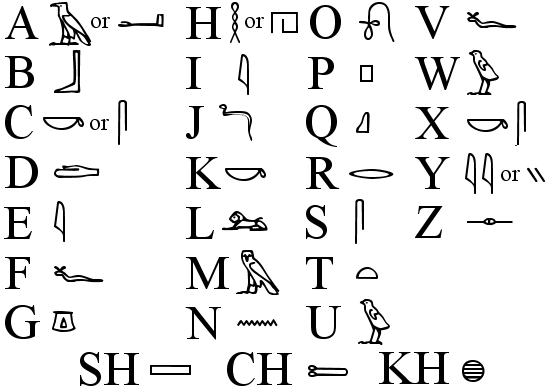
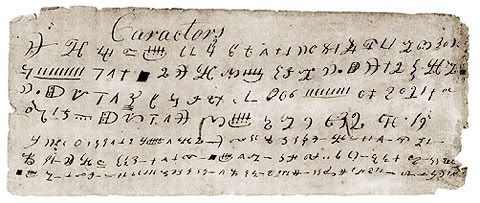
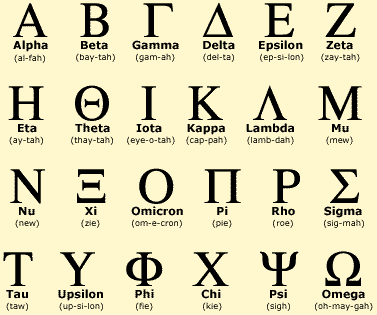
In the Martin Harris account of his visit to Professor Anthon that we have in the JS-H, he asserts that Anthon verified the letters as true characters from the "Egyptian, Chaldaic, Assyriac, and Arabic" languages. Historians have shown that Anthon had at least a rudimentary knowledge of these languages, enough to recognize the alphabets when he saw them. Let us assume that Martin Harris was correctly recalling the languages mentioned by Anthon. We should be able to see some correlations with these ancient alphabets and the JS characters. Below I will post some charts of the alphabets, so we can compare them with the "Caractors Document."
Ancient Assyrian (Akkadian) differs somewhat from modern Assyrian (Neo-Syrian). Akkadian was in use until about 750 BC, and was gradually replaced when writing began to be done on parchment, leather and papyrus rather than clay tablets. Aramaic gradually replaced the Ancient Assyrian because of the technological breakthrough in writing. It is sometimes assumed that Martin Harris meant to say "Aramaic" rather than "Arabic" in his report of Anthon's words because the Arabic language did not come into usage until after Lehi's group left for the New World, and would not have been represented on the plates. Arabic is descended from Aramaic and first appeared about 512 AD.
Now, here again is the "Caractors Document:"
Do you see any correlations here? I don't. It's especially disappointing to see the lack of similarity to Egyptian. In his 1834 letter to E.B. Howe, Anthon denied that the characters he saw included Egyptian, but rather wrote that he saw "Greek and Hebrew letters, crosses and flourishes, Roman letters inverted or placed sideways..." Doesn't this seem more descriptive of the characters to you?? (See especially Greek letters alpha, eta, lambda, tau, and upsilon.)
This post is intended to be a simplistic view of the alphabets as discussed by the major players in the Anthon drama. Other authors have gone into further depth on the relation of the characters to different scripts. [1] I do indeed have a working theory as to how the assertions of Martin Harris came about, but there are a few more points to cover before I get into my conclusions.
______________________________________________________________
[1] Here are only a few samples the many which are available on line.
Apologetic Sources:
Ariel L. Crowley, The Anthon Transcript: A Series of Articles in
The Improvement Era, Jan. - Mar., 1942.
Russell Littlecreek, Evidence for Reformed Egyptian. This is really cool. Click on the letters in the "Caractors Document" and you are taken to a possible corresponding Egyptian Hieratic or Hieroglyph. (Keep in mind as you do this that Professor Anthon would not have had complete knowledge of all these characters.)
John Gee, Some Notes on the Anthon Transcript:Review of Stan and Polly Johnson. Translating the Anthon Transcript.
Stanley B. Kimball, A Visit With Dr. Hayes, Sunstone, July 2002, pp. 12-13
Critical Sources:
Richard Stout, A Singular Discovery: The Curious Manuscript, Mitchill, and Mormonism. (scroll down and read about the close resemblance between the "Caractors" and Tironian notes!)
Friday, March 7, 2008
The Doctrine of Elias, Elijah, and Christ
My stats for the past few days show that there is not a whole lot of interest in the subject of Elias! But I'm still into it, so here I go again.
My eye was drawn to the subheading on page 85 of the JS manual, which reads, A person who has the spirit of Elias has a preparatory work assigned to him by the Lord. Now, we Mormons often apply the title "Elias" to John the Baptist, as is done here in the manual. And Joseph Smith taught that his own ordination under the hand of John the Baptist constituted the Spirit of Elias. But we don't generally apply this title to anyone else. This subheading in the manual suggests that anyone who undertakes a preparatory work in a gospel context has the Spirit of Elias. I wondered if these words were really representative of what Joseph was teaching. So I went to the full text of Joseph Smith's March 10, 1844 discourse, which can be found here. The sermon was delivered on the Nauvoo temple grounds and was reported in several different sources: the Wilford Woodruff journal, James Burgess notebook, Franklin D. Richards "Scriptural Items," Joseph Smith diary (Willard Richards), Thomas Bullock diary and the John S. Fullmer papers. The version in the JS manual comes from Wilford Woodruff, who recorded it in the greatest detail.
The subject of Joseph's talk was to show the differences between the work, spirit, and calling of Elias, Elijah, and Messiah. Joseph describes the spirit of Elias as being a preparatory work, and gives the example of John the Baptist. The Baptist's mission was a true representation of the spirit of Elias, because it was a "going before" of another important work. [1]
After perusing the discourse, I decided that the manual was justified in giving the doctrine of Elias a wider application than I had previously supposed. Joseph said that "it was called the doctrin of Elias even from the early ages of the world" and applied to Aaron, John, Philip, and others. Joseph also told his audience that it is necessary to know who holds the keys of power and who does not, or we are likely to be deceived. A scriptural example is given wherein Joseph gives a unique exegesis of Acts 19:
Paul when he came to Corinth found certain disciples and asked them if they had received the holy ghost since they bleived, and they said we have not so much as heard of the holy ghost and with what surprise says he unto them. unto what were you babtised and they said unto Johns baptism. not so not so my friends if you had you would have heard of the holy ghost but you have been duped by some designing knave who has come in the name of John an imposture. how do you know it Paul? why John verilly babtised with water unto repentance, always telling the people that they should beleive on him that should come after him. he would babtise with fire and with the holy ghost.
Thus those who were doing a preparatory work would not transcend their bounds and would clearly point the way toward the greater work they were sent to advance. Joseph felt that it was important for his audience to know how to distinguish who had the Priesthood of Elias, for "when any man comes among you saying I have the spirit of Elias you can know whether he be true or fals." It sounds as if Joseph was expecting many men to come along claiming the Spirit of Elias!
Perhaps we as a Latter-day Church should be exhibiting more of the spirit of the Elias than we presently realize.
Not included in the manual, but vital to understanding the doctrine of Elias are the spirit, power, and calling of Elijah and Messiah, which Joseph next expounds:
...the spirit power & calling of Elijah is that ye have power to hold the keys of the revelations ordinances, oricles powers & endowments of the fulness of the Melchezedek Priesthood & of the Kingdom of God on the Earth & to receive, obtain & perform all the ordinances belonging to the Kingdom of God even unto the sealing of the hearts of the hearts fathers unto the children & the hearts of the children unto the fathers...
Joseph told his LDS listeners that they were to use the power of Elijah to redeem their dead and to connect themselves with their fathers. The sealing power was used a bit differently in the early days of the Church to form connections between priesthood holders. In this discourse, we can see Joseph's understanding of this sealing power. He tells the brethren to have their sons and daughters sealed to them first, and then seal themselves to their fathers. They should be "crafty" and seal all they can on earth, and these sealings would be in force in the heavens.[2] In this way, the Spirit of Elijah is used to make their calling and election sure.
(In his sermon, Joseph also makes it clear that the power of Elijah may be used by a righteous priesthood holder to seal his enemies or the unrighteous up to the damnation of Hell!)
Finally, the doctrine of Messiah was mentioned. Elias would prepare the way, Elijah would build up the kingdom, and then Messiah would come to his temple. "The Spirit of Messiah is all power in Heaven and in Earth--" Joseph said--"Enthroned in the Heavens as King of Kings and Lord of Lords." Then he ended his sermon with a promise to treat upon the Spirit of Messiah at some future time.
It seems to me that Joseph's purpose in preaching the doctrine of Elias, Elijah, and Messiah was to show his people how to participate themselves in the spirit and calling of the work. I think that a teacher who is well-versed in the teachings of Joseph on this subject might rightly emphasize the spirit of Elias as it relates not only to John the Baptist and to Joseph Smith, but to individual priesthood holders in the classroom.
Now, I'd like to address my final thoughts to how this relates to women, since 50% of those who will hear this lesson in the coming weeks will be female. Joseph had an audience consisting of many women, yet he seemed to address his remarks mainly to Priesthood holders. I often wonder how much he intended to include women in this group, since he may have considered temple-endowed women who were married to priesthood holders as participants in that priesthood. [3] Be that as it may, the discussion on pages 86 and 87 of the manual quite glaringly leaves women out of any direct involvement in the administration of the Gospel and the spirit of Elias. However, perhaps there is precedent for inclusion. Often, when we speak of the spirit of Elijah, we refer to genealogy and temple work and encourage women to be earnestly involved in this work. In the same manner, might we not sanction the participation of females in the work of Elias? Women can effectively prepare the way for the coming of the Messiah in much of their family and Church service.
_____________________________________________
[1] As an aside, Woodruff quotes Joseph saying, "John the Baptist he Came balling through the wilderness prepare ye the way of the Lord." The Burgess version recounts, "he came bounding out of the wilderness saying repent ye for the kingdom of heaven is come unto you." I think it is possible that Joseph was using the word, "bawling." The quote as it appears cleaned up in our manual is, "He came crying through the wilderness, 'Prepare ye the way of the Lord...'"
[2] This advice led to the practice of the law of adoption, whereby a man could have any number of men adopted to himself as his sons for eternity. For example, in June, 1896, Wilford Woodruff gave a synopsis of his work in the ministry since 1834: "I officiated in Adopting 96 Men to Men." (Wilford Woodruff's Journal, 1833-1898, typescript, edited by Scott G. Kenney, 1985, Vol. 9, page 408) In another synopsis for the years 1834-1885, he revealed: "I had 45 Persons Adopted to me." (Ibid., Vol. 8, page 352) Utah historian Hubert Howe Bancroft gave this information about the law of adoption: "The father may be either younger or older than the son, but in any case assumes the character of guardian, with full control of the labor and estate of the adopted son. Many young men give themselves over to the leaders as 'eternal sons,' in the hope of sharing the honor of their adopted parents." (History of Utah, page 361)
[3] For example, Joseph Smith to the Relief Society on 28 Apr 1842 “gave a lecture on the priesthood shewing how the Sisters would come in possession of the privileges & blessings & gifts of the priesthood & that these signs should follow them, such as healing the sick, casting out devils &c. & that they might attain unto these blessings….” (Book of the Law of the Lord, (Joseph Smith’s journal) 28 April 1842; also in Dean Jesse, ed “The Papers of Joseph Smith, Vol 2, 378-79.)
Also: “…What was the power of Melchizedek? ‘Twas not the Priesthood of Aaron which administers in outward ordinances, and the offering of sacrifices. Those holding the fulness of the Melchizedek Priesthood are kings and priests (or “Queens and Priestesses“) of the Most High God, holding the keys of power and blessings.” (Joseph Smith, TPJS, 322)
*
Wednesday, March 5, 2008
Elias in the JS Manual #6
A perusal of upcoming Lesson #6 in the Joseph Smith manual had me revisiting my notes on Elias. Thus far LDS thought has identified 4 uses of "Elias," but even with these many explanations, there are many holes and questions left in our understanding of this doctrine.
First, a review of the meanings of "Elias:"
Elias the Greek form of Elijah
Elias in the NT is simply the Greek form of the OT Hebrew name Elijah, meaning "YHWH is my God." When אליהו (Elijah) is transliterated into Greek it becomes Ἠλίας (Elias).
- James 5:17—-Elias/Elijah had power over rain (see 1 Kings 17:1, 18:1)
- Luke 4:25-26—-Elias/Elijah sent to widow woman of Zarepta (see 1 Kings 17:9)
- Rom. 11: 2-4—-Elias/Elijah makes intercession to God against Israel (see 1 Kgs. 19:10-18)
Elias the Preparer
- John the Baptist—-The JST identifies John as "an Elias," because he prepared the way for Christ, the Elias who was to come and restore all things. See JST Mark 9:3-4, JST Matt 11:13-14, JST John 1:19-28, BD. The D&C states that John would be filled with the Spirit of Elias. (D&C 27:7)
- Joseph Smith—-Joseph named himself as an Elias: "...my ordination [to the AP] was a preparatory work, or a going before, which was the Spirit of Elias; for the Spirit of Elias was a going before to prepare the way for the greater, which was the case with John the Baptist."
- Adam--"In his physical-spiritual state in Eden, Adam was called the "first man" (Moses 1:34) and given responsibility to dress the garden and "open the way of the world" (TPJS, p. 12). As the first on this earth to receive priesthood keys, Adam continues to dispense authority to others and to watch over priesthood administration on the earth.
Elias the Restorer
- Jesus--(JST John 1:20-28) John the Baptist testifies that Christ was the Elias who was to restore all things.
- Joseph Smith--(D&C 77:9, with D&C 110:11-13. See also Rev 7:2)
- John the Revelator--(D&C 77:14)
- Moroni—-Book of Mormon prophet, returned to earth as a resurrected being and prepared Joseph Smith to receive and translate the gold plates. His role was to restore the everlasting gospel to be preached to all the world.
- Gabriel/Noah--In D&C 27:5-13 Elias, who holds the keys of restoration, will be one of the company present at a special sacrament service with Christ at his 2nd coming. This Elias visited Zachariah in angelic form and told him he would have a son. We know from Luke 1:11-19 that this angel was Gabriel. Joseph Smith once said that the angel Gabriel was Noah.
Elias the Prophet
- In D&C 110:11-13 Elias appears as part of the company who committed keys at the Kirtland Temple. BD says this is an unknown prophet from the time of Abraham.
Questions
~Who appeared on the Mount of Transfiguration?
In the NT accounts in Luke 9:28-35; Matt 17:1-12; Mark 9:2-13 Moses and Elias appear on the Mount of Transfiguration. Elias here is traditionally understood to be the OT prophet Elijah. The JST of Mark 9:3 reads “and there appeared unto them Elias with Moses, or in other words, John the Baptist and Moses…” The BD seeks to clarify this statement by explaining, "The curious wording of JST Mark 9: 3 does not imply that the Elias at the Transfiguration was John the Baptist, but that in addition to Elijah the prophet, John the Baptist was present." This actually causes more problems. Luke 9:30 specifies that only two personages appeared, not three: “there talked with him two men, which were Moses and Elias.” Also, Peter suggests making three tabernacles, one for Jesus, one for Moses, and one for Elias. (Luke 9:33, Matt 17:4, Mark 9:5) A fourth tabernacle for John the Baptist is not mentioned. I am willing to entertain the thought that the BD is simply wrong, and that there were only two personages involved. Whether "Elias" was Elijah or John the Baptist is less certain. Elijah and Moses are often linked in scripture. However, some have said that the two prophets represent the Aaronic and the Melchizedek Priesthoods. If this is true, John the Baptist might make a better fit than Elijah as the representative of the AP.
~Is the “Elias” mentioned in D&C 138 John the Baptist, or Elijah?In D&C 138:45 Elias is part of the company of the righteous commissioned to preach the gospel to the dead in the Spirit World. He is specified as the Elias who was with Moses on the Mount of Transfiguration. The company consists of Adam, Eve, Abel, Seth, Noah, Shem, Abraham, Isaac, Jacob, Moses, Isaiah, Ezekiel, Daniel, Elias, Malachi, (Elijah is then quoted in connection with Malachi).
This reference is not mentioned in the BD. It appears to me that Elias here refers to the prophet Elijah, since the other members of the company are all mentioned by name and are Old Testament personalities. However, the question arises, why is a different form of the name used in verse 45 and verses 46-47? Was this a way to distinguish the Baptist from the OT prophet who would restore the sealing power?
~Does the “Elias” who had the keys to the Dispensation of Abraham and is mentioned in D&C 110 refer to the prophet Elijah? Or is he a completely different OT prophet named Elias? Or is this a title meant to refer to John the Baptist, Abraham, or another forerunner? In this revelation, three prophets appear to JS and Oliver Cowdery in the Kirtland Temple to bestow keys: Moses, Elias, and Elijah. One might ask, if Elias is an OT prophet in this section, why the Greek name? Is it a title? Was it used merely to avoid confusion with the Elijah in the next verse? The BD uses this scripture as the only reference to an unknown "man called Elias [who] apparently lived in mortality in the days of Abraham." Why, as Kevin Barney has asked, would God send a man no one had ever heard of and who is nowhere mentioned in the Bible to commit the keys of the dispensation of Abraham to Joseph Smith? The whole point of bringing famous personalities from biblical antiquity to restore these keys is the fact that they were well known and their authority was assured. Once again, the BD strikes out. Kevin postulates that this Elias is John the Baptist. I think his view can be supported by the idea that John the Baptist could have held the keys to the Dispensation of Abraham. (See D&C 84:28.) This theory also works if we accept that there were 3 prophets--Moses, Elias (John the Baptist), and Elijah--present at the Mount of Transfiguration.
Well, I have more to say about Elias, but this post is getting long. So look for part 2 later. I'll include more about Lesson #6 in the JS manual. In the meantime, here are some great references:
Kevin Barney's post at BCC on the Elias of D&C 110
"...my tentative suggestion to the question is that Joseph understood the Elias of the Mount of Transfiguration, which was the model for who appeared to him at the Kirtland Temple in these verses, to be John the Baptist, a separate individual from Elijah the Tishbite."Comment #11 by Last Lemming:
"Kevin makes the case that Joseph seems to have believed that the “Elias” at the transfiguration was John the Baptist. So why not just identify him by name? Maybe because John the Baptist was one resurrected face with which Joseph was already familiar, and it was not the face of the 'Elias' who appeared in Kirtland. So he retained the linkage of Moses with 'Elias,' but was otherwise not confident enough in the identity of 'Elias' to commit it to writing...Incidently, my vote for the restorer of the gospel of Abraham is…ahem…Abraham."
Joe Spencer's post on Elias and Elijah at FUTW
"I think the pairing of Elijah and Moses makes a great deal of sense, and I must confess I am still at a loss as to how to make any sense of the separation between Elijah and Elias. Because of D&C 110, it seems quite clear that there must be two different people here, but the common locution of making “Elias” a title doesn’t really make any sense to me."Comment #2 by Ben McGuire:
"I think that one response is simply to suggest that D&C 110 is simply in error. That is, that Elias there is either not the name of the angelic being referred to. This could be because it was used there as a title to refer to someone else (Noah or John the Baptist or Abraham himself are the leading candidates in speculative literature), or because Joseph simply misidentified the person or the title as the name of the person."
Sam Brown, "The Prophet Elias Puzzle," in Dialogue
"Writers from within Mormonism have historically focused, with precedent in the Prophet's teachings, on a 'Spirit of Elias' borne by various angelic ministrants while positing the existence of a minor but essentially unknown prophet actually named Elias who stays away from center stage. Later writers, exemplified by Bruce R. McConkie, have described these several instances of Elias in impressive detail. These creative solutions have been a response to increduloud critics who see only a glaring error of transliteration made corporeal, a chink in the armor of Joseph Smith's seerhood...I will contextualize the prophet Elijah and attempt to solve the puzzle of Elias, investigating the linguistic evidence, exploring Joseph Smith's discussions of Elias, and providing a theoretical framework for the significance of the Elijah/Elias bifurcation."Comment by Robert C.:
"the article takes the view that making a distinction between Elias and Elijah was, among other things, a way for Joseph Smith to make a distinction between Elijah as Prostestants of the time understood him and the new eternal-family view that Joseph was presenting."Comment by Joe Spencer:
"Sam suggests at once that Joseph was familiar with the equivalence of Elias and Elijah and that he made a sharp distinction between them. I really like this point because it derails the simplistic “Joseph goofed” idea (Joseph was far too careful a reader of the Bible for that). But what is fascinating me the most is the connection between the JST for John 1:22 and D&C 77. I’d like to do some more thinking there. Hmm…."
Saturday, February 16, 2008
JS # 4--How to Conjure Moroni
The visitation of Moroni to the young Joseph Smith was preceeded by a fervent prayer regarding his status before the Lord. There are interesting similarities in Joseph's account of his vision of Moroni and his First Vision almost four years before.
In 1820, Joseph became concerned for the welfare of his immortal soul. His mind become distressed for he became convicted of his sins. Likewise, in 1823, the repentant Joseph was seeking reconciliation with the Lord concerning his sins and follies. Our JS manual tells us that he "desired a manifestation to me, that I might know of my state and standing before him..." (p. 57)
Latter-day Saints tend to emphasize the results of these two prayers relating to the future organization of the Church. The First Vision is seen as important because the Lord told Joseph that no Church currently on the earth held the fulness of the gospel. Moroni's visit is significant because of the information the angel imparted about the Golden Plates that Joseph would later translate. But I believe that to Joseph personally, the greater significance in these manifestations was in uncovering his status before the Lord and the forgiveness of his sins.
In the third Lecture on Faith, it is taught: "Let us here observe, that three things are necessary, in order that any rational and intelligent being may exercise faith in God, unto life and salvation: First, the idea that he actually exists. Second, a correct idea of his character, perfections and attributes. Third, an actual knowledge that the course of life which he is pursuing, is according to his [God's] will."
Joseph's prayer was a desire for all three items in the aforementioned list. I'm beginning to see the importance of the third, and to realize that it is something I tend to neglect. I believe that God exists. I'm well aware of Church teachings regarding His character and attributes. But how often do I go before the Lord to know if my course is in accordance with the Divine Will? I recognize the value of seeking God's approbation regarding the big decisions--choosing a career, or whom to marry. But I'm perhaps a bit afraid of inquiring as to how I'm doing so far. As I pray for forgiveness of our sins, am I brave enough to ask for a view of how far I yet have to go?
Latter-day Saint teachings on prayer often emphasize its spontaneous nature and warn against repetitious and rote invocations. Thus we offer as a format for prayer something like the following:
Dear Heavenly Father,
We thank thee....
We ask thee....
In the name of Jesus Christ, Amen.
Friday, January 4, 2008
Beyond James 1:5
We have a tendency to speak of James 1:5 as if it were the only scripture Joseph Smith ever read. Mormons believe it is THE scripture that sent the young 14-year-old into the woods to pray. Joe Spencer in his review of "The First Vision" chapter of the new JS manual says that in his religious searches Joseph became affected by the public discourse but that his reading of James 1:5 brought him to the more important personal experience.
Joseph’s relation to the text, then, was unique: he had discovered a scripture that was generic enough (from an “epistle of straw,” as Luther put it, and his point was precisely that James was not partisan enough) that it genuinely excepted itself from the public dialogue. Joseph was leaving the public realm entirely, wagering something in a venture that would, as he would soon see, force the situation to change entirely. Joseph’s wager, interestingly enough, was a serious faithfulness or fidelity to the text, to the scripture. One could even say that he was about to stage the scripture, to enact it as if it were a script. This staging, it is clear from the last words of the text, already quoted above, changed the situation by introducing a truth: “I had found the testimony of James to be true….”
Now, I want to backpedal a bit by saying that Joe Spencer's intention in his post is to present a "serious look at the Pearl of Great Price account as quoted in the manual," without bringing in the other accounts of the First Vision. And I certainly don't wish to downplay the importance of James 1:5 in preparing Joseph Smith to ask of God. However, I feel that without a familarity of all of the extant accounts of Joseph Smith's vision, our understanding of this event will remain limited.
Joseph's retreat to the woods was more than a sudden reaction to just one scripture. In the 1832 account from the Joseph Smith Letterbook, Joseph presents himself as a serious scholar of the scriptures from the age of twelve to fifteen. He said that he applied himself to the scriptures and had an "intimate aquaintance" with the different denominations. Through his study he became convicted of his sins and realized that an apostasy had occurred, leaving no denomination built on the gospel of Jesus Christ. This understanding already leaves him with two motivations for an encounter with Deity:
1.) to rectify his standing before the Lord, and
2.) to determine which church, if any, was authorized by God.
Visionary accounts of Joseph Smith's time describe those who are convinced of their sins and go to the Lord in a search for forgiveness. These were published in local news sources. Joseph would have been well acquainted with these stories and their claims of encounters with Christ. Even without his transformational experience with James 1:5 he would have been aware of the possibility of searching for and experiencing the presence of God.
This same 1832 handwritten account shows Joseph's immersion in scriptural references and the religious rhetoric of the day. It seems that quite a few scriptures and ideas played a part in leading him to the Grove. However, James 1:5 is not specifically mentioned in this account:
"I felt to mourn for my own Sins and for the Sins of the world for I learned in the Scriptures that God was the same yesterday to day and forever that he was no respecter to persons for he was God...and when I considered upon these things my heart exclaimed well hath the wise man said the (it is a) fool (that) saith in his heart there is no God my heart exclaimed all all these bear testimony and bespeak an omnipotant and omnipreasant power a being who makith Laws and decreeeth and bindeth all things in their bounds who filleth Eternity who was and is and will be from all Eternity to Eternity and when I considered all these things and that (that) being seeketh such to worship him as worship him in spirit and in truth therefore I cried unto the Lord for mercy for there was none else to whom I could go and to obtain mercy and the Lord heard my cry..."
The 1834-5 account written by Oliver Cowdery and published in the Messenger and Advocate presents Joseph's vision as a response to the religious excitement in Palmyra and a desire for forgiveness of his sins.
"And it is only necessary for me to say, that while this excitement continued, [Joseph] continued to call upon the Lord in secret for a full manifestation of divine approbation, and for, to him, the all important information, if a Supreme being did exist, to have an assurance that he was accepted of him."In an 1835 account written by Warren Cowdery, Joseph tells a Jewish minister of his vision. Here James 1:5 is only one of the scriptures and studyings which lead him to seek the Lord in prayer:
Being wrought up in my mind respecting the subject of Religion, and looking at the different systems taught the children of men, I knew not who was right or who was wrong, but considered it of the first importance to me that I should be right, in matters of so much moment, matter involving eternal consequences. Being thus perplexed in mind I retired to the silent grove and there bowed down before the Lord, under a realizing sense (if the bible be true) ask and you shall receive, knock and it shall be opened, seek and you shall find, and again, if any man lack wisdom, let of God who giveth to all men liberally & upbraideth not. Information was what I most desired at this time, and with a fixed determination to obtain it, I called on the Lord...
An 1839 interview with William Smith, the Prophet's brother presents the idea that Joseph's first encounter with James 1:5 was during a sermon which was preached near Palmyra:
"Meantime the revival was nearing its close...The Reverend Mr. Lane of the Methodist church preached a sermon on the subject, "What church shall I join?" He quoted the golden text of James -- "If any of you lack wisdom, let him ask of God that giveth to all men liberally and up-braideth not, and it shall be given him." The text made a deep impression on the mind of the Prophet. He read it on returning home, and pondered it deeply. Here was a message from the word of God. A message to all men; but to him especially, since he had been made to feel that of all men he lacked wisdom, in respect of a matter to him vital."
In 1844 Joseph wrote an account for publication in a history of religious denominations in the U.S. Here he mentions the scripture in James, but also the important idea that God is not the author of confusion (1 Cor 14:33).
"Considering that all could not be right, and that God could not be the author of so much confusion, I determined to investigate the subject more fully, believing that if God had a church, it would not be split up into factions, and that if he taught one society to worship one way, and administer in one set of ordinances, he would not teach another principles which were diametrically opposed. Believing the word of God, I had confidence in the declaration of James, "If any man lack wisdom let him ask of God, who giveth to all men liberally and upbraideth not, and it shall be given him."
The official account of the First Vision was written in 1839 in the handwriting of James Mulholland. It was first published by Joseph Smith in the March 15th 1842 edition of the Times and Seasons. It is here that the scripture in James is given prominence as the primary reason that Joseph retired to the Grove. This account and all of the later accounts (1840, 1842Wentworth, 1842Hyde, 1843, and 1850) relate that Joseph read this scripture in the Bible and was struck by it, motivating him to retreat to the woods to pray.
Through the study of the different accounts, we can see the development of the increasing importance of the passage in James. It seems that this one verse gradually became representative of Joseph's scriptural search. After reading the several accounts we begin to view Joseph as a boy with a spiritual understanding of many scriptural passages. We understand that several influences were at work to create a yearning in Joseph's heart. We see the influence of the pastors and the religious seekers of the day in nudging Joseph to seek forgiveness of his sins as well as a knowledge of which ecclesiastical path was "right." In fact, forgiveness of sins was probably more important to Joseph when he knelt before God, although today the story is used primarily to explain how and why the Church was restored.
There are many other aspects to Joseph's story which are augmented when consideration is made of all of the versions. I daresay that most church members will be satisfied with one official account. The majority would not, I suspect, appreciate having to deal with the various discrepancies which are apparent. I do not suggest that these be added to our new Joseph Smith manual, or even mentioned in depth in Sunday classes. But I view the availability of these additional accounts as beneficial to those who might enjoy a more nuanced understanding such a study affords.