This was cross-posted over at Mormon Matters.
I took my 10-year-old and 2 friends to see the movie "Where the Wild Things Are," and I watched enthralled as they yawned, ate candy, threw popcorn, and cheered when it was finally over. Apparently the film didn't contain the action required to capture their attention. But I found much to ponder and enjoy.
"I have only one subject. The question I am obsessed with is: How do children survive?" --Maurice Sendak
Friday, October 30, 2009
Where The Wild Mormons Are
Saturday, February 2, 2008
An Idle Princess in Paradise, or an Eccentric Camel?
A Review of "Should Mormon Women Speak Out?" by Claudia Bushman, Dialogue: A Journal of Mormon Thought, vol. 41, No. 1. (This issue should be coming out very shortly. Keep checking the website.)
Claudia Bushman is a Mormon woman who has been speaking out since the late 1960's when she and some friends living in Boston met monthly for a "consciousness-raising" group. These women became the founders of Exponent II and put together the "pink issue" of Dialogue--vol 6 no. 2, an issue devoted to women's concerns--in 1971.
Speaking out by Mormon women has been met in a variety of ways by Church leadership since the 1960's. Some of the more publicized cases have tended to engender fear and reluctance to push the envelope. These cases influenced a generation of Mormon women, who were given the message that if their voice did not fit within strict parameters, they would be excluded.
More likely, an LDS woman who is speaking out will simply be ignored. Russell Ballard has recognized this, and urged Stake and Ward leaders to allow women a greater role in Church councils.
Claudia's article juxtaposes two sentiments: Eugene England, who opines that Mormon women writers are "more free, more daring, inventive, original in thought and unique in voice than Mormon men," and Susan B. Anthony's 1859 observation "why is it that all the pages of history glow with the names of illustrious men, while only here and there a lone woman appears, who, like the eccentric camel, marks the centuries?" Claudia comes to the conclusion: "Women do not speak out." Is her conclusion informed by the fears of the past when "women have spoken out and rued the day?" Or are women finding more of a voice in the Church today?
My personal opinion is that women have more of a voice in the Church than ever before. We see women speaking to a worldwide Church in General Conference. Women are being hired in greater numbers at Church universities. And the internet is one of the frontiers where this is happening. When women of the Church disagreed with RS President Julie Beck's conference talk, the internet was a forum for them to voice their concerns. It was also a place for women who agreed with Beck's sentiments to make it known. Though a number of women signed their names to an expression of disagreement with her talk, there was no official recrimination or disciplinary action. Regardless, there are perhaps some areas of improvement still worth considering which Claudia mentions in her article.
1. In the Church we tend to consider the basic unit the family rather than the individual, hearkening back to that old idea that the married man and woman were one, and that one was the husband.
2. Does having a voice negate the essential nature of women? What is the authentic nature of women and what are we supposed to learn in our sojourn on the earth?
3. Women used to have more opportunities to serve and develop their talents in Church work than they do now.
4. Our male hierarchy sometimes treats grown women as children.
In her article, Claudia proposes a practical program of action for Mormon women to encourage them to speak up and out. None of her suggestions are radical. I think that younger women will read the article and wonder what is the big deal. These women are already speaking out in their homes, their wards, and their stakes. Being more of Claudia's generation than many of the women on the internet, I relate to the fear she mentions. Experiences I've had in the past with male leaders are still very much a part of my life. These experiences, as well as the way women dissidents have historically been treated in the Church, make me hesitant to express my opinions in a Church setting.
I'd love to have some feedback from Mormon women to see how they perceive the woman's voice is being heard in their areas. Please take a minute to answer these questions in the comment section:
- Do you feel your leaders, especially male leaders, know you and relate to you from a position of respect rather than need?
- Are women's views well represented in your ward and stake?
- Are women presenting and carrying out their ideas?
- Are women given an opportunity to persuade and convince, or are their ideas silenced and ignored?
- Do you feel less respected in the Church than in your professional position?
- Do you feel that your voice is heard in the Church as much as you would like it to be?
- How many years have you been an adult (over 18) woman in the Church?
Claudia points to Eve as an example of the direction LDS women today should take. Though she recommends a strong course of action, she also reveals a bit of her trepidation: "[Mother Eve] had to pay for what she did, but she did not remain an idle princess in paradise. She took action."
Thursday, October 4, 2007
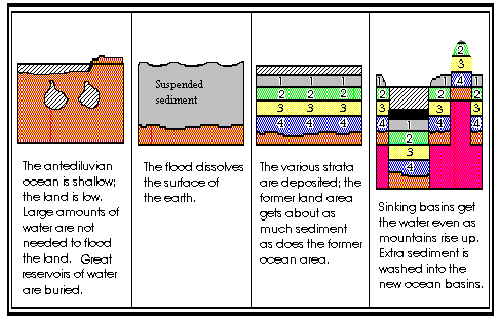
Latter-Day Saints Grapple With the Noachian Flood--A Dialogue Review
LDS discussions of Noah and the Flood are fascinating. We are uniquely qualified among religions to debate this subject. On the one hand, acceptance of science as a means to discover truth has a long-standing tradition among Mormons. Brigham Young is quoted thus:
"How gladly would we understand every principle pertaining to science and art, and become thoroughly acquainted with every intricate operation of nature."On the other hand, Latter-Day revelation confirms the existence of an historical Flood and the reality of the person Noah. As a faith tradition, we often receive mixed signals from our leaders, who are not unified on their interpretation of this Biblical story. Since there is no official and dogmatic position on the historical occurrence of a worldwide Flood, we see much variance among faithful members. Some of the discussions I have enjoyed on this topic are
Duane E. Jeffrey, Noah's Flood: Modern Scholarship and Mormon Traditions, Sunstone Oct 2004.
Donald W. Parry, The Flood and the Tower of Babel, Ensign, Jan 1998.
Julie M. Smith, SS Lesson #6, Times and Seasons, Jan 31, 2006.
GeoffJ, The Noah Version of the Creation Narrative (or, ark=uterus?), New Cool Thang, Feb 2, 2006.
lxxluthor, The Incoherence of the Flood, Faith Promoting Rumor, March 8, 2007
Ronan, Your Monday Poll #2, BCC, Sept 10, 2007
These discussions demonstrate just how much faithful Mormons can differ on their understanding of the Biblical narrative of the Flood. This month's Dialogue, which I have featured on my sidebar, contains yet another discussion on the topic of the Flood. "On Balancing Faith in Mormonism with Traditional Biblical Stories: The Noachian Flood Story" by Clayton M. White and Mark D. Thomas is available online at the Dialogue website. White and Thomas assert that there exist several groups of thought among Latter-Day Saints concerning the Noachian Flood:
1. Many members assume that their religion requires them to believe in the Flood as a world-wide occurrence.
2. A sizable group of LDS believe that the Flood story reports a local event.
3. A third group of believing Saints hold that the story is fictional, but valuable as symbolic and containing moral principles.
The bulk of this article seems dedicated to presenting the scientific evidence against a worldwide Flood. While giving lip service to "room for competent opposing opinions," it seems to me that the authors place their credence in an actual, yet localized Flood. The article does a creditable job presenting scientific evidence against a worldwide Flood in a nutshell. The article is readable and concise. It covers the following salient points:
Insufficient size of the Ark to contain sufficient species for the enormous global biodiversity we see today.
Insufficient time to acquire animals from all land masses on Earth
Impossibility of maintaining specialized conditions required for maintenance of fragile species
Lack of evidence that species on islands and continental land masses arrived there from a single point source.
Complications of requirements of marine vs. fresh-water aquatic species
Discussion of problems relating to parasites and microorganisms.
Fossil records of endemic species and/or groups.
Evidences of tree growth rings
Difficulties of transporting entire ecological systems.
Global distribution of life and it's incompatibiliy with repopulation from a single focal point.
Although these several points were well-presented, I felt the article lacked the balance called for by its thesis. There are many unique reasons that a large group of Latter-Day Saints believe in a literal worldwide flood. Some of these could include the reality of Noah in LDS doctrine, the necessity of the "baptism of the earth," and the location of the Garden of Eden in Missouri necessitating a means of transporting the covenant people to the Middle East. There are undoubtedly other strong reasons for a belief in an historical Deluge.
Lack of consideration of these points leads to the veiled condescension which I detected in this article toward those who reject the authors' conclusions. In spite of the authors' assertion that "our aim in this article is to assess the competing claims regarding the historical core of the biblical story of Noah's flood," in fact only one of the three competing claims was thoroughly treated.
Notwithstanding that I share the perspective presented by the authors, I regret that more space was not given to the exploration of the strong bases upon which proponents of other explanations of the Flood stand.
I can agree most wholeheartedly with the authors' conclusion that
"As we seriously explore the historical core of the story of Noah's ark and the flood, we are likely to encounter several possible temptations at odds with John Taylor's open quest for truth, cited in the opening of this paper. These temptations are to abandon either the text, science, or religion in our quest for truth about the story of Noah."The article is worth reading for its concluding plea to abandon neither science nor religion in grappling with the ambiguity of this powerful Biblical piece of literature.
Additional reviews of this Dialogue article can be seen at T&S, NDBF, LDS Science Review, Adventures in Mormonism.
Wednesday, May 2, 2007
Facing East
Facing East is the newest play by Carol Lynn Pearson which premiered last November in Salt Lake City at Plan B Theater. I was thrilled to see that the play was opening again in Salt Lake before heading to New York City and an off-Broadway run, and then a San Francisco run in August. Last weekend when I was in Salt Lake I had the opportunity to go and see it with my husband.
The play is about a Mormon couple at the graveside of their gay son, who has just committed suicide. There are only three actors--the parents, and their son's partner, who they meet for the first time halfway through the play. The father, a local radio personality, is beginning to question himself and the family he has built as he wonders how he has failed his son. The mother is dealing with her deep grief by holding ever stronger to her Mormon faith.
Carol Lynn succeeds brilliantly at demonstrating how the Mormon faith can conflict so strongly with a gay person struggling to find purpose in life. To her credit, she does this while maintaining an accurate, sympathetic, and poignant view of Mormonism. As liberal as I sometimes am, I found myself sympathizing with the views of the very conservative and doctrinaire mother, Ruth. She believes the teachings of the Church, and she wants her son to be happy, but she feels this cannot happen while he is in the "bonds of sin." She doesn't come across as misguided or stupid, though her religious beliefs cause unbearable pain to her son. It is clear that what she has taught him has made him the beautiful person that he was in life. On the other hand, it is also apparent that there is no reconciling homosexuality and the teachings of the Church of Jesus Christ of Latter-day Saints.
We get to know Andrew through several flashbacks. He was a sensitive cello player and returned missionary. He used terms like "Kolob" in everyday conversation. He sang hymns to divert negative thoughts. It is especially apparent to Latter-day Saints viewing the play that the Church made an indelible mark upon him, as it seems to do to all who grow up under its influence. In fact, I doubt that nonmembers watching this can see as we do the extreme disconnect this causes. Part of you is Mormon, part is something you instinctively fear and abhor. As you come to accept one, you must reject the other. There is no consolidating the two.
The play closes with Ruth leaving her husband and her son's lover at the gravesite and going off to join the rest of the mourners with the food in the chapel. Before she leaves, she reaches out in the only way she can by providing advice on a recipe. But this is a woefully inadequate attempt to make a personal connection. It is symbolic of the efforts the Church has made to reach out to our GLBT members. Alex, the father, represents the direction that perhaps Carol Lynn hopes the Church will take. He has questioned the way he treated his son in the past, realized he never truly knew him, and now reaches out to the partner and makes plans to meet him for dinner. When I was viewing the play, I wondered why Alex didn't invite Marcus back to the chapel with him. I now realize that wouldn't have worked. It is not enough to invite GLBT's to join us on our turf. We must be willing to see things through their eyes and come together on neutral territory.