Showing posts with label musings. Show all posts

Tuesday, March 15, 2011

Progress Report and Introspection

This is my one-month report. I am amazed at how well my recovery from Bell's palsy has gone. My right eyebrow and forehead work almost the same as they always have. (Downside is, I've lost the Botox effect, and my forehead wrinkles are back.) My eye closes and doesn't dry out at night. The blink reflex is back, but I can't squeeze my eye shut tightly, and the undereye muscles are still weak. My smile looks

Friday, July 24, 2009

Some Must Push, and Some Must Pull

Since I didn't get my Pioneer Day fix in Sacrament Meeting this year, you'll have to indulge me as I commemorate the violently beautiful journey taken by a misunderstood and tragic people in 1847 through the 1870's. I tend to internalize the lessons that Pioneer Day teaches in a way that is truly amazing. The Mormon Pioneers are deeply symbolic to me and their stories resonate with some longing deep inside my soul. Here's a new one for me, told by Lydia Ann Lake Nelson. She crossed the plains with her family in 1850, when she was 18 years old:

Friday, June 26, 2009

MJ and Intimations of Mortality

I heard the news of Michael Jackson's death amid the screaming of fans -- but not the type to which he was accustomed. I was one of a group of parents, all about MJ's age, cheering for our teens and tweenies at a swim meet. Michael's death took the breath out of us, reminding us of our own mortality as well as the angst of growing older.

Sunday, March 9, 2008

His Hand is Stretched Out Still--Musings on Doctrine, Apostasy, and Gay Marriage


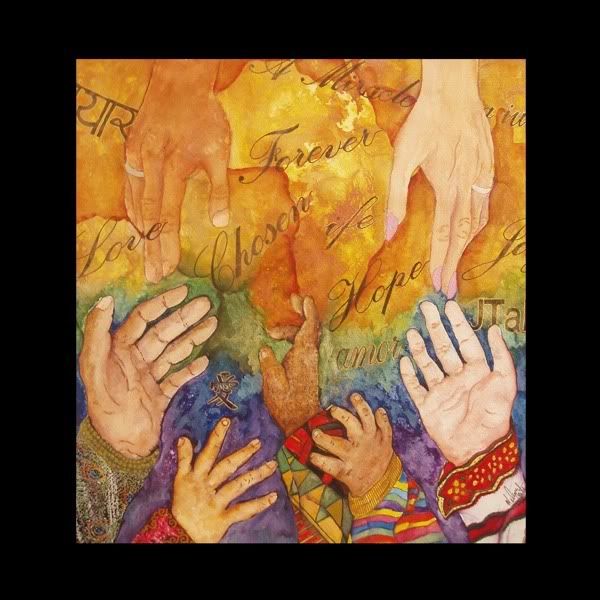
For all this his anger is not turned away, but his hand is stretched out still.

When you read the words of the prophet Isaiah that [the Lord's] hand is stretched out still, does it give you comfort, or does it cause you to tremble?

The phrase is a picturesque one, occurring four times in Isaiah chapters 9 and 10 (9:12, 17, 21; 10:4). These chapters are included in the Isaiah passages found in the Book of Mormon. The refrain has been interpreted in two different ways in biblical exegesis.


The Lord's Arm Stretched Out in Mercy

In the consensus of LDS thought, it is explained that although the House of Israel has sinned and the Lord's anger is not turned away, yet his hand is stretched out to forgive and redeem his people. A footnote to Isaiah 9:12 clarifies the phrase as follows: "In spite of it all, the LORD is available if they will turn to him," and refers the reader to the Topical Guide heading "God, Access to."

In his Oct 2006 Conference address "Prophets in the Land Again," Jeffrey R. Holland reflected this interpretation of the phrase when he stated,

To all of you who think you are lost or without hope, or who think you have done too much that was too wrong for too long, to every one of you who worry that you are stranded somewhere on the wintry plains of life and have wrecked your handcart in the process, this conference calls out Jehovah’s unrelenting refrain, “[My] hand is stretched out still.” ...His is the pure love of Christ, the charity that never faileth, that compassion which endures even when all other strength disappears. I testify of this reaching, rescuing, merciful Jesus, that this is His redeeming Church based on His redeeming love..."

LDS audiences are most familiar with this interpretation of Isaiah's poetic chorus. After watching BYU Broadcasting "Insight into Isaiah," Kelly Miller wrote her own verses on the subject. Part of Kelly's poem reads:
As He extends mercy and assurance
His softly flowing waters fill,
Ever offering hope and guidance.
Where e'er we turn, His hand is stretched out still.


The Lord's Arm Stretched Out in Judgment

Little do most Mormons realize there is another way of looking at this familiar phrase. Note the context in Nephi's quotation of Isaiah 5:
Therefore, is the anger of the Lord kindled against his people, and he hath stretched forth his hand against them, and hath smitten them; and the hills did tremble, and their carcasses were torn in the midst of the streets. For all this his anger is not turned away, but his hand is stretched out still. (2 Nephi 15:25)

In this interpretation the Lord's hand is stretched out in judgment against a rebellious nation. Moeller's commentary on Isaiah 9 reads:
Here God declares himself as the one who is bringing these calamities. The reason: because the punishments have not turned the people to him. Since they continue in their abandonment of the source of their help he will allow further calamities to overtake them. ...There was more to come from the hand of a wrathful God. This series will only end with the complete destruction of the northern kingdom of Israel and their extinction as a political entity.


As I've read the details of the Danzig case, I can only repeat Isaiah's words, over and over, in my mind. I've been reflecting upon these verses as compared to the Church's reactions toward perceived "apostasy" by its members. The hierarchy seems to see itself as the outstretched hand of the Lord, always there with mercy to welcome back the repentant sinner. Yet, members who struggle with reconciling their consciences with Church policies are recipients of the harsher treatment of the refrain. To these, the Church's hand continues to stretch forth in judgment and punishment rather than mercy and healing.

What I have seen of these very public cases over the years are members who sincerely believe in the Church yet struggle with ambiguity. I relate to the Danzig's dilemma since I was present in California when the Church became involved in helping to pass Proposition 22. As members, we were asked to participate in making phone calls supporting the initiative, and to place signs in our front yards. Much pressure was placed upon members in this effort. A few years later, having moved to Texas, a similar situation presented itself. This time, members of the ward sat through a fifth-Sunday combined PH/RS meeting where the position of the Church regarding gay marriage was delineated and members were pressed to spend time and money in passing the legislature. I am strongly in favor of the Church's official position on political neutrality, and believe that on the gay marriage issue this position is being strongly violated.

In an LDS press release, Church representatives stated,
"In his Tribune letter-to-the-editor, Mr. Danzig said he 'was troubled that my church requested I violate my own conscience to write in support of an amendment I feel is contrary to the constitution and to the gospel of Christ.' In reality Church leaders had asked members to write to their senators with their personal views regarding the federal amendment opposing same gender marriage, and did not request support or opposition to the amendment."
This may be the official position of the Church, but it has not been the case in my personal experience, either.

The release also contained this: "Church leaders are always saddened when an individual, whether through his or her actions or personal choices, decides to leave the Church. A welcoming hand of fellowship is always extended to those who wish to return at anytime."

For all this his anger is not turned away, but his hand is stretched out still.

UPDATE!! Come join an interesting discussion on these issues at George's blog Periginatioanimae!

Sunday, February 17, 2008

Can I Put My Earrings Back In Now?


As I grow older, I'm not getting wiser, I'm just getting more confused. I spent a lot of time and energy as a young mother coming to terms with strange doctrines such as God was once a man and the literal conception of Jesus, only to have these demphasized twenty years later. It took a lot of faith and struggle to follow the counsel of Church leaders back then not to use birth control and to have as many children as possible (not to mention their counsel on sexual practices between married couples!). Now it feels like the sacrifice I made has no meaning. Young couples today are told to pray about the decision of how many children to have. I wonder what my family would look like if that had been the counsel I was given. How would it have affected my strained relationship with my husband, my years of depression? How much better could I have done as a mother and as a member of the community?

As time goes by and I measure the years of my Church membership in decades, I see big changes. I welcome many of these, but struggle with feelings of anger. Why was my marriage and my Church membership burdened with the hard patriarchy rhetoric while men and women enjoy much more equality today? What would my choices and opportunities have been if the emphasis on education for women had been preached when I was 21?

Some of the changes are not welcome. I don't see the need for us to defend our status as "Christians." When I joined the Church, I worked for and gained a testimony of our distinctive doctrines, and I don't like to see them watered down so that we can fit in better with evangelical interest groups.

I've seen the reorganization of 5 First Presidencies now, and it will be interesting to see what new directions they will take us. I'm excited about the Church today. I see more acceptance of diversity. I see more openness in dealing with Mormon history. There is an effort at distinguishing between Mormon culture and doctrine. I see a better understanding of international issues. But I fear I'm becoming an LDS dinosaur.

Thursday, January 3, 2008

Latter-Day Morality

You may not be aware of this if you grew up Mormon, but the LDS definition of morality is rather different than that which is generally accepted. Morality is very easily defined to Mormons--it means not having sex. That's all. End of discussion. Immorality means having sex. That's what we teach our teenagers, and that is the definition we carry with us from our church meetings into our daily lives.

Today I'd like to talk about some of the nuances to the word "morality." The meanings that we don't get in Mutual or Seminary or Sunday School. For purposes of this discussion, I would prefer to define "morality" as a system of ideas of right and wrong conduct.

We Mormons like to think of ourselves as a moral people. We accept the Ten Commandments from the Old Testament, Jesus' behavioral standards as described in the New Testament, additional ideals and clarification from the Book of Mormon, and random precepts such as the Word of Wisdom health code from the D&C. We even have our own rules of behavior that come from continuing revelation and church tradition. But out of all of these standards of morality, there are some in which we are truly invested, and some to which we merely give lip service.

As one indicator of standards of morality, let's look at what we teach our children and youth. The standard of conduct that we hit the hardest is of course sexual purity before marriage. We do this to the extent that even the word morality has become synonymous with sexual behavior, as noted above. We reinforce this teaching with related cautions about masturbation for YM and dress standards for YW. I have been dismayed by the amount of emphasis dress standards receives in the Young Women's program. This counsel eclipses all other religious instruction, including teaching of the Savior and the Restoration. Modesty in dress for girls is taught during YW classes, midweek activities, Standards Nights, Seminary, Sunday School, over the pulpit, at Stake dances, Girls Camp, EFY. Indeed, there is scarcely a church activity a YW can attend where she is not warned that she must appear dressed modestly. If her clothing is not appropriate, she is subject to being sent home to try again. The message is firm and unmistakable. Dress standards must not be violated. Here again the very word "modesty" has been coopted to mean only a particular pattern of dress for girls and women.

Additionally, sermonizing abounds in our youth programs on the importance of obedience to the Word of Wisdom. Due to this emphasis the youth of the Church would sooner steal a car, cheat on an exam, or spread vicious rumors about a peer than take a sip of coffee.

The emphasis on the remainder of the wide spectrum of right and wrong behavior is virtually ignored among Latter-Day Saints. To illustrate this point, fill in the blank of the following sentence:

Our Mormon youth are known for never ________________.

One might say that our youth would never drink alcohol, or smoke a cigarette. One might fill in the blank with "never sleep with a boy/girlfriend." But would you even think of filling in the blank as follows:?

Our Mormon youth would never skip classes at school.
Our Mormon youth would never haze their fellow students.
Our Mormon youth would never tell a lie.
Our Mormon youth would never steal.

As a convert who attended evangelical Christian services, I can tell you that in other churches, these standards of moral conduct are given great emphasis. If you have grown up in the LDS church, it is likely that you consider loss of sexual purity and Word of Wisdom adherance as grievous sins. It is possible that you would add murder to this list, with the exception of those you kill while in the military. Other transgressions would be appraised as less important on the moral continuum.

Is there not a morality that is based on the other commands of God found in the scriptures? Is there not a morality that is concerned with practices that minimize the harms that people suffer? Promoting people living together in peace and harmony? Morality that requires charitable action for good? Overcoming selfish vices? What about a morality based on respect for the planet on which we live and the myriad creatures who live upon it?

I hope we can begin to consider the vast implications of religious morality. Morality within the Church should be more than simply refraining from sex. This wider morality should be discussed at least as often as the length of skirts. It should help us formulate ethical theories for personal conduct.

Wednesday, November 28, 2007

Reverse Missionary Work


I got one of those comments on my blog yesterday--you know the type--urging me to leave the Church if I didn't like certain aspects of how it is run. "Anonymous" said:

"I think you are one of those people that is looking for an excuse to be mad and to be offended. A truly humble person can not be offended. Go join the Catholic church. Because the Prophet of this church agrees with Julie B Beck, so if you don't agree with her you don't agree with the Prophet. Maybe it is time for you to find an easier religion!"

I've read these types of comments quite often, and I view them as "reverse missionary work." This week I've been trying to understand why anyone would become involved in reverse missionary work, and what their motivations might be. (And why they are always "Anonymous.") Let's try to put ourselves in the place of these "Anti-Missionaries" and see what they are trying to accomplish:

1. Reverse missionary work will cleanse the Church from those who might be a corrupting influence.

2. Those who complain against Church leaders or policies might lead others astray. For the good of these weaker members, the complainers should be driven away from the body of the Church.

3. People who don't believe the mainstream teachings of the Church are different, and do not belong. They make the faithful members feel uncomfortable. They should leave the Church and find another group which is more closely aligned to their beliefs.

4. Members of the Church have a responsibility to call their less faithful brothers and sisters to repentance. Perhaps inviting them to leave will show them the error of their ways.

5. Faithful members should not have to listen to contention. Dissenters cause a lack of unity and thus do not belong with believers who are trying to build Zion.

6. What other reasoning lies behind reverse missionary work?


And you, dear reader? Are you a missionary, an anti-missionary, or are you lukewarm on the issue? Do you feel a responsibility to keep members like me in the Church, would you rather I leave, or don't you care one way or the other? What is your opinion on reverse missionary work?

Sunday, November 11, 2007

Sabbath-day Thorn in my Side

Stake Conference in our Stake is a bit different than in other places in the world. Because the units are spread out over a vast area, the stake leaders bring the conference to each ward. Members are warned several weeks before the Conference that it will be their chance to obtain a temple recommend. Interviews with the Bishop are held, and the Stake President is available after the meetings to conduct interviews. It is perhaps the only time members will see Stake leaders for 6 months or a year. Because of the difficulties in traveling and in women getting around, the wives of the Stake Presidency are called to be the Stake RS President, Stake YW President, and Stake Primary President.

I enjoyed meeting our Stake leaders, and I had a chance to talk personally with each of the women leaders. They were very nice, and I enjoyed our conversations. They are about my age, and I think I could be good friends with each one of them. However, I cannot contain my opinion of their talks. As I've said before, women leaders have a great opportunity when they speak in Conferences. It is their opportunity to have a voice in the administration of the Church. It is one of a very few times that they can appropriately give counsel and instruction to the general membership of the Church, including men, women, and children. Not surprisingly, I was looking forward to hearing what these women would say during our General Session and also during our Adult Session.


So what did I hear from our illustrious women leaders? None other than RECYCLED CONFERENCE TALKS!! It's the biggest Sabbath-day thorn in my side there is. I don't like when anyone gives recycled Conference Talks. I'm fine with themes are given to speakers, but I feel they should be developed by the speakers themselves, with personal experiences and relevant scripture stories chosen according to personal guidance of the Spirit. This way both speaker and listeners are enriched. A Conference Talk summarized again and again in Sacrament and other meetings loses its immediacy and power that it had when the message was received and given by the General Authorities. I and many other members of the Church read our Conference Ensigns and are quite familiar with the talks. Hearing them summarized in Church is boring.

None of the men speakers at our Stake Conference gave recycled Conference Talks. Every woman who spoke summarized a Conference Talk. None of the women even went so far as to include a personal experience or opinion on the topic. I'm extremely disappointed. By doing this, we women are diluting what little authority and influence we do have. For shame.

Tuesday, November 6, 2007

Bearing Children--The Default Position

This question came up as I wrote my last post, and I'd like to discuss it further with my readership. What is the preferred "righteous" Latter-day Saint position on procreation?


1. Begin having children and don't stop until you receive revelation to do so.
2. Wait to have children until you are directed that it is the right time.
3. Have as many children as you desire unless the Spirit intervenes with different instructions.
4. Use your own wisdom to figure out how many children you can support financially, physically, and emotionally.
5. Strive to discover the exact number of children that Heavenly Father wishes to send to your home, and act upon this information.
6. Other?

Do you think there is a general Latter-day Saint position on this question? Does it differ from your personal position?


When I was a young mother, I perceived the Church's position was to have as many children as you possibly physically could. I began by having my first two girls less than a year apart. There were some problems with #2, and the Dr. advised that we should be satisfied with two children and not attempt to have more. He sent us home with a prescription for the Pill. I held the paper in my hand and cried. I felt strongly that I should not use this contraception. We went home and researched statements of General Authorities on birth control. I could find nothing that condoned the use of artificial birth control, and discovered many General Authority quotes preaching against it. These impressed my mind so much that to this day I have never used it. As you know, readers, I went on to have 8 children. Miraculously, there were no further physical problems.

As the years went by, my zeal for having children has waned. I once saw my childbearing as a great demonstration of faith and obedience to the Lord and dedication to Church teachings. But in recent years, teachings on procreation have changed in their emphasis. Now a young couple can be considered perfectly orthodox and faithful while waiting to finish schooling or spacing their children. I feel that my sacrifice has become essentially meaningless. I could have had 4 children and saved myself the year of serious post-partum depression, financial struggles, and marital discord. Perhaps the children would have had more advantages, more attention, a better home life. I would have been free to pursue educational and other interests. I love and value each of my children, but I don't know if my choice was the wisest one I could have made. I don't even know if it was the Father's will that I have that many children. I just had them by default because I believed the #1 example above. Since I never had a direct revelation to stop having children, I often feel guilty that I haven't had more.

Julie Beck's talk has taken us back to the era in which I was starting my childbearing. I react to it differently than many younger couples. I feel pressured to have more children. I'm noticing that many younger couples can listen to the directives without feeling this pressure. They are not applying Julie's admonition directly to themselves. They see it as advice that doesn't necessarily have to be acted upon immediately.


I'm waffling dreadfully on this issue. In a way, I'd love to be true to that zealous, faithful little Latter-day Saint girl I was in the beginning. But I've lived long enough to see that there are other ways I can contribute to society and to my family than having children and staying at home to cook for them and clean up after them.


What is the Spirit trying to tell me? I just don't know.

Monday, November 5, 2007

"Wanna-Be" Woman Who Knows

Alternate Post Title: Still Whining

I may be a complainer and a whiner, but I have now read our illustrious RS President's talk 2,049 times and can quote large sections of it, so that must count for something!

The thing is, I want to be a woman who knows. I've spent a great portion of my life trying to discover the doctrines of the gospel and searching after the face of the Divine. And I want so badly to know as I am known.

So here's my latest on Julie's talk. Halloween night we spent some time with another LDS family, and "Sister Suzy" engaged me in discussing the talk. She asked me, "Have you ever heard of Feminist Mormon Housewives?" :) and then proceeded to scold those who were speaking ill of their leaders and refusing to take the counsel of the speakers as if from the Lord's own mouth. Now, in my previous incarnation, I would have meekly listened while seething inside. But a year of blogging and being honest with the latent liberal Mormon inside emboldened me, and I indulged in a bit of ranting (regretting it later, of course.) "Sister Suzy" was taken aback and I felt a chasm as wide as eternity open up between myself and one of the few people here who has been truly kind and generous to me and my family. Later in the evening, Sister Suzy's husband brought the subject up again, urging me to try to find some pearl of wisdom from the talk that would apply to me. These people have such a different perspective of Julie Beck's talk it's like we live in an alternate universe. Yet the strange thing is, my Molly Mormon head can see things exactly the way they do.

Dear Readers, so far I have considered this talk as completely ineffective in creating a people who know God. I mean, seriously, bringing your son to Church in a starched white shirt? Spending the day housecleaning? I'd much rather sit at the feet of Blake Ostler and discuss Atonement theory, something Julie Beck didn't even mention!

But...what if, Naaman-like, I'm simply being told to dip myself 7 times into the River Jordan? What then, readers? What does this bode for your tormented BiV?

I'll tell you--if I truly value the family, and desire children as a woman who knows I will not hesitate to bring yet another small spirit down here to live with me. At age 47, I find myself still gravid. We have the financial resources, the space. I've never had that enviable revelation that I was finished childbearing. Yes, people, of course I've prayed about this. But in the absence of any reply, it seems that Beck's talk places the default position as being----pregnancy. So. A 9th child, and I'd be 48 years old at it's birth.

The scary thing is I'm such a fanatic that I'm seriously considering all this. After 15 years of non-stop pregnancy and nursing; 25 years of devoting myself to home and family, I've begun to step out into the world and attend conferences, women's retreats, get back into coaching, reenter the workforce and find personal stimulation. Now I'm ready to quit my job, cut out those unnecessary activities and turn my eyes back to the home, cleaning and polishing and "nurturing," never off duty. Perhaps I've been gaining the world and losing my soul.

As a wanna-be woman who knows, can I turn my back on this counsel? In the absence of a sure voice from On High, do I listen to my own worldly wisdom, or the words of my church leader, speaking for the Lord and approved by His prophet? Shall I take the step of faith that will bring me the blessings of eternity? Or am I poised on the brink of a quagmire of depression, guilt, and loneliness????

Wednesday, October 10, 2007

A Powerful Voice

All of my adult life I have longed for a powerful voice. There is a small soprano sound which my vocal cords emit, and this voice does not serve me well. As a swim coach, I need a powerful sound which carries over the splashing. With such a voice as I have, I must earn my authority as a coach slowly and painfully. When I answer the telephone, even today as a woman of a certain age, people ask me if my mother is at home. I have wished for a voice that would command attention and respect.

Here's the comment fmhLisa made when she met me:

And as long as we’re being scary mean uber feminists, can I just say that I’m still a little blown away by how supremely feminine Bored in Vernal is. Her blog voice in my head sounds a lot like a super firm Eleanor Roosevelt, but in person she this tiny little thing, with a very very feminine way about her, and a tiny little girl voice. I was just following her comments around the nacle and trying to read them with her actual voice in my head rather than the “Roosevelt esque Bored in Voice” I’d created for her, and I couldn’t do it. Is that weird?

I was so flattered that my blog voice was commanding.

With my "tiny little girl voice" and less than statuesque height, I have throughout my life confronted and pondered issues of respect and authority. And lately I have wondered what I would do if placed in such a position. My recent blog post, "If You Were a (Female) Speaker At General Conference" was my effort to see what other Mormon women would do given an authoritative placement in the LDS Church. Although this post was read by over 200 people, I tellingly only received 4 willing speculators. Perhaps many are uncomfortable with "aspiring" to a calling. I can sympathize with this feeling, since I have been hurt by accusations in the Bloggernacle of wanting to be a Bishop or usurping the Priesthood. In addition, after I had put the post up, a furor arose over Julie Beck's talk in Conference, and I think many were reluctant to seemingly denigrate her remarks. However, I think it's important for us to define our personal philosophies regarding this issue. The probability that each LDS woman will at some time in our lives hold a position of some small authority is quite high.


The first thing I would do as a high-profile woman would be to choose one or two specific platforms. I think for everyone from political candidates to Apostles it is extremely effective to become known for one or two strong stances. I'd choose something that was meaningful to me and something I think that women could have a strong influence over. I'd strive diligently both for revelation and to get to know the concerns of LDS women worldwide. I'd eschew platforms such as modesty or homemaking in favor of education or literacy or saving the earth. I'd strongly consider service as a platform, though it would have to be more specific and defined than the broad category we now invoke. I think a woman leader must select causes which are universal to women in every circumstance, which cause a great good for the entire world, and have eternal implications.

Next, I would give talks which emphasize my platform in a way that reaches all within the sound of my voice. When a woman gives a talk in General Conference she is speaking to all: women, men and children; members and non-members; rich and poor; mothers, single women, divorced women, etc. Though she might address herself to mothers or to young women, her messages fall upon the ears of the fathers and the young men and give them subtle messages also. For example, a father might pick up from a talk given to mothers that his wife is responsible for the length of their son's hair.

I regret the fact that appearance makes such a difference in the regard in which a woman in the public sphere is held. However, I would recognize that I must present a clean, fit, and professional appearance in order to be taken seriously. This would not preclude my wearing of the quirky items I love on occasion and in appropriate circumstances. I think I'd also wear pantsuits to travel and give talks in (a la Hilary Clinton.) I noticed in a press release about newly called General RS counselor Barbara Thompson that she said she felt more comfortable in pants than dresses. I wished that she would continue to wear her pants often, and to make them more acceptable in Mormon circles.

Finally, I would travel widely and attempt to make Mormon women everywhere aware and accepting of other cultures. The Salt Lake Tribune reported that the General RS presidency recently met for lunch with 17 women from African nations. The visitors included a Muslim from Djibouti with whom Beck fasted in honor of Ramadan. I was extremely impressed by her willingness to experience cultural and religious diversity in her calling to serve the women of the world.

Now, the title of my hypothetical General Conference talk: Using Your Education as a Spiritual Force for Good. I'd emphasize the variety of levels of education to which we can attain--some are self-taught, some gain their education through life experience, some through advanced degrees. Some are educated in music, some in physics, some in nutrition. These can all be used as a spiritual force for good in whatever sphere we are placed. I wouldn't address my remarks specifically to the female sex, though I would hope my remarks would resonate particularly with women.

With that, I'll give all you readers a second chance: tell us what you'd do with a powerful voice!

Sunday, July 1, 2007

Writing a Life


"It’s the people who write, who last. If any woman out there has any inclination to to remembered in the future, the next few generations, she’d just better get busy and write out her story, her experiences." --Claudia Bushman

I haven't been very satisfied with the writing of my own story. I wish I had a more representative record of my life. I began journaling in 1974 when I was 14 years old. I had a diary all through my high school years. I was certain that when I was a teenager I had some intelligent thoughts. But reading back in my journal, I am not so sure. By what I wrote, it seems that I thought about nothing but boys. Many things happened during the years I was in high school. The Watergate scandal, and the resignation of President Richard Nixon. The war in Vietnam. Unrest on college campuses and the Kent State Massacre. Manned space flights to the moon. The first test tube baby. Affirmative Action and Title IX. Radioactive leak at Three Mile Island. I remember all these things happening, but I did not find them important enough to write down. Instead, here is a typical journal entry, written on the date of the fall of Saigon and the end of the Vietnam War:
30 April 1975
This morning I had a big fight with Mom because someone took my toothbrush and I refused to go to school without brushing my teeth. I finally used someone else's. Later we found out that Kenny had it in his room. Don't ask me why. Today I made up the math test I missed on logarithms. We had swimming fifth block. We had a boy in our gym class that was swimming with us--we all wondered what he was doing there. He was a good swimmer though, and pretty cute. After school, Kenny, Doug, Mark and I sat outside and fooled around with a magnifying glass trying to start some paper on fire. We did, a couple of times. A cop car came by and Mark sat on the fire. Doug kept putting his arm around me. I wonder if he likes me again?
Tonight was Allison's night to go somewhere with Dad but she wanted to see the movie "The Great Waldo Pepper." But all of the rest of us wanted to see it too, so we all went. It was starring Robert Redford!! He is the best actor and so cute!! The only other movie I want to see is "Tommy." It has Elton John (the singer) in it. I want to see him. He is the greatest!! And he sings the best songs!!

I joined the Church in 1979, when I was in college. For several years my journals are very saccharine and faith-promoting. I write a lot of quotes from the Book of Mormon and books I've been reading such as "Faith Precedes the Miracle." I did find one entry that gives an insight into what kind of person I had become as a Mormon:
30 Nov 1979
A very sad experience happened to me before I left for Christmas. I saw T. drinking coffee in the cafeteria. She is a member who has not been attending meetings lately. I went over to talk to her and asked why she was drinking coffee. She said the doctor told her not to drink any beverages except for coffee and tea. I mentioned that it might be better to just drink water. She was very upset with me. That night I received a package which contained a Book of Mormon, a D&C, and two Institute manuals. This note was with it: "I give these things to you and you can give them to someone else but just don't drive them up and down a wall and away from the Church as you have me. Don't approach me on campus and don't come down to the room to talk about it cause I will not answer the door."

Hopefully I learned something from this experience!

You've already had a few samples from my missionary journals. I probably did a fairly good job representing myself, the ups and downs, and the things I was learning during this time. Soon after my mission I married and started having children right away. I wrote very rarely. This is the time I really wish I had kept up my journal. It seems that during these years I only wrote when I was angry and overwhelmed.
1 Oct 1991
Thoughts are flying through my head like crazy--I can't get them down. The RS class and the article set off some kind of dissatisfaction in my mind. They seemed so basic and so boring--I tried to tell [a friend] how I felt but I didn't really feel like she understood me. She said they'd had that discussion in their family and they'd concluded that the Church had to gear materials to the new-convert-type member, or as she put it, "the least common denominator." I don't know why they can't include more meaty talks along with basic ones for new converts. I just feel so disappointed, jaded and cynical.

And then there are some entries about cars that break down, and financial troubles, and fights with the husband, and it sounds like I don't have a positive thought for the next ten years.

Now that I've started to blog, it looks like I may have fallen into the same trap. Though I am an active and faithful member of the Church, I tend to use my writing for airing my grievances. Apparently, I give the impression that I am an apostate or disgruntled member. I don't know quite how to remedy this. For when I read blogs that are supposedly encouraging and faith-promoting, all I can think is "Yawn!" I want to show the spiritual side of myself, but I refuse to write a bunch of smarmy pablum.

Unfortunately, Sister Bushman, my writings probably won't be of much interest to future historians. Neither am I representative of a twentieth-century Mormon woman. I'm just one of myriads of bloggers, sitting at a screen and pouring out the day's frustrations, hoping to make a couple of sympathetic connections and stay sane at the end of the day.

Wednesday, May 16, 2007

Our Family is Complete--The Decision

I was recently asked the question, "When did you decide your family was complete? Did you have any sort of revelation/answer that you are 'done' with having children?"

I remember exactly when I started feeling scared about having so many children. It was right after #5 was born. She was about a week old and I was feeling well enough to go for a walk. I had baby in a sling, #3 and #4 in the double stroller, and #1 and #2, who were only 5 and 6 years old, were on either side of me on their bikes, with training wheels, not really able to ride well yet. We started walking down the sidewalk in a big parade. I thought, "What have I done?!! There is no way I can do this."

For the first time, I had postpartum depression with this baby. It was sort of a "functional" depression--from the outside I looked like I was OK. I held Church callings, homeschooled like crazy, (I taught all of my kids to read by age 3, had them all working 2 grades ahead of their ages), and did projects like stripping all of the wallpaper off a large home and repainting.) But I lost a lot of weight and lived an entire fantasy life inside my head. My husband and I had horrible fights, I hurt myself and had suicidal thoughts constantly. It was an awful year.

How did I deal with it? After about a year, we moved, which sort of put everything into a new perspective, I read a book called "Cognitive Therapy" and started practicing it (more on that later) and I became more realistic about what "being a good mother" entails. Then I had another baby. My husband went back to school to get his PhD. We lived on less than $10,000 a year for 3 years. Here's a pic of my stairstep children that year. They are ages 8,7,5,4,2, and newborn:


In spite of all this, I have never had a revelation/answer that I was done having children. In fact, I still get twinges every once in a while that maybe I should have more. (I am 47!!) The story of why I stopped at eight children is less than spiritual. When I was 40, and #8 was 2 years old, my husband wanted to have another child. I was barely feeling healthy again, and I didn't want to. I asked him, "if I had another one right now, it would cause a lot more work for me. What would you be willing to change in your life?" He said, "Nothing, I'm doing everything I'm supposed to do already." His answer made me furious. So I decided the time was not right for another one. I think if I had stuck to spirituality, I would have 12 kids and be a raving lunatic. So basically I have no good answers on that one.

Blog friends, how do you balance faith and logic when deciding when your family is complete? Have any of you had revelations that there were no more children waiting to come into your family? Have you felt pressure to have more children? Do any of you deal with the guilt that perhaps you should have had more children, but your faith or your physical or emotional strength was too weak?

How have you come to peace with your family size?

Friday, May 4, 2007

The Weeping Mormon


The clouds in Vernal today were so close to the ground, it seemed you could reach out and touch the face of God. They were grey-blue in color, and the celestial palette was that one you see on certain spring days when the sun shines through the rain and the leaves are the brightest emerald green. It struck my heart so strongly that the pain has been there all day. As I read through the blogs, I've mourned, and I've wept, and I've wished to comfort those faceless souls I know only through their passionate words.

First, I came across a tribute by John Remy:

...today I realized that when I hear Regina Spektor sing, I think about Jana. Her music makes me hyperaware of Jana’s presence in my heart, my mind, my soul.

People at Church seem to remember two of my pseudo-sermons across the pulpit. One was my apology-ridden ‘doubtamony,’ and the other was when I declared that Jana was my goddess.

Mormons take this god and goddess business serious–every one of us is a literal child of god and are therefore godlings, beings of Godly potential. And Jana has always been my goddess. In a life stripped of much of the divinity and meaning that it once had, Jana is my Ishtar, my Innana, my Isis. She is the one being left to me to invest all my irrational faith in, to spend my life in adoration.

I like to think that ours is a love of legends–that some day someone will write songs about it. When I listen to Regina Spektor, I feel like someone already has
.

Strange that reading this would make me weep. I read this, and I wondered what my life would be like if someone loved me so much.

A poignant image of the "Mormon Circle" written by Margaret Young also touched me deeply:

[My father] would continue giving priesthood blessings to me and to my siblings throughout our lives—the most difficult one being at my brother’s hospital bedside after we were told he would not survive the injuries he had sustained in an accident. That brother, Dad’s namesake (Bobby), lifted his arms as high as he could when Dad walked into the ER room. Bobby was threaded and tubed to monitors and IVs, and being transfused. He said one word: “Hug.” And that’s it—that’s the picture. Dad is maneuvering around the ganglia of wires and tubes to embrace his son, and then to bless him. It’s a godly scene. It expresses the image I have of God—a corporeal being who can reach around our mortal mischief and earthbound wiring to embrace us in the fullness of His glory, no matter how damaged we are.

Later, when Dad’s pancreas failed, it was Bobby who blessed him. That’s the Mormon circle.

Love, eternal union, the Mormon circle. They are so beautiful and so ethereal they make one want to sing and to weep, at the same time. But like the clouds I watch above the Uintah Basin, they can be elusive. There is another side to the story. There are those who have been evicted from the Mormon circle.

Mayan Elephant wrote, concerning the PBS special:

Will y'all think I am a lesser elephant if I admit that I cried? It's fine if you think that. It is true. That was brutal to watch. Effing brutal.

I lost it.

Margaret Toscano did me in. I was just amused without seeing anything very interesting, until Toscano came along. Then, it all changed.

I don't know if there are others on here that have sat on the jury side of a Mormon church court. I have. I was a High Priest in the church. I was in the seats they pictured in that video, the jury seats. Damnit. There is no redemption for that. None. Not ever. It is part of me now. I dont expect to ever be redeemed for having been a part of one of those courts. I can only hope to adjust after having made that part of my life experience.

Hearing Toscano tore me to pieces...
On one hand, I saw Toscano, and I knew she would sit in that chair, and take the bullet for me, for my local leaders, for my mission companions, for my wife and kids, for all women, for Mormons. She could do it because she loved Mormons. Does anyone get that? She loves that community.

Toscano being denied the chance to dress her sister is unreal. If anyone reads this and claims families are forever, remember that image, of a sister, divided from her family, her heritage and ritual...

Tribes and families take care of their own. Cults threaten their own and brainwash them to think its a blessing.

This is not what my people gave their lives for
...

Equality's words on the same subject:

And then Margaret Toscano told her story. Toscano's sister Janice Allred was excommunicated for publishing a scholarly article on Heavenly Mother (and whose heart-wrenching account of her own kangaroo-court church trial can be found right here) and her story hit me like the sucker punch that killed Houdini. I was floored, overcome with a wave of undifferentiated emotion--a mingling of anger, sadness, liberation, enlightenment. I had read Allred's story and some of the stories of the September Six. But Toscano tells her story so eloquently and passionately that I could not help but be deeply, profoundly moved. And then I went to the PBS web site and as I read her whole interview, two years of searching, praying, meditating, discussing, reading, and thinking about Mormonism and my relationship to it coalesced in my soul.

The totality of thoughts and feelings from hour upon hour of exploration and examination gathered into tight focus. And I was left with a conviction stronger than the cords of death. I now believe that, in good conscience, I can no longer sustain an organization that finds women like Margaret Toscano a threat; an organization that inspires a misplaced zeal that tears families apart; an organization that inspires the kind of unblinking obedience that keeps a missionary from coming home for his mother's funeral (and whose death was a direct result of sacrificing reason on the altar of a misguided faith); an organization that fears the search for knowledge, discourages the publication of accurate history, and punishes the telling of truth; an organization that scapegoats gays, subjugates women, and vilifies intellectuals; an organization that, in short, dehumanizes people to advance its own interest in self-preservation. In sum, I have arrived at the conclusion that the LDS Church "as presently constituted" does violence to my sense of morality
.

I saw it happen before my eyes again today on a thread at FMH. A commenter seemed to relate to Margaret's story and shared some of his private pain. He spoke of how Mormon ritual can get in the way of human compassion and the process of grief, and sever the family in one of its most vulnerable moments. "We probably all know someone who wasn’t able to attend a marriage ceremony because they hadn’t met ritual requirements. Many of my own family couldn’t attend my wedding for that exact reason," he said. "Now that I no longer number myself among the faithful, I will not be ritually qualified to fully participate in the celebration of any new child born into my family."

Rather than words of comfort or encouragement, those in the Mormon circle assigned words of blame:

"No one is banned from those spiritual steps except by their own choice."

"The apostasy and/or the sinful life which separates from the individual from the gospel is the source of the violence in the separation. It creates the conflict the, the rest of it is symptomatic of the situation."

"Nowhere does it say that Christ allowed those who were not worthy and did not seek worthiness or forgiveness the same blessings that those who did do what was required received."

"I think it’s that you are choosing to separate yourself from her. It is her decision to marry in the temple. Your choices separate you from the temple."

"the Lee guy from the MMM argued to his deathbed (if I get the facts wrong, I am just arguing a point) that he was justified in killing those pioneers. Should he have full access to the rituals because he felt like he was acting with integrity?"

"I’m not sure I believe your assertion that you have found peace. I hate to point out the obvious but your very presence commenting on this blog is a good indication that you haven’t."

"There seems to be an intentional naivete, a willful simplicity about how you understand love and family which allows, indeed, causes you to think you see a contradiction where others do not."

"You seem to like to put this issue in the darkest, most insulting light. That is my point. You could choose to see it as a positive expression of deep personal conviction, but instead you let yourself be insulted and excluded."


Today I am the weeping Mormon. I see the Mormon circle and it's beauty--I see its exclusivity. We like to believe that someone is being excluded because they choose to remove themselves through sin. Our Savior never let sin stop him from holding one of his sheep close to his bosom. We don't know what sin or righteousness resides in others' hearts. In reality we are excluding people because they are different. We leave them out because we do not understand.

Today I hear these stories, and I wish to be a part of their circle. A circle of integrity, of questioning, of questing. I admire their great souls, stretched large with travail and heartbreak. I wish in my weeping to share a bit of the pain. I wish you to hear their words and feel their humanity and their longing.

Johnny writes:

The most valuable thing I learned from being Mormon was the experience of losing it. Honestly, it is the deepest pain I have ever gone through. If God asked me to do it again, I would plead for him to rip out my finger nails one by one instead. I feel the angst that Satre’s protagonist in his novel Nausea felt. “Then the Nausea seized me, I dropped to a seat, I no longer knew where I was; I saw the colours spin slowly around me, I wanted to vomit. And since that time, the Nausea has not left me, it holds me.”

I don’t know of anyone else who has has experienced this the same way, and if I do, they have never actually told me. Emerging from that has taken a lot of courage, and I feel like I can face existential struggles with more strength then I ever had in the past. Also, choosing to leave went against everything that my underlying psychological desires would have led me to. Thus, I feel like I can say that I don’t believe things based upon purely psychological motivations.

I know it sounds strange to say that the most valuable experience I gained from Mormonism was leaving it, but for the first time I took a step in the dark and that was a defining moment for me
.


Mormons take this god and goddess business seriously-–every one of us is a literal child of god and are therefore godlings, beings of Godly potential.

Friday, March 23, 2007

Word of the Day

Insipid
anemic, anesthetized, apathetic, arid, banal, beige, blah, bland, boring, bromidic, characterless, cloying, colorless, common, commonplace, conventional, dead, distasteful, drab, dreary, driveling, drudging, dry, dull, feeble, flat, flavorless, hackneyed, inane, innocuous, insipid, interminable, irksome, jejune, lackluster, lifeless, limp, monotonous, moth-eaten, mundane, namby-pamby, nebbish, nothing, nowhere, ordinary, pablum, pedestrian, phlegmatic, plain, platitudinous, plebeian, pointless, prosaic, prosy, routine, savorless, slight, soft, spiritless, square, stagnant, stale, stodgy, stupid, subdued, tame, tedious, tenuous, thin, tired, tripe, trite, unappetizing, unexciting, unpalatable, unsavory, unimaginative, unmemorable, unpassioned, vacuous, vapid, watery, weak, weariful, wearisome, wiped out, wishy-washy, yawn, zero.

Wednesday, January 10, 2007

Ignored, or Hated?

I read this post by One Dude where he asks the question, "Would you rathar be dumb and happy or smart and bitter?" What a synchronicity, on the bus home from the swim meet tonight we all discussed the question: "Would you rather be hated or ignored?" Most all of the high-schoolers said they would rather be hated because it would at least give them some kind of attention. Interesting. Do you think people's answers to this question might vary as a function of age? Me, I would rather be ignored. But that's just little old(er) me...

Thursday, December 28, 2006

The Baptism Blues

My youngest child turned eight this week. I'm not having the Baptism Blues because they grow up so fast, etc, etc. No, my angst stems from the fact that she is the first of my chilies to be baptized in Utah...and have a Stake Baptism! I first attended one of these illustrious events last year when I was asked to direct the music. I really was taken aback by the impersonal nature of the affair. In the mission field, baptisms are very intimate. Family, friends and ward members gather to celebrate this special rite of passage. The day of the baptism can be scheduled on the child's exact birthday, if desired. The eight-year-old often picks the music and the speakers. Mothers make refreshments. Siblings give prayers or lead the music. Talks are given directly to the child. In contrast, the Stake Baptism I attended was huge. The entire chapel was filled to overflowing. Children were called out of the chapel by wards to go into the baptismal font area. It seemed like a cattle call.

I'm really trying to have a good attitude toward this, so my baby girl will have happy memories. But I miss being out in the "mission field," and the precious experiences that all of our baptisms were.

Tuesday, November 14, 2006

What Kind of "Fold" is This?

(Posted at Exponent 2 blog--go there to see some interesting comments!)

The other day I had a rude comment on my blog by an anonymous poster. This poster berated me for my opinions and urged me to “come back to the fold.” I continue to be surprised that the perspectives I present on my blog and in my comments on other blogs are perceived to be so apostate. I realize that my viewpoint is probably not mainstream, but I don’t know why bloggers reading my posts immediately assume that I am not a member in good standing.

As far as I can ascertain, the following opinions of mine are those which have drawn the most acrimony:
1. I don’t believe Church leaders are infallible.
This is something I taught to people on my mission. I don’t believe I’m doctrinally incorrect here. I see leaders as people much like myself who are doing the best they can and will occasionally make mistakes. When mistakes are made, I see no problem discussing them in a respectful manner, without covering them up or pretending they don’t exist.
2. Faithful endowed women hold some type of “priestesshood” which we do not understand completely at this time. Latter-day revelation goes so far as to tell us that we have a Heavenly Mother, but goes no farther. Perhaps we will not be able to increase our understanding very much by discussing the matter, but we can harm no one by our speculations, hopes, dreams, poetry, or attempts to move toward a theological understanding of the feminine.
3. The Church’s official stand in regards to politics is strict neutrality. We are reminded of this over the pulpit on each and every election day. Members are free to hold any political position that they deem righteous and in accord with their personal integrity. As members of the Church, we should be able to maintain any political position, and though others certainly may disagree heatedly, they should not call into question our Church standing due to our political views.
4. Certain practices in the Church are “policy” related rather than doctrinal. An example of this might be that we don’t allow guitars in the chapel. Withholding the priesthood from blacks is a policy which is no longer practiced today. Who we give welfare help to or who should be excommunicated are both policy related issues and may vary in different wards throughout the Church. It is usually a mistake to attempt to attach doctrine to those things which are policy related.

After receiving criticism from the anonymous poster, I responded by outlining my level of activity in the Church. But I felt angry that I needed to justify myself on my own blog. What kind of “fold” ostracizes good members who may be pied, spotted, straked or just a little different? How do people who actually are less active ever gain the courage to come back to a “fold” which is so intolerant of diversity, or for that matter, sin?

I address this to you who consider themselves part of “the fold.” Do you think these opinions place me outside of the pale of true Mormonism? Are my opinions simply diverse, or are they dangerous and subversive? You are welcome to browse my blog

Monday, September 18, 2006

Singing A Capella

This was originally posted at BCC.

Last Sunday my daughter had her missionary farewell—oops, I mean, she gave a talk in her singles ward, along with another young man who was going on a mission. The two sang an arrangement of “A Marvelous Work.” The boy’s father, an accomplished musician, accompanied them on the piano. I, the proud mother, thought they did a fabulous job. Except, in the middle of the song, the piano stopped playing. At first, I and the rest of the congregation simply thought they were singing a cappella. Their voices blended wonderfully. But then the boy cast a glance at his father, and I realized the pianist was frantically searching for a missing page. He finally found his place, came in on the last page, and all had stayed on key. My daughter told me later she was shaking and clinging to the podium during the “a cappella” section.

This incident made me ponder the times when we are singing a cappella through life. Sometimes it feels as if the Lord has deserted us; left us without accompaniment in this lone and dreary world.

Is he really right there with us all the time, totally involved in our lives, and due to lack of spiritual sensitivity we just can’t tell? (a la “Footsteps in the Sand?”) Does he withdraw for a time so that we can learn and grow? Or has he placed us here to make our own way through life by faith, with little or no personal contact? At times in my journey, I’ve subscribed to each of the three positions.

1. The most scriptural support comes down on the side of the first option. “and lo, I am with you alway, even unto the end of the world.” (Matt 28:20) In fact, D&C 59:21 warns us that God’s anger is kindled against those who do not acknowledge his hand in all things. I would like to think that the Lord himself is continually taking a very personal interest in the details of my small life. But the only people I know who really live this philosophy are just a bit kooky. My friend TJ, a born-again Christian, believes much as Corrie Ten-Boom that any little flea that comes along is there for a cosmic purpose. Whenever TJ so much as drops an egg on the floor, she will loudly proclaim, “Praise the Lord!”

2. When mankind turned to wickedness in the days of Noah, Jehovah told them, “My Spirit shall not always strive with man.” (Gen. 6:3; see also 2 Ne. 26:11 and D&C 1:33)
Perhaps this is true not only for the wicked, but for all. In the temple, where Adam and Eve stand as representatives of the human race, the Lord tells them that he will go away, but he will return and give them instructions from time to time. Many mainstream Latter-day Saints seem to hold this view.

3. You need not run the risk of being branded an apostate if you hold the third view. It is a comfortable place for Latter-day Saints who believe that “Surely the Lord God will do nothing, but he revealeth his secret unto his servants the prophets.” (Amos 3:7) We have the scriptures and the revealed word of the Lord to direct us through life. This is enough to guide us and bring us back into the Father’s presence without the necessity of his personal intervention in the affairs of the common person.

How are we to know if the Lord is carrying us through the sand when it feels as if we are singing alone into the wind? Does a strong faith necessitate a belief in his ongoing presence? Should we strive to assimilate one of these paradigms, or is it OK to just follow what we’ve been told, cling to the podium, and wait for the accompanist to come back in?