Originally posted at FPR
Bart Ehrman has pointed out that the popular view of Paul and his conversion makes it difficult for historians to evaluate what actually happened to make him "turn around." In the scriptural record Paul does not present himself as a guilt-ridden legalist whose realization that the law was impossible to keep led him to find forgiveness in Christ and motivated him to bring the good news of release to those burdened with guilt complexes like his own. Ehrman calls this view "fiction" and "widespread misperception" and instead directs us to Paul's own accounts found in Acts chapters 9, 22, and 26. The problem is that these accounts are difficult to harmonize; as they differ in several details. Paul's recounting of the event is suspect because he is remembering the event long afterward and reflecting upon it in light of his later experiences. Such a conundrum finds a parallel in our own Mormon foundation narrative of Joseph Smith's first vision. In Joseph's case, he leaves at least seven narratives, each a bit different, each a bit contradictory of the others.
Thursday, September 30, 2010
The Truth of Personal Narrative
Sunday, January 31, 2010
Virgins and White Raisins
Those of us who have studied ancient Middle Eastern languages know how difficult it is to arrive at an exact translation of ancient texts. There are several words in the Hebrew Bible which are used only once and which have no modern counterpart. Even after making such efforts as comparing them to Akkadian, or examining numerical clues, they remain a puzzle.
Wednesday, January 20, 2010
Adam and Eve in Modern Art
While looking for a piece of art to illustrate my post on Mormon Matters about the figurative nature of Adam and Eve, I discovered several modern paintings which impressed me, and I thought I'd share.
The first piece is the one I included on my post. I chose this because it went along so well with my emphasis on symbolism and my postulation that the allegorical elements of the Adam and Eve story are veiled in Mormonism, perhaps because of our emphasis on a literal, physical Adam and Eve.
Thursday, December 3, 2009
Making A Little Scripture
I read this quote today, and it made me laugh, it was so Brigham Young-ish. But it also brought up some questions, as reading the words of early prophets tends to do.
Monday, March 31, 2008
Characters and Correlations
Part 8 of a series on Martin Harris and the Anthon Transcript
(for the whole series, click here)
Is the Caractors Document an accurate rendering of what appeared on the Gold Plates? What correlation does it have with the Anthon Transcript which Martin Harris took with him to show the learned men?
An important part of the story has to do with which characters Professor Anthon was shown. We have assumed that Anthon's description of the paper Harris gave him differs from the Caractors Document because it was arranged in vertical columns and contained a circular figure divided into compartments. But I have concluded that the characters Anthon viewed were the very same we have copied on the Caractors Document.
The Witness of David Whitmer
David Whitmer, who had come into possession of the Caractors Document, said that it was the text that Martin Harris showed to Charles Anthon. Stanley B. Kimball has traced this claim as follows:
"The first account of Whitmer's possession of this document was made by Edward Stevenson (later a member of the First Presidency of Seventies) who visited Whitmer in 1871 and made a copy of the document. Later, the March 25, 1881, edition of the Richmond (Missouri) Conservator reported that Whitmer had the original transcript, a claim which Whitmer made again in 1887 when he wrote, "I have in my possession the original paper containing some of the characters transcribed from one of the golden plates, which paper Martin Harris took to Professor Anthon of New York. . . ." In 1884 a committee of the RLDS Church conversed with Whitmer and were shown the transcript. Unfortunately we lack any further information regarding how, when, or why Whitmer acquired this document. Though inconclusive, it is of interest to note that Martin Harris neither confirmed nor denied Whitmer's claim. [1]The RLDS transcript was given to the Church in 1903 by the heirs of David Whitmer, fifteen years after his death in 1888. In 1941, Frederick Smith wrote describing the Caractors Document: "the paper itself is old, and of the same quality and appearance of the paper of the [Book of Mormon] manuscript and of early Revelation, manuscripts undoubtedly made before 1833." [2]
Publishing of the Characters
Additionally, these characters were published several times within the lifetime of Martin Harris purporting to be the characters which Joseph was translating from the Book of Mormon, and which were taken to Professors Mitchill and Anthon. [3] When I began writing this post I was already convinced that if the Caractors Document was not the actual writing shown to Charles Anthon, it contained the same letters the Professor saw, and was an accurate representation of what Joseph said was the writing of the plates.
Arrangement of the Characters
When I was searching for an image of the characters as they appeared in the December 21 edition of the New York Prophet, I discovered the following:
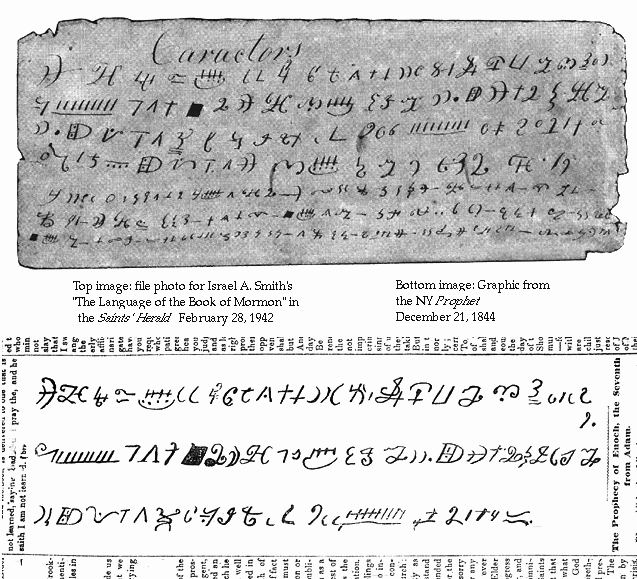
The characters that appeared in the newspaper are a handwritten reproduction of the first three lines of those which appear on the "Caractors Document." [4] But notice that the bottom image is turned on its side. The characters in the newspaper appear in vertical columns, as was described in the Anthon letter! Since this was the only reason I had for not believing the Caractors Document was one and the same as the Anthon Transcript, I was shocked by the discovery!
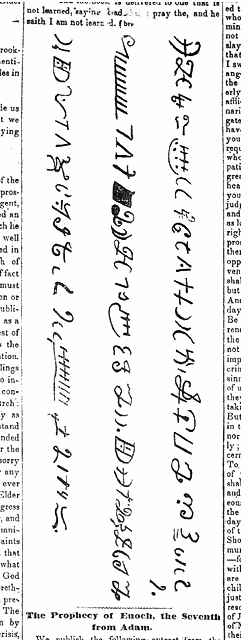 This discovery explains some things, and brings up more questions. First, Anthon's letter describes the characters as "crooked." He says that "Greek and Hebrew letters, crosses and flourishes, Roman letters inverted or placed sideways, were arranged in perpendicular columns." For example, we see letters similar to the Roman "H," "T," "V," "C," and "U," and if they were viewed in columns, they would appear to be "placed sideways." But the question might be raised: was the slip of paper we know as the "Caractors Document" written in columns, with the label "Caractors" written as an afterthought? Or had Martin Harris and Charles Anthon looking at the document turned the wrong way? Since Joseph was not there to instruct them, this is a possibility.
Here's something else to consider: an 1831 newspaper account reports that "Harris with several manuscripts in his pocket went to the city of New York and called upon one of the professors of Columbia College for the purpose of showing them to him..." [5] Some have speculated that a translation of the characters was one of these manuscripts. This is rather doubtful. Anthon's letters speak of only one paper. He is clear that Harris was coming to him to "decypher" the paper; and that no translation had been furnished. In the Mormon version of the story, there is no mention of a translation until many years later. Anthon did, however, mention that Harris had "a note from Dr. Mitchell of our city, now deceased, requesting me to decypher, if possible, a paper, which the farmer would hand me, and which Dr. M. confessed he had been unable to understand." So what were the several documents Harris had in his pocket? Do we have one of these documents today?
 Well, dear readers, I leave you with my impressions that the characters with which we are by now familiar were those viewed by Charles Anthon in 1828. Over the years, these characters have become well-known to members of the Church. In 1980 the Church came out with a gold-cover edition of the Book of Mormon which had the letters from the Caractors Document inscribed in black lettering. I had one in my possession until this last move. :( These characters and the story of the Anthon transcript fascinate us because, since we do not have the gold plates to handle and touch, they represent the most concrete and tangible evidence we have. Of course, a testimony of the Book of Mormon will never depend on evidence, but our mortal minds do appreciate what little there is.
_______________________________________________________
[1] Stanley B. Kimball, The Anthon Transcript: People, Primary Sources, and Problems, BYU Studies Vol. 10, No. 3, Pages 325-352 (Spring 1970).
[2] From a letter of Frederick M. Smith, May 9, 1941, to John A. Widtsoe as cited in Kirkham, A New Witness, Vol. 1, p. 176.
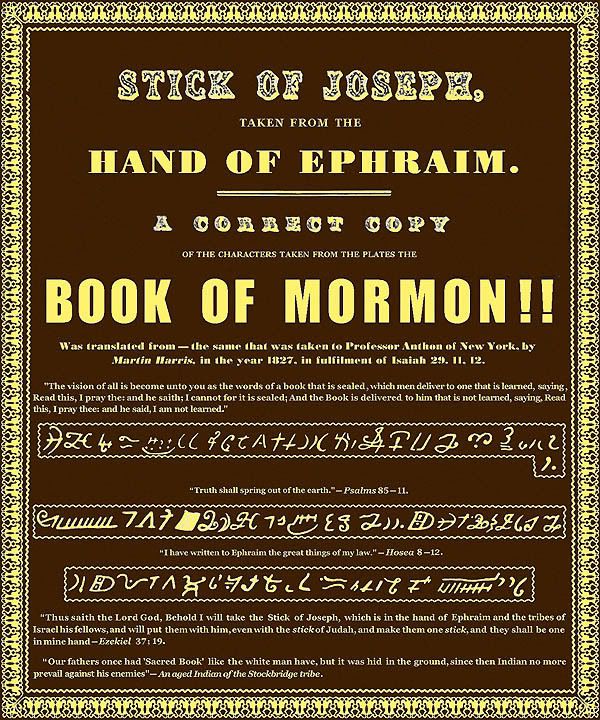 [3] BYU Studies, vol.20, no.4, p.325. Twice in late 1844, after the Prophet's martyrdom, portions of these symbols were published as characters that Joseph Smith had copied from the gold plates. Characters appeared in the December 21 issue of the Mormon newspaper The Prophet. Also, (right, click to enlarge) in 1844 the Latter-day Saints published a broadside with the title "Stick of Joseph" which contained these same characters copied from the plates.
 [4] Kimball, _The Anthon Transcript_, "On Saturday, December 21, Samuel Brannan, the presiding Elder of the branch in New York City and publisher and editor of a semi-official Church publication, The Prophet, published in this newspaper a three-line reproduction of the 'Anthon transcript.' With no introductory remarks or any indication of source, this illustration was printed under a headline reading, 'The Stick of Joseph taken from the hand of Ephraim.' He then added that. . . 'The following is a correct copy of the characters taken from the plates which the Book of Mormon was translated from: the same that was taken to Professor Mitchell, and afterwards to Professor Anthon of New York, by Martin Harris in the year 1827 [sic] in fulfillment of Isaiah 29: 11-12.' (The quotation was given in full.)"
[5] Canandaigua (New York) Morning Courier and Enquirer of September 1, 1831.
Thursday, March 27, 2008
Prophecy and Professor Anthon
Part 6 of a series on Martin Harris and the Anthon Transcript
(For the whole series, click here)
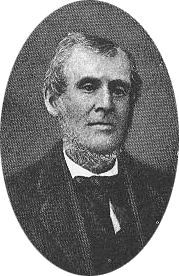
Anthon's and Harris' accounts changed over time. But there are certain undisputed historical facts from which we can form a coherent narrative. Joseph Smith copied some characters which he said he got from the gold plates onto a sheet of paper. Martin Harris took this and other materials back East to get the opinion of the classicists of the day. Professor Charles Anthon spoke with Martin Harris and gave him an opinion. Latter-day Saints believe this event fulfills the prophecy in Isaiah 29.
The disputed points are immaterial:
1. Were the characters Egyptian? The writings in the Book of Mormon were done in reformed Egyptian, and certainly changed even more during the many years in the New World before Mormon made his abridgement. [1]
2. Did Professor Charles Anthon possess the ability to recognize ancient Egyptian in 1828? It is unlikely that Anthon would have been able to actually translate ancient Egyptian texts. But he certainly had a familiarity with the hieroglyphics and possessed a reference book that would have contained Egyptian writings. However, being "reformed" and evolved, the characters did not necessarily have a recognizable correspondence with the Egyptian alphabets with which Anthon was familiar in 1828.
3. Did Anthon verify the characters in writing? A verification of the characters by Anthon was not necessary for the encounter to satisfy Biblical prophecy. In fact, if Anthon had been able to translate the characters in any way, it would have served to weaken the correlation between this story and the Isaiah prophecy that the learned man was unable to read the sealed book. A verification was only important to Martin Harris to satisfy him that he should contribute financially to the publication of the Book of Mormon. Apparently his interactions with the "learned men" were enough to convince him to do so.
Some Latter-day Saints have attempted to view the encounter with Anthon as a way to verify that the characters were of ancient origin. They would be better served to drop this approach and instead see the incident as did Orson Pratt: "...it was a sealed writing to the learned professor—the aboriginal language of ancient America could not be deciphered by him. He was as much puzzled as the wise men of Babylon were to interpret the unknown writing upon the wall. Human wisdom and learning, in this case, were altogether insufficient. It required another Daniel, who was found in the person of Mr. Smith." [2]
Although there are several questions in my mind as to whether the characters represent a form of ancient Egyptian, I can agree that the Anthon encounter fits well into Biblical prophecy:
And the vision of all is become unto you as the words of a book that is sealed, which men deliver to one that is learned, saying, Read this, I pray thee: and he saith, I cannot; for it is sealed: And the book is delivered to him that is not learned, saying, Read this, I pray thee: and he saith, I am not learned. Wherefore the Lord said, Forasmuch as this people draw near me with their mouth, and with their lips do honour me, but have removed their heart far from me, and their fear toward me is taught by the precept of men: Therefore, behold, I will proceed to do a marvellous work among this people, even a marvellous work and a wonder: for the wisdom of their wise men shall perish, and the understanding of their prudent men shall be hid.
Next: is the Caractors Document an accurate rendering of what appeared on the Gold Plates? What correlation does it have with the Anthon Transcript which Martin Harris took with him to show the learned men?
______________________________________________
[1] An interesting paper on this subject is _Reformed Egyptian: "In the Language of my Fathers"_ by Richard G. Grant.
[2] Orson Pratt, "Divine Authority, or the Question, Was Joseph Smith sent of God?" Doctrines of the Gospel (Salt Lake City: Juvenile Instructor Office, 1884), 9.
Wednesday, March 19, 2008
Letters From a Learned Man
Part 4 of a series on Martin Harris and the Anthon Transcript
(For the whole series, click here)
It seems like I've taken a long time just to say that Martin Harris was in possession of a copy of some of the characters from the Book of Mormon and that he consulted some of the leading candidates of the day who might have been able to authenticate them. Now the time has come to more fully examine Professor Anthon's account of Martin Harris' visit. Extant are two letters in which Charles Anthon replied to enquiries about his encounter with Harris. I will reproduce them in their entirety and then discuss what they reveal about Mormon history and scholarship.
1. This letter was written to Eber D. Howe, Editor of the Painesville Telegraph (1822–1835), author, and publisher of Mormonism Unvailed. On February 9, 1834 Howe wrote to Charles Anthon about Mormon claims that he had authenticated Book of Mormon characters. Anthon answered in a response dated Feb. 17, 1834:
New York, Feb. 17, 1834
Dear Sir -
I received this morning your favor of the 9th instant, and lose no time in making a reply. The whole story about my having pronounced the Mormonite inscription to be "reformed Egyptian hieroglyphics" is perfectly false. Some years ago, a plain, and apparently simple-hearted farmer, called upon me with a note from Dr. Mitchell of our city, now deceased, requesting me to decypher, if possible, a paper, which the farmer would hand me, and which Dr. M. confessed he had been unable to understand. Upon examining the paper in question, I soon came to the conclusion that it was all a trick, perhaps a hoax. When I asked the person, who brought it, how he obtained the writing, he gave me, as far as I can now recollect, the following account: A "gold book," consisting of a number of plates of gold, fastened together in the shape of a book by wires of the same metal, had been dug up in the northern part of the state of New York, and along with the book an enormous pair of "gold spectacles"! These spectacles were so large, that, if a person attempted to look through them, his two eyes would have to be turned towards one of the glasses merely, the spectacles in question being altogether too large for the breadth of the human face. Whoever examined the plates through the spectacles, was enabled not only to read them, but fully to understand their meaning. All this knowledge, however, was confined at that time to a young man, who had the trunk containing the book and spectacles in his sole possession. This young man was placed behind a curtain, in the garret of a farm house, and, being thus concealed from view, put on the spectacles occasionally, or rather, looked through one of the glasses, decyphered the characters in the book, and, having committed some of them to paper, handed copies from behind the curtain, to those who stood on the outside. Not a word, however, was said about the plates having been decyphered "by the gift of God." Every thing, in this way, was effected by the large pair of spectacles. The farmer added, that he had been requested to contribute a sum of money towards the publication of the "golden book," the contents of which would, as he had been assured, produce an entire change in the world and save it from ruin. So urgent had been these solicitations, that he intended selling his farm and handing over the amount received to those who wished to publish the plates. As a last precautionary step, however, he had resolved to come to New York, and obtain the opinion of the learned about the meaning of the paper which he brought with him, and which had been given him as a part of the contents of the book, although no translation had been furnished at the time by the young man with the spectacles. On hearing this odd story, I changed my opinion about the paper, and, instead of viewing it any longer as a hoax upon the learned, I began to regard it as part of a scheme to cheat the farmer of his money, and I communicated my suspicions to him, warning him to beware of rogues. He requested an opinion from me in writing, which of course I declined giving, and he then took his leave carrying the paper with him. This paper was in fact a singular scrawl. It consisted of all kinds of crooked characters disposed in columns, and had evidently been prepared by some person who had before him at the time a book containing various alphabets. Greek and Hebrew letters, crosses and flourishes, Roman letters inverted or placed sideways, were arranged in perpendicular columns, and the whole ended in a rude delineation of a circle divided into various compartments, decked with various strange marks, and evidently copied after the Mexican Calender given by Humboldt, but copied in such a way as not to betray the source whence it was derived. I am thus particular as to the contents of the paper, inasmuch as I have frequently conversed with my friends on the subject, since the Mormonite excitement began, and well remember that the paper contained any thing else but "Egyptian Hieroglyphics." Some time after, the same farmer paid me a second visit. He brought with him the golden book in print, and offered it to me for sale. I declined purchasing. He then asked permission to leave the book with me for examination. I declined receiving it, although his manner was strangely urgent. I adverted once more to the roguery which had been in my opinion practised upon him, and asked him what had become of the gold plates. He informed me that they were in a trunk with the large pair of spectacles. I advised him to go to a magistrate and have the trunk examined. He said the "curse of God" would come upon him should he do this. On my pressing him, however, to pursue the course which I had recommended, he told me that he would open the trunk, if I would take the "curse of God" upon myself. I replied that I would do so with the greatest willingness, and would incur every risk of that nature, provided I could only extricate him from the grasp of rogues. He then left me.
I have thus given you a full statement of all that I know respecting the origin of Mormonism, and must beg you, as a personal favor, to publish this letter immediately, should you find my name mentioned again by these wretched fanatics.
Yours respectfully, CHAS. ANTHON.
2. The second letter was in response to a letter from Reverend Dr. Thomas Winthrop Coit who was Rector of Trinity Church in New Rochelle, New York from 1839-1849. Having heard the Mormon claim that Anthon had actually validated Joseph Smith's "translation" of the Book of Mormon but had torn up the alleged affidavit before Harris could leave with it, Rev. Coit wrote to Anthon requesting a statement from him about his involvement in the affair. Anthon responded on April 3, 1841 with the following:
New York, April 3d, 1841.
Rev. and Dear Sir:
I have often heard that the Mormons claimed me for an auxiliary, but, as no one, until the present time, has ever requested from me a statement in writing, I have not deemed it worth while to say anything publicly on the subject. What I do know of the sect relates to some of the early movements; and as the facts may amuse you, while they will furnish a satisfactory answer to the charge of my being a Mormon proselyte, I proceed to lay them before you in detail.
Many years ago, the precise date I do not now recollect, a plain looking countryman called upon me with a letter from Dr. Samuel L. Mitchell requesting me to examine, and give my opinion upon, a certain paper, marked with various characters, which the Doctor confessed he could not decypher, and which the bearer of the note was very anxious to have explained. A very brief examination of the paper convinced me that it was a mere hoax, and a very clumsy one too. The characters were arranged in columns, like the Chinese mode of writing, and presented the most singular medley that I ever beheld. Greek, Hebrew and all sorts of letters, more or less distorted, either through unskilfulness or from actual design, were intermingled with sundry delineations of half moons, stars, and other natural objects, and the whole ended in a rude representation of the Mexican zodiac. The conclusion was irresistible, that some cunning fellow had prepared the paper in question for the purpose of imposing upon the countryman who brought it, and I told the man so without any hesitation. He then proceeded to give me the history of the whole affair, which convinced me that he had fallen into the hands of some sharper, while it left me in great astonishment at his simplicity.
The countryman told me that a gold book had been recently dug up in the western or northern part (I forget which), of our state, and he described this book as consisting of many gold plates, like leaves, secured by a gold wire passing through the edges of each, just as the leaves of a book are sewed together, and presented in this way the appearance of a volume. Each plate, according to him, was inscribed with unknown characters, and the paper which he handed me, a transcript of one of these pages. On my asking him by whom the copy was made, he gravely stated, that along with the golden book there had been dug up a very large pair of spectacles! so large in fact that if a man were to hold them in front of his face, his two eyes would merely look through one of the glasses, and the remaining part of the spectacles would project a considerable distance sideways! These spectacles possessed, it seems a very valuable property, of enabling any one who looked through them, (or rather through one of the lenses,) not only to decypher the characters on the plates, but also to comprehend their exact meaning, and be able to translate them!! My informant assured me that this curious property of the spectacles had been actually tested, and found to be true. A young man, it seems, had been placed in the garret of a farm-house, with a curtain before him, and having fastened the spectacles to his head, had read several pages in the golden book, and communicated their contents in writing to certain persons stationed on the outside of the curtain. He had also copied off one page of the book in the original character, which he had in like manner handed over to those who were separated from him by the curtain, and this copy was the paper which the countryman had brought with him. As the golden book was said to contain very great truths, and most important revelations of a religious nature, a strong desire had been expressed by several persons in the countryman's neighbourhood, to have the whole work translated and published. A proposition had accordingly been made to my informant, to sell his farm, and apply the proceeds to the printing of the golden book, and the golden plates were to be left with him as security until he should be reimbursed by the sale of the work. To convince him more clearly that there was no risk whatever in the matter, and that the work was actually what it claimed to be, he was told to take the paper, which purported to be a copy of one of the pages of the book, to the city of New York, and submit it to the learned in that quarter, who would soon dispel all his doubts, and satisfy him as to the perfect safety of the investment. As Dr. Mitchell was our "Magnus Apollo" in those days, the man called first upon him; but the Doctor, evidently suspecting some trick, declined giving any opinion about the matter, and sent the countryman down to the college, to see, in all probability what the "learned pundits" in that place would make of the affair. On my telling the bearer of the paper that an attempt had been made to impose on him and defraud him of his property, he requested me to give him my opinion in writing about the paper which he had shown to me. I did so without hesitation, partly for the man's sake, and partly to let the individual "behind the curtain" see that his trick was discovered. The import of what I wrote was, as far as I can now recollect, simply this, that the marks in the paper appeared to be merely an imitation of various alphabetical characters, and had, in my opinion, no meaning at all connected with them. The countryman then took his leave, with many thanks, and with the express declaration that he would in no shape part with his farm, or embark in the speculation of printing the golden book.
The matter rested here for a considerable time, until one day, when I had ceased entirely to think of the countryman and his paper, this same individual, to my great surprise, paid me a second visit. He now brought with him a duodecimo volume, which he said was a translation into English of the "Golden Bible." He also stated, that notwithstanding his original determination not to sell his farm, he had been induced evidently to do so, and apply the money to the publication of the book, and had received the golden plates as a security for payment. He begged my acceptance of the volume, assuring me that it would be found extremely interesting, and that it was already "making great noise" in the upper part of the state. Suspecting now that some serious trick was on foot, and that my plain looking visitor might be in fact a very cunning fellow I declined his present, and merely contented myself with a slight examination of the volume while he stood by. The more I declined receiving it, however, the more urgent the man became in offering the book, until at last I told him plainly, that if he left the volume, as he said he intended to do, I should most assuredly throw it after him as he departed. I then asked him how he could be so foolish as to sell his farm and engage in this affair; and requested him to tell me if the plates were really of gold. In answer to this latter inquiry, he said, that he had never seen the plates themselves, which were carefully locked up in a trunk, but that he had the trunk in his possession. I advised him by all means to open the trunk and examine its contents, and if the plates proved to be of gold, which I did not believe at all, to sell them immediately. His reply was, that. if he opened the trunk, the "curse of heaven would descend upon him and his children.' "However," added he, "I will agree to open it, provided you take the 'curse of Heaven' upon yourself, for having advised me to the step." I told him I was perfectly willing to do so, and begged he would hasten home and examine the trunk, for he would find that he had been cheated. He promised to do as I recommended, and left me, taking his book with him. I have never seen him since.
Such is a plain statement of all I know respecting the Mormons. My impression now is, that the plain looking countryman was none other than the prophet Smith himself, who assumed an appearance of great simplicity in order to entrap me, if possible, into some recommendation of his book. That the prophet aided me by his inspiration, in interpreting the volume, is only one of the many amusing falsehoods which the Mormonites utter relative to my participation in their doctrines. Of these doctrines I know nothing whatever, nor have I ever heard a single discourse from any of their preachers, although I have often felt a strong curiosity to become an auditor, since my friends tell me that they frequently name me in their sermons, and even go so far as to say that I am alluded to in the prophecies of Scripture!
If what I have here written shall prove of any service in opening the eyes of some of their deluded followers to the real designs of those who profess to be the apostles of Mormonism, it will afford me satisfaction equalled, I have no doubt, only by that which you yourself will feel on this subject.
I remain, very respectfully and truly, your friend,
CHAS. ANTHON.
These two letters are rich with information about early Church history. The tidbit which fascinates me the most is Anthon's description of the translation process, as explained to him by Martin Harris. It adds more to our understanding of how Joseph Smith's contemporaries perceived the translating was done. W.W. Phelps explained that the translation was done "through the aid of a pair of Interpreters, or spectacles — (known perhaps, in ancient days as Teraphim, or Urim and Thummim) ..." [1] Some have disagreed with Phelps' speculation and supposed that the "Urim and Thummim" referred to the Seer Stone that Joseph later used in the translation process. [2] But Anthon's letter makes it clear that in 1828 Harris was describing the means of translating the Book of Mormon as a large pair of spectacles. David Whitmer explained that the "Interpreters" (spectacles) were taken from Joseph as a punishment after he and Martin Harris lost the 116 pages of manuscript of the Book of Mormon. Later Joseph was allowed to recommence the translation using a Seer stone. [3] Accounts of the translation done with the use of the Seer stone abound. Isaac Hale explained that the translation was done by use of the Seer Stone without the physical presence of the plates. Joseph placed his seer stone in a hat and the translation would appear. [4] Emma Smith's description of the process agrees with her father's, saying that Joseph translated with his face buried in a hat. [5] David Whitmer's account adds detail to this idea, explaining how the characters appeared one at a time. [6]
Anthon's letters thus help to clarify how the translation of the Book of Mormon was done. The 116 manuscript pages were translated using a large pair of spectacles. The portion of the plates which comprises our Book of Mormon was translated by the use of a Seer Stone. Since the various accounts call both the spectacles and the Seer Stone(s) by the words "Interpreters" and "Urim and Thummim," [7] I would speculate that these two terms might loosely be used to refer to any divine instrument of translation.
I will leave you now with this one interesting example of how the Anthon letters contribute to our understanding of Mormonism. Perhaps my readers may wish to add comments with other insights from the above letters.
To be continued....
____________________________________________________
[1] W.W. Phelps, Evening and Morning Star, vol. 1, no. 8, (Independence, Missouri, January 1833) p. 2.
[2] This confusion has resulted from the accounts of some of the early Saints which concatenate the Urim and Thummim, the Interpreters, and the seer stone. For example, Oliver Cowdery, who joined in the translation effort in the winter of 1828 exults: "These were days never to be forgotten — to sit under the sound of a voice dictated by the inspiration of heaven, awakened the utmost gratitude of this bosom! Day after day I continued, uninterrupted, to write from his mouth, as he translated, with the Urim and Thummim, or, as the Nephites would have said, 'Interpreters,' the history, or record, called 'The book of Mormon." (Oliver Cowdery, Messenger and Advocate, (Kirtland, Ohio, 1834), vol. 1, no. 1, p.14.)
[3] In an 1885 interview, Zenas H. Gurley, then the editor of the RLDS Saints’ Herald, asked David Whitmer if Joseph had used his "Peep stone" to do the translation. Whitmer replied: "... he used a stone called a 'Seers stone,' the 'Interpreters' having been taken away from him because of transgression. The 'Interpreters' were taken from Joseph after he allowed Martin Harris to carry away the 116 pages of Ms [manuscript] of the Book of Mormon as a punishment, but he was allowed to go on and translate by use of a 'Seers stone' which he had, and which he placed in a hat into which he buried his face, stating to me and others that the original character appeared upon parchment and under it the translation in English." (Elder Z.H. Gurley holograph in LDS Church archives, cited by Richard S. Van Wagoner in "Joseph Smith: The Gift of Seeing," Dialogue: A Journal of Mormon Thought, 15:2 (Summer 1982), p. 54.)
[4] ""The manner in which he pretended to read and interpret, was the same as when he looked for the money-diggers, with a stone in his hat, and his hat over his face, while the Book of Plates were at the same time hid in the woods." (Affidavit of Isaac Hale dated March 20, 1834, cited in Rodger I. Anderson, Joseph Smith’s New York Reputation Reexamined, (Salt Lake City: Signature Books, 1990), pp. 126-128.)
[5] "In writing for your father I frequently wrote day after day, often sitting at the table close by him, he sitting with his face buried in his hat, with the stone in it, and dictating hour after hour with nothing between us." (History of the RLDS Church, 8 vols., Independence, Missouri: Herald House, 1951, "Last Testimony of Sister Emma," 3:356.)
[6] "Joseph Smith would put the seer stone into a hat, and put his face in the hat, drawing it closely around his face to exclude the light; and in the darkness the spiritual light would shine. A piece of something resembling parchment would appear, and on that appeared the writing. One character at a time would appear, and under it was the interpretation in English. Brother Joseph would read off the English to Oliver Cowdery, who was his principal scribe, and when it was written down and repeated to Brother Joseph to see if it was correct, then it would disappear, and another character with the interpretation would appear." (David Whitmer, An Address to All Believers in Christ, Richmond, Missouri: n.p., 1887, p. 12.)
[7] In 1823 Joseph Smith equated the Urim and Thummim with the spectacles: "...there were two stones in silver bows—and these stones, fastened to a breastplate, constituted what is called the Urim and Thummim--deposited with the plates; and the possession and use of these stones were what constituted “seers” in ancient or former times; and that God had prepared them for the purpose of translating the book." (JS-H 1:35) By 1835 the term "Urim and Thummim" was added to the revelation published as D&C 10 (verse 1), and thereafter, was used to refer to both the Nephite interpreters and the seer stone(s) by Joseph Smith and numerous other people. Joseph Knight, Sr., an early member of the Church and a close friend of Joseph Smith, equates the Urim and Thummim with the Seer stone: "Now the way he translated was he put the urim and thummim into his hat and darkened his eyes then he would take a sentance and it would appear in brite roman letters then he would tell the writer and he would write it then that would go away the next sentence would come and so on. But if it was not spelt rite it would not go away till it was rite, so we see it was marvelous. Thus was the hol [whole] translated." (Cited in Dean Jessee, "Joseph Knight's Recollection of Early Mormon History," BYU Studies, vol. 17:1 (Autumn 1976), p. 35.)
Tuesday, March 18, 2008
Assessing the Alphabets
Part 3 of a series on Martin Harris and the Anthon Transcript
(For the whole series, click here)
Before I get to my next post, I'll take some time to respond to John F. and Sanford's questions on my last one. Keep in mind that I am completely out of my depth here, and feel free to correct or add to my thoughts.
In the Martin Harris account of his visit to Professor Anthon that we have in the JS-H, he asserts that Anthon verified the letters as true characters from the "Egyptian, Chaldaic, Assyriac, and Arabic" languages. Historians have shown that Anthon had at least a rudimentary knowledge of these languages, enough to recognize the alphabets when he saw them. Let us assume that Martin Harris was correctly recalling the languages mentioned by Anthon. We should be able to see some correlations with these ancient alphabets and the JS characters. Below I will post some charts of the alphabets, so we can compare them with the "Caractors Document."
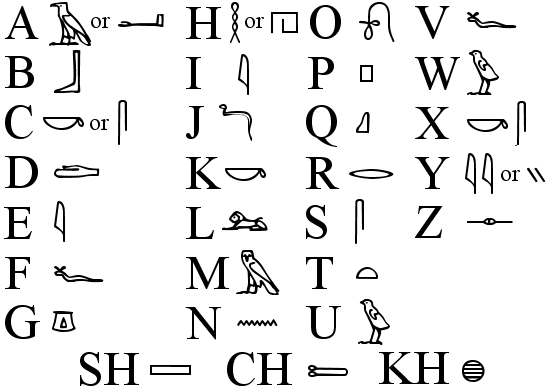


Ancient Assyrian (Akkadian) differs somewhat from modern Assyrian (Neo-Syrian). Akkadian was in use until about 750 BC, and was gradually replaced when writing began to be done on parchment, leather and papyrus rather than clay tablets. Aramaic gradually replaced the Ancient Assyrian because of the technological breakthrough in writing. It is sometimes assumed that Martin Harris meant to say "Aramaic" rather than "Arabic" in his report of Anthon's words because the Arabic language did not come into usage until after Lehi's group left for the New World, and would not have been represented on the plates. Arabic is descended from Aramaic and first appeared about 512 AD.
Now, here again is the "Caractors Document:"
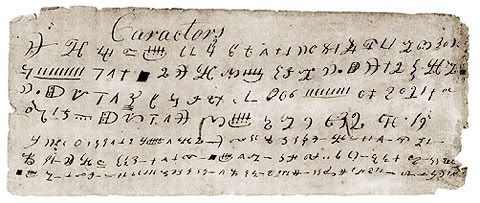
Do you see any correlations here? I don't. It's especially disappointing to see the lack of similarity to Egyptian. In his 1834 letter to E.B. Howe, Anthon denied that the characters he saw included Egyptian, but rather wrote that he saw "Greek and Hebrew letters, crosses and flourishes, Roman letters inverted or placed sideways..." Doesn't this seem more descriptive of the characters to you?? (See especially Greek letters alpha, eta, lambda, tau, and upsilon.)
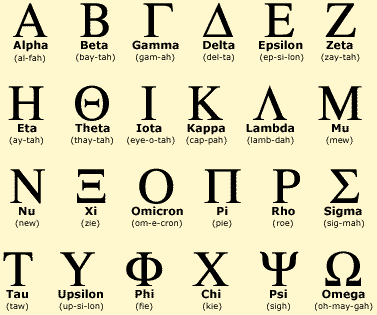
This post is intended to be a simplistic view of the alphabets as discussed by the major players in the Anthon drama. Other authors have gone into further depth on the relation of the characters to different scripts. [1] I do indeed have a working theory as to how the assertions of Martin Harris came about, but there are a few more points to cover before I get into my conclusions.
______________________________________________________________
[1] Here are only a few samples the many which are available on line.
Apologetic Sources:
Ariel L. Crowley, The Anthon Transcript: A Series of Articles in
The Improvement Era, Jan. - Mar., 1942.
Russell Littlecreek, Evidence for Reformed Egyptian. This is really cool. Click on the letters in the "Caractors Document" and you are taken to a possible corresponding Egyptian Hieratic or Hieroglyph. (Keep in mind as you do this that Professor Anthon would not have had complete knowledge of all these characters.)
John Gee, Some Notes on the Anthon Transcript:Review of Stan and Polly Johnson. Translating the Anthon Transcript.
Stanley B. Kimball, A Visit With Dr. Hayes, Sunstone, July 2002, pp. 12-13
Critical Sources:
Richard Stout, A Singular Discovery: The Curious Manuscript, Mitchill, and Mormonism. (scroll down and read about the close resemblance between the "Caractors" and Tironian notes!)
Sunday, March 16, 2008
Sigils From a Sealed Book
Part 1 of a series on Martin Harris and the Anthon Transcript
(For the whole series, click here)
This week in SS we discussed 2 Nephi 27 (Isaiah 29) where a book comes forth from the dust and is presented to a learned man who cannot read it. The book is then delivered to one who is not learned. The teacher made the usual parallel in Church history when Martin Harris takes characters from the Gold Plates to learned professor Charles Anthon of Columbia University. As Martin Harris tells the story, Anthon first gives him a certificate of authenticity, verifying that the translation is correct, and that the characters are true representatives of Egyptian, Chaldaic, Assyriac, and Arabic writing. (JS-H 1:64-65)
As always when this story is discussed, I wondered idly what qualifications Professor Anthon had that qualified him to make these statements, and why he seemed so sure of the translation when the study of the ancient Egyptian language was in its infancy in 1828.
In response, I've written a post which is quite long, so I'll break it up into sections and post it over the rest of the week. Many of you may be familiar with these facts, since they are available on the net, but I'd like to discuss them and see what people think. Let's start with the Anthon transcript itself.
The Anthon Transcript was a sheet of paper upon which Joseph Smith copied sample "reformed Egyptian" characters from the plates of the Book of Mormon. In the winter of 1828, Martin Harris showed these characters, along with a translation, to at least three scholars in the eastern United States, including Dr. Samuel L. Mitchell, described as a "Magnus Apollo" because of his extensive and broad learning; and Charles Anthon, an acclaimed classicist and lover of antiquities at Columbia College. No one knows what happened to the sheet of paper Martin Harris had in his possession. (Perhaps it is now languishing somewhere along with the 116 lost manuscript pages! :) ) We do have several clues which help us learn more about the Anthon Transcript.
First, Charles Anthon wrote at least two letters describing Martin Harris' visit. I will discuss these letters in their entirety in a forthcoming post. However, in both of these letters Anthon included a description of the paper which was shown him:
"This paper was in fact a singular scrawl. It consisted of all kinds of crooked characters disposed in columns, and had evidently been prepared by some person who had before him at the time a book containing various alphabets. Greek and Hebrew letters, crosses and flourishes, Roman letters inverted or placed sideways, were arranged in perpendicular columns, and the whole ended in a rude delineation of a circle divided into various compartments, decked with various strange marks, and evidently copied after the Mexican Calender given by Humboldt, but copied in such a way as not to betray the source whence it was derived." [1]
"The characters were arranged in columns, like the Chinese mode of writing, and presented the most singular medley that I ever beheld. Greek, Hebrew and all sorts of letters, more or less distorted, either through unskilfulness or from actual design, were intermingled with sundry delineations of half moons, stars, and other natural objects, and the whole ended in a rude representation of the Mexican zodiac." [2]
As I read these narratives, I was taken by the description of the Mexican-looking "circle divided into various compartments."
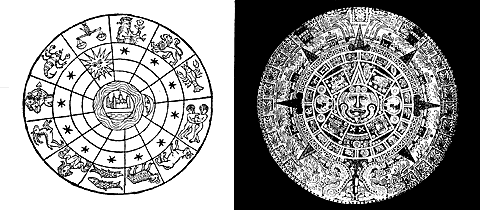 Pictured at left are a pictorial horoscope chart and a Mexican calendar stone. A Mexican calendar stone was rediscovered in 1791 and Anthon, with his fascination for antiquities, would surely have been familiar with it. But to me the description seems reminiscent of the hypocephalus which Joseph Smith would later obtain from Michael Chandler and include as Facsimile #2 in the Pearl of Great Price Book of Abraham. However, Chandler did not obtain his mummies until 1833, and did not bring them to Kirtland until 1835. Actual historical events and coincidences of this period seem so fantastic that Joseph's metaphysical claims almost pale in comparison.
The Community of Christ possesses a handwritten text which is known as the "Caractors Document." This fragment contains seven horizontal lines of characters apparently copied from the plates, as seen in the image below:
The characters are written on a piece of paper measuring 8 by 3¼ inches. The paper appears to be of the same quality and appearance as that on which the manuscript of the Book of Mormon was written. David Whitmer, who once owned the document, claimed that it was this text that Martin Harris showed to Charles Anthon. [3] But the Caractors Document in no way corresponds with Anthon's description. The characters are not arranged in vertical columns, and there are no images of moons or stars. Neither is there evidence of a circular figure.
Though this document is not the original, it almost certainly represents characters either copied from the plates in Joseph Smith's possession or copied from the document carried by Harris. Twice in late 1844, after the Prophet's martyrdom, portions of these symbols were again published as characters that Joseph Smith had copied from the gold plates. Characters appeared in the December 21 issue of the Mormon newspaper The Prophet. Also, in 1844 the Latter-day Saints published a broadside with the title "Stick of Joseph" which contained supposed characters copied from the plates. [4] These are somewhat different from the Anthon transcript. We don't know who prepared this 1844 sheet.Considering that we have this sample of the "Reformed Egyptian" characters, I would think that Mormon linguists would be interested in attempting to translate them and match them with the corresponding Book of Mormon text. And indeed I found a few attempts to do this by several authors. Back in 1942 Ariel Crowley, an LDS attorney from Boise, presented evidence that the characters might be of Egyptian origin. He discussed Chaldaic, Assyriac, and Arabic in relation to hieratic and demotic Egyptian, and Martin Harris's report that Anthon mentioned those languages when he reviewed the transcript. He also presented 194 pairs of photographs comparing characters from the Anthon Transcript with similar or identical characters in recognized Egyptian works such as the Book of the Dead and the Rosetta Stone. [5]
In 1970 Carl Hugh Jones published another serious study of the characters. [6] Jones identified more than 224 characters from the various available sources, and assigned reference numbers to each. Though he felt linguistically unprepared to do so himself, he felt that he had found evidence for an alphabet of between 20 and 32 letters and was confident that a translation could be made. Jones also did some work matching certain of the characters with various Oriental and Mexican scripts.
Community of Christ adherent Blair Bryant claims to have found correlation between the Caractors document and the Book of Mormon title page. [7]
Lastly, Stan and Polly Johnson argue that the Anthon transcript corresponds to Ether 6:3–13 in the present Book of Mormon. [8]
Apologist John Gee is more pessimistic about the possibility of translation of the characters. He postulates that the characters came from the text Joseph was then translating--the 116 missing manuscript pages. Additionally Gee feels that the sample of letters is not large enough to render decipherment feasible. [9] Even so, I would be interested to see a comparison of the claims of Martin Harris with those of Charles Anthon. Harris says that Anthon identified Egyptian, Chaldaic, Assyriac, and Arabic figures in the sample that was given him. Anthon writes that he saw recognizable though deformed Greek, Hebrew, and Roman letters. Can we tell, by a study of the Caractor Document, which of these languages are represented?
In this age of computer assisted research, I am baffled as to why cryptographic studies have not yielded results in this area. Unfortunately, to date no Mormon "Robert Langdon" has cracked the code of the Anthon Transcript. Do my readers still think the characters are in fact authentic? Do Latter-day Saints retain faith that translation might one day be done?
In 1980 a document surfaced which more closely resembled Anthon's specifications and appeared to be the original Anthon Transcript. But in 1987, Mark W. Hofmann admitted that he had forged it. The forgery certainly fits the picture I have in my mind of the Anthon transcript! But what does it say about the state of our linguistic study of the characters that Latter-day Saints were so easily fooled?

___________________________________________
[1] letter written by Charles Anthon to Eber D. Howe dated Feb. 17, 1834. Originally published in Eber D. Howe, _Mormonism Unvailed_, 1834, chapter xviii. The letter appears in full in B. H. Roberts, _A Comprehensive History of the Church, Century One_ (Brigham Young University Press, Provo, UT: 1965), pp. 102-104.
[2] letter written by Charles Anthon to Rev. T. W. Coit dated April 3, 1841. Originally published in Rev. T. W. Coit, _Gleanings By The Way_, 1841. The letter appears in full in Roberts, _CHC_, pp. 104-107.
[3] A photograph of the characters was published in a 1908 history of the Reorganized LDS Church. Twenty-two years later LDS historian B. H. Roberts published a new photograph of the same document in his Comprehensive History of the Church. There is little question that this transcript was at least part of the material presented to Anthon to display characters copied from the gold plates.
[4] BYU Studies, vol.20, no.4, p.325
[5] Improvement Era, Feb 1942
[6] “The ‘Anthon Transcript’ and Two Mesoamerican Cylinder Seals, Newsletter and Proceedings of the Society for Early Historical Archaeology 122 (Sept. 1970): 1–8. An online FARMS article New Light: "Anthon Transcript" Writing Found? mentions the study and laments, "Issues that Jones raised remain today a challenge not yet taken up by scholars."
[7] See Blair Bryant's Caractors Translation.
[8] Stan and Polly Johnson, _Translating the Anthon Transcript_ (Parowan, Utah: Ivory Books, 1999)
[9] Some Notes on the Anthon Transcript by John Gee
*
Sunday, March 9, 2008
His Hand is Stretched Out Still--Musings on Doctrine, Apostasy, and Gay Marriage
For all this his anger is not turned away, but his hand is stretched out still.
When you read the words of the prophet Isaiah that [the Lord's] hand is stretched out still, does it give you comfort, or does it cause you to tremble?
The phrase is a picturesque one, occurring four times in Isaiah chapters 9 and 10 (9:12, 17, 21; 10:4). These chapters are included in the Isaiah passages found in the Book of Mormon. The refrain has been interpreted in two different ways in biblical exegesis.
The Lord's Arm Stretched Out in Mercy
In the consensus of LDS thought, it is explained that although the House of Israel has sinned and the Lord's anger is not turned away, yet his hand is stretched out to forgive and redeem his people. A footnote to Isaiah 9:12 clarifies the phrase as follows: "In spite of it all, the LORD is available if they will turn to him," and refers the reader to the Topical Guide heading "God, Access to."
In his Oct 2006 Conference address "Prophets in the Land Again," Jeffrey R. Holland reflected this interpretation of the phrase when he stated,

To all of you who think you are lost or without hope, or who think you have done too much that was too wrong for too long, to every one of you who worry that you are stranded somewhere on the wintry plains of life and have wrecked your handcart in the process, this conference calls out Jehovah’s unrelenting refrain, “[My] hand is stretched out still.” ...His is the pure love of Christ, the charity that never faileth, that compassion which endures even when all other strength disappears. I testify of this reaching, rescuing, merciful Jesus, that this is His redeeming Church based on His redeeming love..."
LDS audiences are most familiar with this interpretation of Isaiah's poetic chorus. After watching BYU Broadcasting "Insight into Isaiah," Kelly Miller wrote her own verses on the subject. Part of Kelly's poem reads:
As He extends mercy and assurance
His softly flowing waters fill,
Ever offering hope and guidance.
Where e'er we turn, His hand is stretched out still.
The Lord's Arm Stretched Out in Judgment
Little do most Mormons realize there is another way of looking at this familiar phrase. Note the context in Nephi's quotation of Isaiah 5:
Therefore, is the anger of the Lord kindled against his people, and he hath stretched forth his hand against them, and hath smitten them; and the hills did tremble, and their carcasses were torn in the midst of the streets. For all this his anger is not turned away, but his hand is stretched out still. (2 Nephi 15:25)
In this interpretation the Lord's hand is stretched out in judgment against a rebellious nation. Moeller's commentary on Isaiah 9 reads:
Here God declares himself as the one who is bringing these calamities. The reason: because the punishments have not turned the people to him. Since they continue in their abandonment of the source of their help he will allow further calamities to overtake them. ...There was more to come from the hand of a wrathful God. This series will only end with the complete destruction of the northern kingdom of Israel and their extinction as a political entity.
As I've read the details of the Danzig case, I can only repeat Isaiah's words, over and over, in my mind. I've been reflecting upon these verses as compared to the Church's reactions toward perceived "apostasy" by its members. The hierarchy seems to see itself as the outstretched hand of the Lord, always there with mercy to welcome back the repentant sinner. Yet, members who struggle with reconciling their consciences with Church policies are recipients of the harsher treatment of the refrain. To these, the Church's hand continues to stretch forth in judgment and punishment rather than mercy and healing.
What I have seen of these very public cases over the years are members who sincerely believe in the Church yet struggle with ambiguity. I relate to the Danzig's dilemma since I was present in California when the Church became involved in helping to pass Proposition 22. As members, we were asked to participate in making phone calls supporting the initiative, and to place signs in our front yards. Much pressure was placed upon members in this effort. A few years later, having moved to Texas, a similar situation presented itself. This time, members of the ward sat through a fifth-Sunday combined PH/RS meeting where the position of the Church regarding gay marriage was delineated and members were pressed to spend time and money in passing the legislature. I am strongly in favor of the Church's official position on political neutrality, and believe that on the gay marriage issue this position is being strongly violated.
In an LDS press release, Church representatives stated,
"In his Tribune letter-to-the-editor, Mr. Danzig said he 'was troubled that my church requested I violate my own conscience to write in support of an amendment I feel is contrary to the constitution and to the gospel of Christ.' In reality Church leaders had asked members to write to their senators with their personal views regarding the federal amendment opposing same gender marriage, and did not request support or opposition to the amendment."This may be the official position of the Church, but it has not been the case in my personal experience, either.
The release also contained this: "Church leaders are always saddened when an individual, whether through his or her actions or personal choices, decides to leave the Church. A welcoming hand of fellowship is always extended to those who wish to return at anytime."
For all this his anger is not turned away, but his hand is stretched out still.
UPDATE!! Come join an interesting discussion on these issues at George's blog Periginatioanimae!
Friday, March 7, 2008
The Doctrine of Elias, Elijah, and Christ
My stats for the past few days show that there is not a whole lot of interest in the subject of Elias! But I'm still into it, so here I go again.
My eye was drawn to the subheading on page 85 of the JS manual, which reads, A person who has the spirit of Elias has a preparatory work assigned to him by the Lord. Now, we Mormons often apply the title "Elias" to John the Baptist, as is done here in the manual. And Joseph Smith taught that his own ordination under the hand of John the Baptist constituted the Spirit of Elias. But we don't generally apply this title to anyone else. This subheading in the manual suggests that anyone who undertakes a preparatory work in a gospel context has the Spirit of Elias. I wondered if these words were really representative of what Joseph was teaching. So I went to the full text of Joseph Smith's March 10, 1844 discourse, which can be found here. The sermon was delivered on the Nauvoo temple grounds and was reported in several different sources: the Wilford Woodruff journal, James Burgess notebook, Franklin D. Richards "Scriptural Items," Joseph Smith diary (Willard Richards), Thomas Bullock diary and the John S. Fullmer papers. The version in the JS manual comes from Wilford Woodruff, who recorded it in the greatest detail.
The subject of Joseph's talk was to show the differences between the work, spirit, and calling of Elias, Elijah, and Messiah. Joseph describes the spirit of Elias as being a preparatory work, and gives the example of John the Baptist. The Baptist's mission was a true representation of the spirit of Elias, because it was a "going before" of another important work. [1]
After perusing the discourse, I decided that the manual was justified in giving the doctrine of Elias a wider application than I had previously supposed. Joseph said that "it was called the doctrin of Elias even from the early ages of the world" and applied to Aaron, John, Philip, and others. Joseph also told his audience that it is necessary to know who holds the keys of power and who does not, or we are likely to be deceived. A scriptural example is given wherein Joseph gives a unique exegesis of Acts 19:
Paul when he came to Corinth found certain disciples and asked them if they had received the holy ghost since they bleived, and they said we have not so much as heard of the holy ghost and with what surprise says he unto them. unto what were you babtised and they said unto Johns baptism. not so not so my friends if you had you would have heard of the holy ghost but you have been duped by some designing knave who has come in the name of John an imposture. how do you know it Paul? why John verilly babtised with water unto repentance, always telling the people that they should beleive on him that should come after him. he would babtise with fire and with the holy ghost.
Thus those who were doing a preparatory work would not transcend their bounds and would clearly point the way toward the greater work they were sent to advance. Joseph felt that it was important for his audience to know how to distinguish who had the Priesthood of Elias, for "when any man comes among you saying I have the spirit of Elias you can know whether he be true or fals." It sounds as if Joseph was expecting many men to come along claiming the Spirit of Elias!
Perhaps we as a Latter-day Church should be exhibiting more of the spirit of the Elias than we presently realize.
Not included in the manual, but vital to understanding the doctrine of Elias are the spirit, power, and calling of Elijah and Messiah, which Joseph next expounds:
...the spirit power & calling of Elijah is that ye have power to hold the keys of the revelations ordinances, oricles powers & endowments of the fulness of the Melchezedek Priesthood & of the Kingdom of God on the Earth & to receive, obtain & perform all the ordinances belonging to the Kingdom of God even unto the sealing of the hearts of the hearts fathers unto the children & the hearts of the children unto the fathers...
Joseph told his LDS listeners that they were to use the power of Elijah to redeem their dead and to connect themselves with their fathers. The sealing power was used a bit differently in the early days of the Church to form connections between priesthood holders. In this discourse, we can see Joseph's understanding of this sealing power. He tells the brethren to have their sons and daughters sealed to them first, and then seal themselves to their fathers. They should be "crafty" and seal all they can on earth, and these sealings would be in force in the heavens.[2] In this way, the Spirit of Elijah is used to make their calling and election sure.
(In his sermon, Joseph also makes it clear that the power of Elijah may be used by a righteous priesthood holder to seal his enemies or the unrighteous up to the damnation of Hell!)
Finally, the doctrine of Messiah was mentioned. Elias would prepare the way, Elijah would build up the kingdom, and then Messiah would come to his temple. "The Spirit of Messiah is all power in Heaven and in Earth--" Joseph said--"Enthroned in the Heavens as King of Kings and Lord of Lords." Then he ended his sermon with a promise to treat upon the Spirit of Messiah at some future time.
It seems to me that Joseph's purpose in preaching the doctrine of Elias, Elijah, and Messiah was to show his people how to participate themselves in the spirit and calling of the work. I think that a teacher who is well-versed in the teachings of Joseph on this subject might rightly emphasize the spirit of Elias as it relates not only to John the Baptist and to Joseph Smith, but to individual priesthood holders in the classroom.
Now, I'd like to address my final thoughts to how this relates to women, since 50% of those who will hear this lesson in the coming weeks will be female. Joseph had an audience consisting of many women, yet he seemed to address his remarks mainly to Priesthood holders. I often wonder how much he intended to include women in this group, since he may have considered temple-endowed women who were married to priesthood holders as participants in that priesthood. [3] Be that as it may, the discussion on pages 86 and 87 of the manual quite glaringly leaves women out of any direct involvement in the administration of the Gospel and the spirit of Elias. However, perhaps there is precedent for inclusion. Often, when we speak of the spirit of Elijah, we refer to genealogy and temple work and encourage women to be earnestly involved in this work. In the same manner, might we not sanction the participation of females in the work of Elias? Women can effectively prepare the way for the coming of the Messiah in much of their family and Church service.
_____________________________________________
[1] As an aside, Woodruff quotes Joseph saying, "John the Baptist he Came balling through the wilderness prepare ye the way of the Lord." The Burgess version recounts, "he came bounding out of the wilderness saying repent ye for the kingdom of heaven is come unto you." I think it is possible that Joseph was using the word, "bawling." The quote as it appears cleaned up in our manual is, "He came crying through the wilderness, 'Prepare ye the way of the Lord...'"
[2] This advice led to the practice of the law of adoption, whereby a man could have any number of men adopted to himself as his sons for eternity. For example, in June, 1896, Wilford Woodruff gave a synopsis of his work in the ministry since 1834: "I officiated in Adopting 96 Men to Men." (Wilford Woodruff's Journal, 1833-1898, typescript, edited by Scott G. Kenney, 1985, Vol. 9, page 408) In another synopsis for the years 1834-1885, he revealed: "I had 45 Persons Adopted to me." (Ibid., Vol. 8, page 352) Utah historian Hubert Howe Bancroft gave this information about the law of adoption: "The father may be either younger or older than the son, but in any case assumes the character of guardian, with full control of the labor and estate of the adopted son. Many young men give themselves over to the leaders as 'eternal sons,' in the hope of sharing the honor of their adopted parents." (History of Utah, page 361)
[3] For example, Joseph Smith to the Relief Society on 28 Apr 1842 “gave a lecture on the priesthood shewing how the Sisters would come in possession of the privileges & blessings & gifts of the priesthood & that these signs should follow them, such as healing the sick, casting out devils &c. & that they might attain unto these blessings….” (Book of the Law of the Lord, (Joseph Smith’s journal) 28 April 1842; also in Dean Jesse, ed “The Papers of Joseph Smith, Vol 2, 378-79.)
Also: “…What was the power of Melchizedek? ‘Twas not the Priesthood of Aaron which administers in outward ordinances, and the offering of sacrifices. Those holding the fulness of the Melchizedek Priesthood are kings and priests (or “Queens and Priestesses“) of the Most High God, holding the keys of power and blessings.” (Joseph Smith, TPJS, 322)
*
Wednesday, March 5, 2008
Elias in the JS Manual #6
A perusal of upcoming Lesson #6 in the Joseph Smith manual had me revisiting my notes on Elias. Thus far LDS thought has identified 4 uses of "Elias," but even with these many explanations, there are many holes and questions left in our understanding of this doctrine.
First, a review of the meanings of "Elias:"
Elias the Greek form of Elijah
Elias in the NT is simply the Greek form of the OT Hebrew name Elijah, meaning "YHWH is my God." When אליהו (Elijah) is transliterated into Greek it becomes Ἠλίας (Elias).
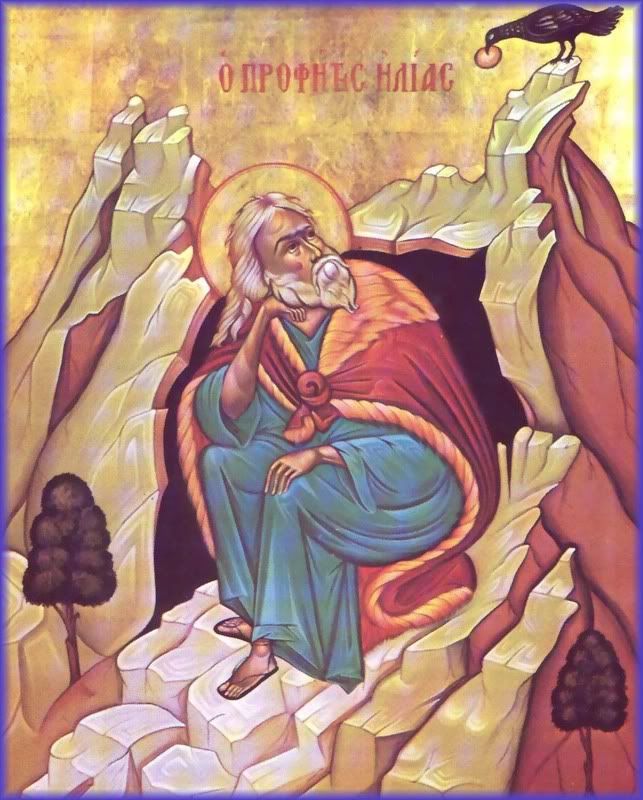
- James 5:17—-Elias/Elijah had power over rain (see 1 Kings 17:1, 18:1)
- Luke 4:25-26—-Elias/Elijah sent to widow woman of Zarepta (see 1 Kings 17:9)
- Rom. 11: 2-4—-Elias/Elijah makes intercession to God against Israel (see 1 Kgs. 19:10-18)
Elias the Preparer
- John the Baptist—-The JST identifies John as "an Elias," because he prepared the way for Christ, the Elias who was to come and restore all things. See JST Mark 9:3-4, JST Matt 11:13-14, JST John 1:19-28, BD. The D&C states that John would be filled with the Spirit of Elias. (D&C 27:7)
- Joseph Smith—-Joseph named himself as an Elias: "...my ordination [to the AP] was a preparatory work, or a going before, which was the Spirit of Elias; for the Spirit of Elias was a going before to prepare the way for the greater, which was the case with John the Baptist."
- Adam--"In his physical-spiritual state in Eden, Adam was called the "first man" (Moses 1:34) and given responsibility to dress the garden and "open the way of the world" (TPJS, p. 12). As the first on this earth to receive priesthood keys, Adam continues to dispense authority to others and to watch over priesthood administration on the earth.
Elias the Restorer
- Jesus--(JST John 1:20-28) John the Baptist testifies that Christ was the Elias who was to restore all things.
- Joseph Smith--(D&C 77:9, with D&C 110:11-13. See also Rev 7:2)
- John the Revelator--(D&C 77:14)
- Moroni—-Book of Mormon prophet, returned to earth as a resurrected being and prepared Joseph Smith to receive and translate the gold plates. His role was to restore the everlasting gospel to be preached to all the world.
- Gabriel/Noah--In D&C 27:5-13 Elias, who holds the keys of restoration, will be one of the company present at a special sacrament service with Christ at his 2nd coming. This Elias visited Zachariah in angelic form and told him he would have a son. We know from Luke 1:11-19 that this angel was Gabriel. Joseph Smith once said that the angel Gabriel was Noah.
Elias the Prophet
- In D&C 110:11-13 Elias appears as part of the company who committed keys at the Kirtland Temple. BD says this is an unknown prophet from the time of Abraham.
Questions
~Who appeared on the Mount of Transfiguration?
In the NT accounts in Luke 9:28-35; Matt 17:1-12; Mark 9:2-13 Moses and Elias appear on the Mount of Transfiguration. Elias here is traditionally understood to be the OT prophet Elijah. The JST of Mark 9:3 reads “and there appeared unto them Elias with Moses, or in other words, John the Baptist and Moses…” The BD seeks to clarify this statement by explaining, "The curious wording of JST Mark 9: 3 does not imply that the Elias at the Transfiguration was John the Baptist, but that in addition to Elijah the prophet, John the Baptist was present." This actually causes more problems. Luke 9:30 specifies that only two personages appeared, not three: “there talked with him two men, which were Moses and Elias.” Also, Peter suggests making three tabernacles, one for Jesus, one for Moses, and one for Elias. (Luke 9:33, Matt 17:4, Mark 9:5) A fourth tabernacle for John the Baptist is not mentioned. I am willing to entertain the thought that the BD is simply wrong, and that there were only two personages involved. Whether "Elias" was Elijah or John the Baptist is less certain. Elijah and Moses are often linked in scripture. However, some have said that the two prophets represent the Aaronic and the Melchizedek Priesthoods. If this is true, John the Baptist might make a better fit than Elijah as the representative of the AP.
~Is the “Elias” mentioned in D&C 138 John the Baptist, or Elijah?In D&C 138:45 Elias is part of the company of the righteous commissioned to preach the gospel to the dead in the Spirit World. He is specified as the Elias who was with Moses on the Mount of Transfiguration. The company consists of Adam, Eve, Abel, Seth, Noah, Shem, Abraham, Isaac, Jacob, Moses, Isaiah, Ezekiel, Daniel, Elias, Malachi, (Elijah is then quoted in connection with Malachi).
This reference is not mentioned in the BD. It appears to me that Elias here refers to the prophet Elijah, since the other members of the company are all mentioned by name and are Old Testament personalities. However, the question arises, why is a different form of the name used in verse 45 and verses 46-47? Was this a way to distinguish the Baptist from the OT prophet who would restore the sealing power?
~Does the “Elias” who had the keys to the Dispensation of Abraham and is mentioned in D&C 110 refer to the prophet Elijah? Or is he a completely different OT prophet named Elias? Or is this a title meant to refer to John the Baptist, Abraham, or another forerunner? In this revelation, three prophets appear to JS and Oliver Cowdery in the Kirtland Temple to bestow keys: Moses, Elias, and Elijah. One might ask, if Elias is an OT prophet in this section, why the Greek name? Is it a title? Was it used merely to avoid confusion with the Elijah in the next verse? The BD uses this scripture as the only reference to an unknown "man called Elias [who] apparently lived in mortality in the days of Abraham." Why, as Kevin Barney has asked, would God send a man no one had ever heard of and who is nowhere mentioned in the Bible to commit the keys of the dispensation of Abraham to Joseph Smith? The whole point of bringing famous personalities from biblical antiquity to restore these keys is the fact that they were well known and their authority was assured. Once again, the BD strikes out. Kevin postulates that this Elias is John the Baptist. I think his view can be supported by the idea that John the Baptist could have held the keys to the Dispensation of Abraham. (See D&C 84:28.) This theory also works if we accept that there were 3 prophets--Moses, Elias (John the Baptist), and Elijah--present at the Mount of Transfiguration.
Well, I have more to say about Elias, but this post is getting long. So look for part 2 later. I'll include more about Lesson #6 in the JS manual. In the meantime, here are some great references:
Kevin Barney's post at BCC on the Elias of D&C 110
"...my tentative suggestion to the question is that Joseph understood the Elias of the Mount of Transfiguration, which was the model for who appeared to him at the Kirtland Temple in these verses, to be John the Baptist, a separate individual from Elijah the Tishbite."Comment #11 by Last Lemming:
"Kevin makes the case that Joseph seems to have believed that the “Elias” at the transfiguration was John the Baptist. So why not just identify him by name? Maybe because John the Baptist was one resurrected face with which Joseph was already familiar, and it was not the face of the 'Elias' who appeared in Kirtland. So he retained the linkage of Moses with 'Elias,' but was otherwise not confident enough in the identity of 'Elias' to commit it to writing...Incidently, my vote for the restorer of the gospel of Abraham is…ahem…Abraham."
Joe Spencer's post on Elias and Elijah at FUTW
"I think the pairing of Elijah and Moses makes a great deal of sense, and I must confess I am still at a loss as to how to make any sense of the separation between Elijah and Elias. Because of D&C 110, it seems quite clear that there must be two different people here, but the common locution of making “Elias” a title doesn’t really make any sense to me."Comment #2 by Ben McGuire:
"I think that one response is simply to suggest that D&C 110 is simply in error. That is, that Elias there is either not the name of the angelic being referred to. This could be because it was used there as a title to refer to someone else (Noah or John the Baptist or Abraham himself are the leading candidates in speculative literature), or because Joseph simply misidentified the person or the title as the name of the person."
Sam Brown, "The Prophet Elias Puzzle," in Dialogue
"Writers from within Mormonism have historically focused, with precedent in the Prophet's teachings, on a 'Spirit of Elias' borne by various angelic ministrants while positing the existence of a minor but essentially unknown prophet actually named Elias who stays away from center stage. Later writers, exemplified by Bruce R. McConkie, have described these several instances of Elias in impressive detail. These creative solutions have been a response to increduloud critics who see only a glaring error of transliteration made corporeal, a chink in the armor of Joseph Smith's seerhood...I will contextualize the prophet Elijah and attempt to solve the puzzle of Elias, investigating the linguistic evidence, exploring Joseph Smith's discussions of Elias, and providing a theoretical framework for the significance of the Elijah/Elias bifurcation."Comment by Robert C.:
"the article takes the view that making a distinction between Elias and Elijah was, among other things, a way for Joseph Smith to make a distinction between Elijah as Prostestants of the time understood him and the new eternal-family view that Joseph was presenting."Comment by Joe Spencer:
"Sam suggests at once that Joseph was familiar with the equivalence of Elias and Elijah and that he made a sharp distinction between them. I really like this point because it derails the simplistic “Joseph goofed” idea (Joseph was far too careful a reader of the Bible for that). But what is fascinating me the most is the connection between the JST for John 1:22 and D&C 77. I’d like to do some more thinking there. Hmm…."
Sunday, February 24, 2008
5 LDS Interpretations of the Isaiah Passages that Should Not be Perpetuated
I promised some posts on upcoming Book of Mormon Sunday School lessons. But I have to warn you, I've been in a blue funk lately. So I suspect my thoughts are neither inspiring nor fit for Sunday School consumption. But maybe it will help you know what not to say.
LDS Sunday School students will soon take a quick leap through 13 chapters of Isaiah which are quoted by Nephi in 2nd Nephi chapters 12-24. All too often, some uniquely Mormon interpretations are given to these chapters which merit a critical analysis. In this post I present five Mormonisms which I believe hinder a deeper and more accurate understanding of Isaiah's writings.
1. 2 Nephi 12:2,3 Popular LDS commentary on this verse identifies it as Isaiah's vision of people from many lands coming to Salt Lake City, Utah.
Many prophecies of Isaiah are dual and can be applied to more than one time, situation or people. I am aware that latter-day prophets and apostles have related this verse to the Salt Lake temple or even to the Conference Center from which the word of the Lord is issuing forth in these days. However, if we insist too strongly on this Mormon-centric view, we can miss the primary application which this verse has to the millennial reign of the Messiah. The word "mountain" as used in the Bible is a metaphor for "nation," "government," or "political system." In verses 2 and 3 Isaiah is speaking of the millennial condition when Christ shall establish the political Kingdom of God upon the earth. This will be established "in the top of the mountains," or in other words "as the head of the nations."
2. 2 Nephi 12:3 Isaiah wrote that the word of the Lord will come from Jerusalem, and the law will come from Zion, the New Jerusalem, located in Jackson County, Missouri. There will be two distinct centers of influence for God's people.
This may be, but verse 3 should not be used as a proof-text. Here we have a synonymous chiastic parallel where
the Law = the Word of the Lord, and
Zion = Jerusalem (one and the same)
The chiastic structure of this phrase indicates that Isaiah equated Zion with Jerusalem (the one located in Israel!) If we accept this, we will be able to learn more about Zion as it relates to the ancient City of David.
3. 2 Nephi 12:9 In the Book of Mormon, verse 9 is clarified by adding the word "not" to the following statement: "And the mean man boweth [not] down and the great man humbleth himself [not], therefore forgive him not."
This verse actually makes much more sense in its original context, without the extra "not" added in the Book of Mormon version. Verse 8 speaks of idols which are found throughout the land. And the mean (common) man and the great (important) man boweth down (to these idols). This version makes more sense coming as it does right after the description of people worshipping idols, the work of their own hands.
4. 2 Nephi 12:13-17 Some Mormons still insist that this passage is an example of the restoration in the Book of Mormon of passages that were lost in the Old Testament. As noted in footnote 16a, “The Greek (Septuagint) has ‘ships of the sea.’ The Hebrew has ‘ships of Tarshish.’ The Book of Mormon has both, showing that the brass plates had lost neither phrase.”
Pike and Seely have shown the challenges of accepting this interpretation. I love the poetry of the passage and find that the addition of the extra phrase and other interjected words spoils the beauty of the chiastic tripled bicola. Isaiah used poetic conventions frequently to emphasize his points. The Book of Mormon addition does not enhance the poetic structure of the passage, but instead inhibits it. The Greek "ships of the sea" and the Hebrew "ships of Tarshish" are probably different translations of one original phrase and it is not necessary or preferable to include both. Observe the perfection of the Masoretic text with the pattern of w- (conjunction) + al (preposition "upon") followed by kol- ("all/every") and then two words (here in English translation):
For the day of the LORD of hosts shall be
upon every one that is proud and lofty,
and upon every one that is lifted up; and he shall be brought low:
and upon all the cedars of Lebanon, that are high and lifted up,
and upon all the oaks of Bashan,
and upon all the high mountains,
and upon all the hills that are lifted up,
and upon every high tower,
and upon every fenced wall,
and upon all the ships of Tarshish,
and upon all pleasant pictures (fine craft)
and the loftiness of man shall be bowed down,
and the haughtiness of men shall be made low;
and the LORD alone shall be exalted in that day.
(if all this fascinates you, there is a well-reasoned apologetic view here. But I stand by my opinion.)
5. 2 Nephi 14:1 The Mormon speculation on this verse goes as follows: With so many men killed in war, righteous single priesthood holders are in short supply. Thus, plural marriage is reinstituted, with many women stating they will support themselves in order to receive priesthood covenant protection.
My examination of the Hebrew of this verse makes me confident in translating "one man" as "a certain man." The verse thus teaches that in the latter day seven women (symbolic number of completeness, denotes the covenant people) shall take hold of a certain man (guess who that would be?) and ask him "let us be called by thy name," which will take away their reproach (effects of atonement). In my view this verse is Messianic and has nothing whatsoever to do with polygamy.
Update: Our SS teacher gave 2 of these very interpretations while presenting the lesson! How about yours??
*
Monday, February 11, 2008
Enough About Keystones!

I'm getting bored with the obligatory lesson every time we begin a study on the Book of Mormon which involves the teacher drawing a very poor diagram of an arch on the board and explaining the importance of a keystone. This year we are subjected to the convention twice, once in Sunday School Lesson #1 and now in the JS Manual Lesson #4.
Joseph Smith's statement that the Book of Mormon is the keystone of our religion is no more than a figurative and not strictly legitimate use of the term to suggest that the book is the central supporting element of the larger structure of the Church. In our lessons we are stretching the metaphor to the point of being grossly inaccurate. (Besides that, I like to think of Christ as the central element.)
Now I wouldn't have any problem if a qualified architect or mason came to SS prepared to discuss the intricacies of archwork and new applications we could bring to the metaphor. For example, here's an interesting definition:

The keystone is the block without which the structure is not whole; it receives and joins forces of upwardly-reaching members of an arch and creates a structure that soars with lightness yet with solid integrity and strength. The integrative strength of the keystone is a natural one that does not depend for its function on massiveness but rather works because everything falls into place around it and is strengthened and brought together by it, making all the components work together. A keystone is synergistic, yielding a structure that is stronger than the individual parts would be if they were merely stacked together, one on top of the other. It exists to unite structural elements.
But I think I'd rather just drop the overemphasis on this old chestnut. There are more fascinating things in this lesson to discuss. Tomorrow I will blog about one of them.
Friday, February 8, 2008
Immigration Policy Based on 2 Nephi 1
Warning: Do not discuss in Sunday School Lesson #6
As a hard core pacifist, I've always wondered why Mormons don't put greater faith in Second Nephi, chapter 1. In this chapter, Lehi tells his sons that he has obtained a promise from the Lord. Whoever has been led out of the land of Jerusalem and brought to the land of promise (which we are told is the American continent) will prosper as long as they keep the commandments. In fact, no other nations will be able to molest them or take them into captivity. They will not be overrun by other nations, and they will always have a place for an inheritance.
A more careful reading of these verses reveals that this promise applies to more than just the Book of Mormon peoples. "None shall come into this land," prophesies Lehi, "save they shall be brought by the hand of the Lord." God promises to give the American continent to ALL THOSE who in the future shall be led out of other countries by his power. Thus, the promise found in verse 7 is quite comprehensive. Anyone who lives here, who is keeping the commandments shall be protected. The land is a land of liberty, and as long as we are righteous, we will never be brought into captivity.
In the past, I've wondered why Latter-day Saints who live in the U.S. support war as a necessity for protecting and defending our country. If we really believe this promise, wouldn't it be much more effective to protect our country, our homes, and our families by concentrating on our personal righteousness rather than espousing military action?
Today in Sunday School, I realized the scripture has an additional application. Lehi is told in verse 8 that the Lord is keeping the Promised Land from the knowledge of other nations, so that they will not overrun the land and keep the branch of Israel which has been led there from having place for an inheritance. Should we not apply these verses to ourselves also? Does a careful reading of this chapter suggest that we should allow the Lord to bring to this land whom he will? Will he not keep them from overrunning the land if we are righteous? If we keep the commandments, shall we not maintain an inheritance, be safe and protected, and even be blessed and prosper upon the land?
What applications does 2 Nephi 1 have to the immigration policies now being discussed in the United States?
"Give me your tired, your poor,
Your huddled masses
yearning to breathe free,
The wretched refuse of
your teeming shore.
Send these, the homeless,
tempest-tost to me,
I lift my lamp
beside the golden door!"
Emma Lazarus, 1883


 Posts
Posts


