In today's economy, you have to be really sharp to stand out over all those other applicants competing for the job you want. For example, I've heard that the following was a question used as part of a job application, designed to test good judgment:
Warning: Do not discuss in Sunday School Lesson #6
As a hard core pacifist, I've always wondered why Mormons don't put greater faith in Second Nephi, chapter 1. In this chapter, Lehi tells his sons that he has obtained a promise from the Lord. Whoever has been led out of the land of Jerusalem and brought to the land of promise (which we are told is the American continent) will prosper as long as they keep the commandments. In fact, no other nations will be able to molest them or take them into captivity. They will not be overrun by other nations, and they will always have a place for an inheritance.
A more careful reading of these verses reveals that this promise applies to more than just the Book of Mormon peoples. "None shall come into this land," prophesies Lehi, "save they shall be brought by the hand of the Lord." God promises to give the American continent to ALL THOSE who in the future shall be led out of other countries by his power. Thus, the promise found in verse 7 is quite comprehensive. Anyone who lives here, who is keeping the commandments shall be protected. The land is a land of liberty, and as long as we are righteous, we will never be brought into captivity.
In the past, I've wondered why Latter-day Saints who live in the U.S. support war as a necessity for protecting and defending our country. If we really believe this promise, wouldn't it be much more effective to protect our country, our homes, and our families by concentrating on our personal righteousness rather than espousing military action?
Today in Sunday School, I realized the scripture has an additional application. Lehi is told in verse 8 that the Lord is keeping the Promised Land from the knowledge of other nations, so that they will not overrun the land and keep the branch of Israel which has been led there from having place for an inheritance. Should we not apply these verses to ourselves also? Does a careful reading of this chapter suggest that we should allow the Lord to bring to this land whom he will? Will he not keep them from overrunning the land if we are righteous? If we keep the commandments, shall we not maintain an inheritance, be safe and protected, and even be blessed and prosper upon the land?
What applications does 2 Nephi 1 have to the immigration policies now being discussed in the United States?
"Give me your tired, your poor, Your huddled masses yearning to breathe free, The wretched refuse of your teeming shore. Send these, the homeless, tempest-tost to me, I lift my lamp beside the golden door!"
In October of 2000 the Security Council of the United Nations adopted its landmark resolution 1325 on women, peace, and security. This resolution was an effort to protect the rights of women across the globe and remove barriers to their equal participation and full involvement in the maintenance and promotion of sustainable peace. Every year since 2000, this resolution has been reaffirmed. Three months ago, in October, an open debate was held to discuss progress on the implementation of this resolution. I recently became aware of this debate and the efforts that are being made to safeguard women around the world.
This year the Council expressed their concern that armed conflicts persist in many parts of the world and are an ongoing reality affecting women. Specific acts of violence against women and girls continue to occur including killing, maiming, sexual violence, rape, exploitation and abuse. A statement by the Security Council reported:
"such acts remain pervasive, and in some situations have become systematic, and have reached appalling levels of atrocity. The Council stresses the need to end impunity for such acts as part of a comprehensive approach to seeking peace, justice, truth and national reconciliation. In this context, the Council reiterates paragraph 9 of resolution 1325 (2000) and calls on all parties to armed conflict to respect fully international law applicable to the rights and protection of women and girls, especially as civilians."
As part of the effort to stop atrocities committed against women during war, the Council recommended that women be made a more vital part of formal peace process. I believe it would be extremely beneficial to have women more involved in peace talks, and providing gender perspective during the making of policies and programs promoting peace in their various countries. Women continue to be underrepresented despite the U.N.'s efforts toward this goal.
The obstacles women in many countries face result from shattered economies and social structures, lack of rule of law, poverty, limited access to education and other resources, and various forms of discrimination and stereotypes. My native country is one in which women's rights have been a priority for many years. We haven't been held back significantly by the above obstacles. However, I knew nothing about this initiative which has been an ongoing effort for seven years! Why isn't the U.S. promoting this resolution in a major way?
Perhaps the atrocities of war regarding women are so far removed from us that we do not realize their seriousness? Maybe we feel these acts are not the fault of our soldiers? Do we think that American women are already adequately represented in forming policies and procedures regarding peace initiatives?
As a U.N. member nation, have we fully participated in the Women and Peace and Security Resolution? (Read more about it here!)
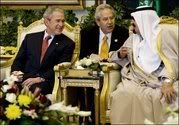
...or rather his cavalcade as he passed the snarl of traffic in which our bus was entangled. We had to wait 3 hours at the outside of our compound. Helicopters were buzzing overhead. Women swathed in abayas were begging armed guards to let them in to their homes so they could care for their children. Men were honking maniacally, and riots were only stemmed by army Rambos stationed every 25 yards along all major highways. We'd been told that George Bush was coming this week, but information was carefully guarded, and we had no idea when he would arrive or why he was here. We certainly had no idea of this! Tomorrow school will be cancelled and businesses will be closed as all routes to anywhere will be cordoned off.
Really, I just wish "W" would sit around and watch TV until November. The last thing the Middle East needs is $20 billion in weapons.
Still going strong and right on track for finishing the Book of Mormon by the end of the month! You know what is harder for me than making it through the Isaiah passages? You guessed it, I can't stand all the war stuff in the latter chapters of Alma. We're into the large plates now, so we have a lot of historical information (thankfully) abridged by Mormon. These chapters on wars and war strategies are very difficult for me to read. There are many yukky parts like kings being stabbed and Amalickiah swearing an oath to drink Moroni's blood, and dead bodies, and well, you know.
I just cannot see why it is necessary for the righteous Nephites to involve themselves in so many battles. Supposedly they believe the promise that the Lord made them that if they were righteous they would be protected and never brought down into captivity. It seems to me that they could rely on their righteousness and/or leave the lands of the Lamanites' possession, like Nephi did early in the book.
I've always really admired Moroni because of the verse that says that if all men had been, and were, and ever would be like unto him, the very powers of hell would be shaken forever. But I was disappointed to read one of his letters today. He just doesn't sound very nice, kind or fair. Ammoron sends to Moroni to ask him to exchange prisoners. Moroni writes back telling Ammoron how ignorant he and the rest of the Lamanites are concerning the gospel (I would tell you these things if ye were capable of hearkening unto them), he tells him he is a child of hell, and he refuses to negotiate unless the Lamanites will exchange a Nephite man, wife, and children for one Lamanite prisoner.
Ammoron's response to all this is actually pretty admirable, considering his point of view. He says: you have murdered my brother, I am not afraid of your threats, I will exchange prisoners according to your request since I want my men of war back, so we can fight you. Furthermore, we don't know anything about a God, but neither do you, and if there is a God, he has made us as well as you! And if there is a hell, won't God send you there for murdering my brother?
Anyway, I don't think I'm getting what I am supposed to be getting out of these war chapters. Peace out.
With my oldest daughter serving a mission in South Korea, I've been particularly concerned with the nuclear threat in nearby North Korea. Since 2003, when North Korea withdrew from the Nuclear Nonproliferation Treaty and restarted its reactor, activities in the country have been a concern.
This morning, encouraging news has been reported. The sole operating reactor has reportedly been shut down, apparently in response to U.S.-backed sanctions placed upon the country by the United Nations Security Council. These sanctions were put into place after North Korea's nuclear test in October 2006. U.N. inspectors are to verify the shutdown later today. In response to this action, North Korea will receive a large oil shipment. Disabling of the facilities will continue as economic sanctions are lifted.
This news is very welcome. It's encouraging to see an example of a peaceful solution to tensions among the nations. I'm not always confident that sanctions are enough of an incentive for countries to dismantle their nuclear programs. It remains to be seen if North Korea will cooperate fully. But I'm thrilled that things are moving in a positive direction.
"War, rather than any foreign state, is the supreme enemy of country and mankind. One day citizens will covet for this nation the prestige of being the first to escape the shackles of war." (Jessie Wallace Hughan, Founder of the War Resisters League 1876-1955)
Memorial Day is a United States federal holiday which "commemorates U.S. men and women who have died in military service to their country." Update: Eight U.S. troops were killed in Iraq this Memorial Day 2007. At the risk of coming under the condemnation of Mormon bloggers everywhere, I wish to register my objection to the deplorable sentiments underlying this holiday.
We can all agree on the magnitude of the sacrifice offered by American soldiers. They answered the call of the leaders of their country to go to war. They did this with the knowledge that their own lives might be taken. I am not one who looks upon military volunteers as being either bloodthirsty warmongers or poverty-stricken and brainwashed victims. Their brand of courage is not ordinary, and will never be ordinary.
I must, however, denounce the commemoration of lives destroyed by militarism. Instead of celebrating lives given up for war, I would mourn the lives snuffed out and stolen by our country's participation in martial combat. It seems to me that Memorial Day might more aptly commemorate the lives of America's great Peacemakers--people such as Henry David Thoreau, Martin Luther King, Peace Pilgrim, Jeannette Rankin, A.J. Muste, Jane Addams, and a myriad of others.
"The job of the peacemaker is to stop war, to purify the world, to get it saved from poverty and riches, to heal the sick, to comfort the sad, to wake up those who have not yet found God." (Muriel Lester, Social Activist, Gandhian Pacifist, 1883-1968)
Throughout history, nations have consigned their young men (and now women) to kill one another for reasons honorable or absurd. Often war was declared as a response to evil or oppression; other times violence came as political or economic conflicts that should have been resolved without violence. When the causes are just and when they are not, lives lost to war are sacred and full of promise and potential. Those who ponder these things can only regret that wars are still waged and lives are still lost. I wish that on the day which has been set apart as a "Memorial", we would not only remember the courageous souls who were sent by their governments to die on battlefields, but rather we would regret and repudiate the conditions that lead some people to believe that offering their lives in military service is the best or only hope for peace, protection or patriotism.
Indeed, conceit, arrogance, and egotism are the essentials of patriotism. Let me illustrate. Patriotism assumes that our globe is divided into little spots, each one surrounded by an iron gate. Those who have had the fortune of being born on some particular spot, consider themselves better, nobler, grander, more intelligent than the living beings inhabiting any other spot. It is, therefore, the duty of everyone living on that chosen spot to fight, kill, and die in the attempt to impose his superiority upon all the others.
The inhabitants of the other spots reason in like manner, of course, with the result that, from early infancy, the mind of the child is poisoned with blood-curdling stories about the Germans, the French, the Italians, Russians, etc. When the child has reached manhood, he is thoroughly saturated with the belief that he is chosen by the Lord himself to defend HIS country against the attack or invasion of any foreigner. It is for that purpose that we are clamoring for a greater army and navy, more battleships and ammunition. (Emma Goldman: Patriotism: A Menace to Liberty From the 1917 edition of Emma Goldman's Anarchism and Other Essays)
Military indoctrination, by its nature, teaches the young that the enemy is unworthy of life.
Christian pacifists are often asked about Romans 13. ["Therefore, it is necessary to submit to the authorities, not only because of possible punishment but also because of conscience."] The Mormon counterpart seems to be our Article of Faith #12: ["We believe in being subject to kings, presidents, rulers, and magistrates, in obeying, honoring, and sustaining the law."] But I find my answer in Romans 12, which says to do good to your enemy and to overcome evil with good. In World War II, after all, there were many Catholics and Lutherans in Germany who used Romans 13 to justify fighting for the Nazis.
"Many people know the simple spiritual law that evil can only be overcome by good. Pacifists not only know it, they also attempt to live it." (Peace Pilgrim, Philosopher, Activist, Ethical Vegetarian, Vegan 1908-1981)
A new song, Hymn for Anzac Day, was sung for the first time at Mornington Methodist Church in New Zealand on April 29, 2007. Anzac Day is New Zealand and Australia's version of Memorial Day. Notice the third stanza, where the brave who do not answer the call of war are also honored:
Honour the dead, our country’s fighting brave, honour our children left in foreign grave, where poppies blow and sorrow seeds her flowers, honour the crosses marked forever ours .
Weep for the places ravaged by our blood, weep for the young bones buried in the mud, weep for the powers of violence and greed, weep for the deals done in the name of need.
Honour the brave whose conscience was their call, answered no bugle, went against the wall, suffered in prisons of contempt and shame, branded as cowards in our country’s name.
Weep for the waste of all that might have been, Weep for the cost that war has made obscene, Weep for the homes that ache with human pain, Weep that we ever sanction war again.
Honour the dream for which our nation bled, Held now in trust to justify the dead, Honour their vision on this solemn day, Peace known in freedom, peace the only way.
(words by Shirley Murray, music by Colin Gibson)
I challenge supporters of the American military machine to demonstrate how war brings about peace. How does more killing honor the lives of those who have died? The world has been at war throughout recorded history, and never has war brought definitive peace to any generation. Violent resistance to violence always fails to bring about peace. Rather, it establishes a realignment of forces under principles of violence. War is rarely motivated by the high ideals that its supporters use to justify it.
"Returning violence for violence multiplies violence, adding deeper darkness to a night already devoid of stars. Darkness cannot drive out darkness: only light can do that. Hate cannot drive out hate: only love can do that. Hate multiplies hate, violence multiplies violence, and toughness multiplies toughness in a descending spiral of destruction.... The chain reaction of evil — hate begetting hate, wars producing more wars — must be broken, or we shall be plunged into the dark abyss of annihilation." (Martin Luther King Jr.)
In this day and age, with our weapons of mass destruction and our new and improved ways of torturing each other, war is insanity. It is destructiveness; it is immorality; it is total waste. Our goal today must be the end of war. Negotiation should be our commitment. Perhaps the best way to memorialize the sacrifice of those who have lost their lives in war is to strive for a mastery of peace--a better way of resolving conflict--a commitment to the transformational power of love.
from Ron Paul before the U.S. House of Representatives, 6/29/06. Hat tip to Connor.
"...Policy changes in wartime are difficult, for it is almost impossible for the administration to change course since so much emotional energy has been invested in the effort. That’s why Eisenhower ended the Korean War, and not Truman. That’s why Nixon ended the Vietnam War, and not LBJ. Even in the case of Vietnam the end was too slow and costly, as more then 30,000 military deaths came after Nixon’s election in 1968. It makes a lot more sense to avoid unnecessary wars than to overcome the politics involved in stopping them once started. I personally am convinced that many of our wars could be prevented by paying stricter attention to the method whereby our troops are committed to battle. I also am convinced that when Congress does not declare war, victory is unlikely.
The most important thing Congress can do to prevent needless and foolish wars is for every member to take seriously his or her oath to obey the Constitution. Wars should be entered into only after great deliberation and caution. Wars that are declared by Congress should reflect the support of the people, and the goal should be a quick and successful resolution.
Our undeclared wars over the past 65 years have dragged on without precise victories. We fight to spread American values, to enforce UN resolutions, and to slay supposed Hitlers. We forget that we once spread American values by persuasion and setting an example – not by bombs and preemptive invasions. Nowhere in the Constitution are we permitted to go to war on behalf of the United Nations at the sacrifice of our national sovereignty. We repeatedly use military force against former allies, thugs we helped empower – like Saddam Hussein and Osama bin Laden – even when they pose no danger to us...
How have the 2,500 plus deaths, and the 18,500 wounded, made us more free? What in the world does Iraq have to do with protecting our civil liberties here at home? What national security threat prompted American’s first pre-emptive war? How does our unilateral enforcement of UN resolutions enhance our freedoms?...
Some of the strongest supporters of the war declare that we are a Christian nation, yet use their religious beliefs to justify the war. They claim it is our Christian duty to remake the Middle East and attack the Muslim infidels. Evidently I have been reading from a different Bible. I remember something about “Blessed are the peacemakers.”
My beliefs aside, Christian teaching of nearly a thousand years reinforces the concept of “Just War Theory.” This Christian theory emphasizes six criteria needed to justify Christian participation in war. Briefly the six points are as follows:
War should be fought only in self-defense; War should be undertaken only as a last resort; A decision to enter war should be made only by a legitimate authority; All military responses must be proportional to the threat; There must be a reasonable chance of success; and A public declaration notifying all parties concerned is required. The war in Iraq fails to meet almost all of these requirements. This discrepancy has generated anger and division within the Christian community.
Some are angry because the war is being fought out of Christian duty, yet does not have uniform support from all Christians. Others are angry because they see Christianity as a religion as peace and forgiveness, not war and annihilation of enemies.
Constitutional and moral restraints on war should be strictly followed...
The solution to this mess is not complicated; but the changes needed are nearly impossible for political reasons. Sound free market economics, sound money, and a sensible foreign policy would all result from strict adherence to the Constitution. If the people desired it, and Congress was filled with responsible members, a smooth although challenging transition could be achieved. Since this is unlikely, we can only hope that the rule of law and the goal of liberty can be reestablished without chaos.
We must move quickly toward a more traditional American foreign policy of peace, friendship, and trade with all nations; entangling alliances with none. We must reject the notion that we can or should make the world safe for democracy. We must forget about being the world’s policeman. We should disengage from the unworkable and unforgiving task of nation building. We must reject the notion that our military should be used to protect natural resources, private investments, or serve the interest of any foreign government or the United Nations. Our military should be designed for one purpose: defending our national security. It’s time to come home now, before financial conditions or military weakness dictates it.
The major obstacle to a sensible foreign policy is the fiction about what patriotism means. Today patriotism has come to mean blind support for the government and its policies. In earlier times patriotism meant having the willingness and courage to challenge government policies regardless of popular perceptions.
Today we constantly hear innuendos and direct insults aimed at those who dare to challenge current foreign policy, no matter how flawed that policy may be. I would suggest it takes more courage to admit the truth, to admit mistakes, than to attack others as unpatriotic for disagreeing with the war in Iraq."
Read the entire talk here, and let me know what you think. Connor said that this article convinced his mom that the war in Iraq was wrong and that we should leave. Did it convince you?
I'm still considering World Peace today--I read an article from the top news stories of today entitled, "Jordan's King Urges U.S. to Work on Mideast Peace." For a moment I was thrilled, but as my eyes quickly scanned the article, I realized that King Abdullah was calling for the United States to become more involved in the Middle East. I continue to contemplate the wisdom in our continued presence in Iraq as a peacekeeping measure. Abdullah addressed a recent joint meeting of Congress(which has been searching for ways to diminish the U.S. involvement in Iraq). He pled that the U.S. has an "unrivaled" potential to help with the core problem in the area; the Palestinian-Israeli conflict.
Coincidentally, several hours after reading this article I came across the following quotation by Gordon B. Hinckley: "I have often thought that if great numbers of the women of all nations were to unite and lift their voices in the cause of peace, there would develop a worldwide will for peace which could save our civilization and avoid untold suffering, misery, plague, starvation and the death of millions."
I wish President Hinckley could have been a bit more specific as to what our voices could say or how we could unite together to effect this change. My personal desire would be to send thousands of Americans to the Middle East as a true "peacekeeping force"--without guns or ammunition but with medical supplies, textbooks, love and reason. Just to roam about the country spreading ideals and goodwill. What a dumb plan, right? I would volunteer to do this. I don't know how many others could be persuaded.
This poem, written by Rebecca del Rio-Ruso is a stirring protest of war using the same imagery I used in my poem "I Put on Black."
DE LUTO
El día que lanzaron el bombardeo (digo ellos, porque nosotros no tenemos bombas,) me vestí de luto.
Doble y metí en un pliegue el rojo, el amarillo, la ira y puse La esperanza en su lugar. Almacené el verde, el azul, la anticipación, Y el deseo en un rinconcito lindo.
El día que lanzaron el bombardeo (digo ellos, Porque nosotros no tenemos bombas,) apilé el verde oliva, el marrón, La serenidad y el reposo en el tocador Y me vestí de luto.
El día que se lanzaron el bombardeo (digo ellos, Porque nosotros no tenemos bombas,) me fijé mientras el naranja estalló en estrellas espectaculares, como chispas de Una hoguera del desierto. Almacene mis bufandas, mis pulseras, Los amuletos y la risa. Y me vestí de luto.
El día que se lanzaron el bombardeo (digo ellos, Porque nosotros no tenemos bombas,) me absorbió del pecho El aire en tragos tremendos, tragos turquesa, fucsia, De doloridos tonos morado. Lo sentí cuando el aire giraba encima y Me vestí de luto.
El día que lanzamos el bombardeo (digo nosotros porque Por mas que me rehusé lo hicieron en mi nombre) Doblé la alegría como doblaría una tienda de campaña de los Bedoin, Una carpa reluciente, de flequillo, que ondula en la brisa del desierto Y me vestí de luto.
Rebecca del Rio-Ruso -------------------------------
IN BLACK
The day they started bombing (they, not we Because we do not have bombs), I put on black.
I folded away red, yellow, rage, and Hope. I tucked greens, blues, anticipation And desire in a neat corner And I put on black.
The day they started bombing (they, not we Because we do not have bombs) I stacked olive, tan, Quietude and rest in the cabinet. And I put on black.
The day they started bombing (they, not we Because we do not have bombs) I watched orange Shower up in spectacular sparks like A desert bonfire. I put away my scarves, silver bracelets, Amulets and laughter. And I put on black.
The day they started bombing (they, not we Because we do not have bombs,) I felt The air being sucked out of me In great gulps of teal, fuchsia, pained Shades of purple. I felt the air wheeling over as I put on black.
The day we started bombing (we because no matter How I refused, they used my name anyway) I folded up joy, like a Bedouin's tent, bright, Fringed and billowing and put on black.
Whenever something deeply affects me, it always seems to come out in poetry. I was moved by those who participated in fasting for peace on Sunday. I enjoyed the feeling of togetherness it brought. I was especially touched by John's post on the pathology of war. It responded to my concern that my small prayer was not likely to do much good.
A Prayer For Peace
Afar beyond the surging sea In regions yet unknown to me The jaws of war gape wild and wide; A frightful beast.
The troubled, war-torn region lies In shambles under sinking skies Another wounded warrior dies While others feast.
The heads of nations, bickering Have set my candles flickering. My heart cannot shut out the cries Nor take my ease.
I fast, and put aside my meal, A meager effort--meant to heal. Will heaven heed my simple sighs? Let conflict cease.
A pinprick in the conscience of A nation so devoid of love Is my petition, small in size: A Prayer for Peace.
I'm glad that we were able to set aside a time to think about those personally affected by war, the hard decisions of national leaders, and peaceful endeavor. I feel ready to accept a bigger part in working for peace if it comes my way.
In a few hours, I'll start my fast for World Peace. I'm praying that leaders of the nations will increasingly consider nonviolent ways to solve conflicts. I'm glad that several people around the Bloggernacle will be joining me in a Vigil tomorrow, Sunday March 4, to promote peace.
I sent out about 50 emails to invite Mormon bloggers to participate in this effort. I was hoping that many of them would put something up on their site to pass the word. Those who posted on peace are featured in my sidebar. (If I missed you, let me know!) I didn't get much of a response among traditional Mormons. Almost everyone I sent emails to who responded to me or put something up on their blog were non-traditional or "post-Mormons." I found this interesting and a little disappointing, and can't help but wonder why.
Perhaps some "traditional" Mormon bloggers associated this effort with non-violent methods of achieving peace. Do Mormons on the whole support military force to defend their countries and keep their families safe? Comments I have received on this blog and read on other blogs seem to suggest this view.
Perhaps some did not respond because praying or fasting for peace seems ineffective. One little person or family and their prayers may not make much of a difference when stacked up against world leaders, nations, and nuclear weapons.
Some may have had more important or more interesting posts to make this week.
Or maybe my emails just went into their junk mail.
___________________
I invite you all to participate tomorrow in whatever way you feel comfortable; to pray, fast, or meditate for World Peace. Send me a comment and let me know how it went.
Readers and Friends, a few concerned citizens would like to announce a peace vigil to be held Sunday, March 4, 2007. We are concerned at the escalating tensions in the Middle East and desire to send positive energy into the universe toward this situation. If you would like to participate, we urge you to pray, fast, or meditate that American and world leaders will be directed to work in peaceful ways for the solutions to political tensions. We hope that many of you will feel directed to write blog posts announcing the vigil and calling for peace and positive solutions.
I have been most disturbed about rumors of impending war in Iran. I believe in actively working for peace and finding other solutions to war. Yes, I love my family, home, and country, but if defending them means taking the lives of others, the price to pay is too large. If we truly believe that America is a Promised Land and a Divine Democracy, can’t we trust that the Lord will safeguard this country when our efforts are righteous and focused toward bringing peace?
Wednesday marked the deadline for Iran’s government to suspend their nuclear development plans in compliance with the U.N.’s demand. Now that this sanction has not been met, U.S. and world leaders are considering further measures. Tension in the Arabian Gulf has reached a point where any action by either side could trigger a major escalation of military activities. In his blog, John Dehlin stated, “When I pray, I pray that this won’t happen.” It made me think of my own prayers. I often pray for peace in the world. My own little private rebellion is that when I hear my fellow Church members praying for the troops, I will not add my “Amen” to that prayer. This does not mean that I do not wish for the safety and protection of each individual man and woman who serves in the military. Rather, I cannot in good conscience pray for the success of Americans as military units who are using mortal force to achieve their ends. I’ve especially been bothered when I hear this rhetoric in prayer circles in the temple. Only once have I heard someone pray for peace among the nations. Usually they are praying for the safety and success of our troops.
I’m not always confident of the effectiveness of prayer. It’s one of the things I ponder deeply and continue to practice. Today I plan to go to the temple and write on the prayer roll. This is what I will write, “I pray for peace in Iran and that American leaders will be directed to work in peaceful ways for the solutions to political tensions.” It comforts me to know that if it is aligned with the Lord’s will, the faith of many people will be directed to this prayer as it lies upon the altar of the temple today. Perhaps this isn’t a very large activist gesture. I’ll continue to look for ways to do more. But if prayer really works, who knows what could happen?










 Posts
Posts


