Showing posts with label Book Reviews. Show all posts

Thursday, January 28, 2010

A Short Stay in Hell

Can you imagine a worse hell for a Mormon than to wake up on the Other Side and to realize we were wrong about EVERYTHING? No three degrees of glory, no families are forever, no anthropomorphic God--not even an outer darkness as we picture it. That's what happens in Steven L. Peck's provocative, self-published novella, A Short Stay in Hell.

Tuesday, March 17, 2009

Human Love and Sexuality in Stephenie Meyer's "The Host"

My regular readers will certainly not be surprised that the theme that most interested me in Stephenie Meyer's novel "The Host" was its treatment of human love.

The story begins when the alien life form "Wanderer" is placed into the body of human female Melanie Stryder. Melanie continues to maintain her human awareness while Wanderer controls the body (and narrates the tale). Wanderer can feel the physical attraction that Melanie's body maintains for Jared, Mel's partner. At the same time, another human male, Ian, falls in love with Wanderer, the alien being inside Melanie's body.

Monday, December 1, 2008

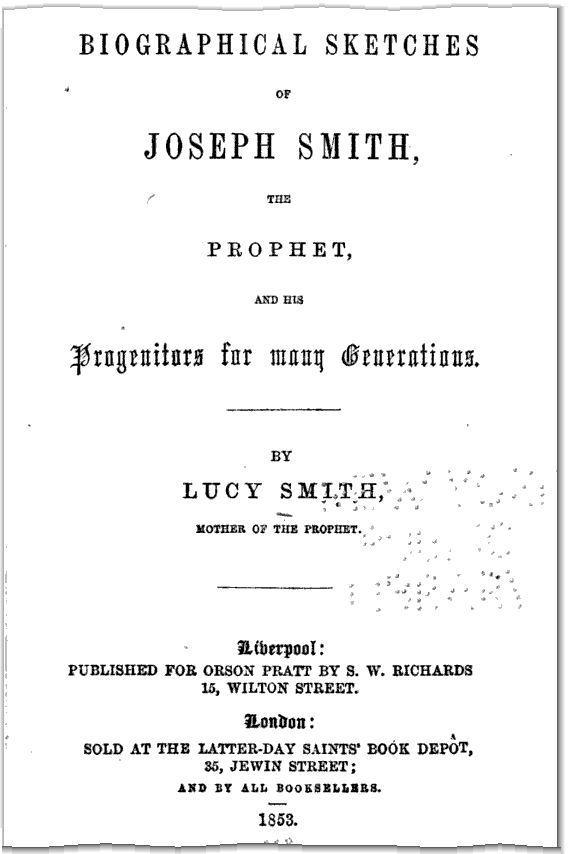
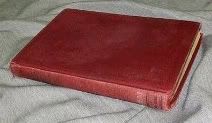
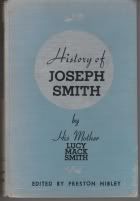
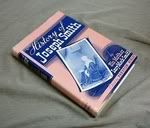
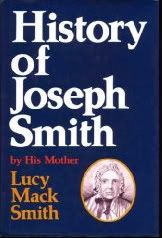
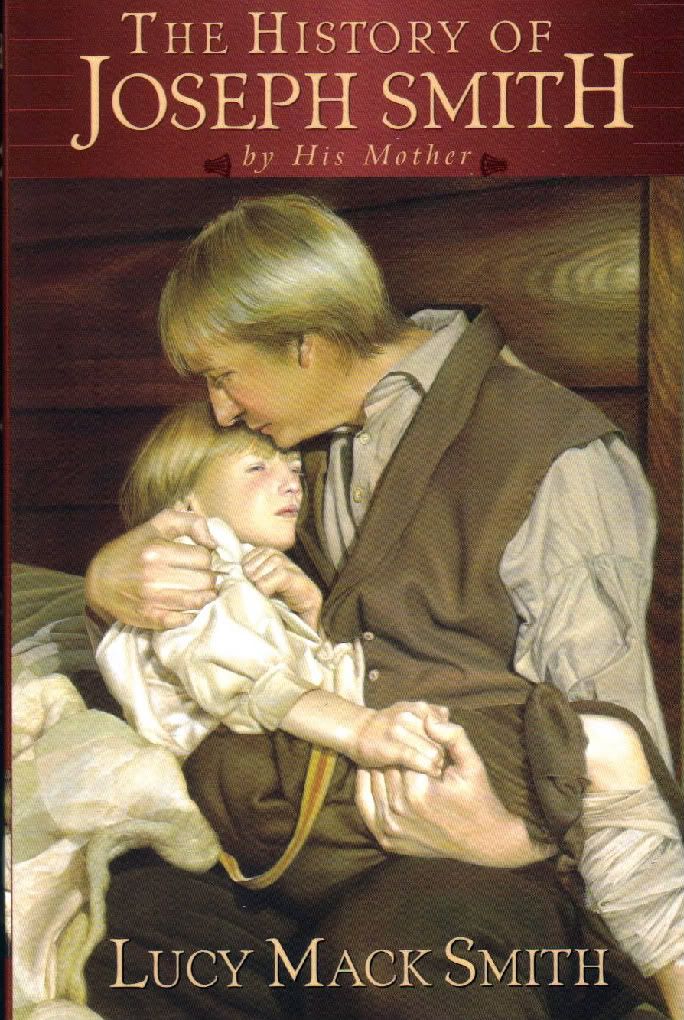
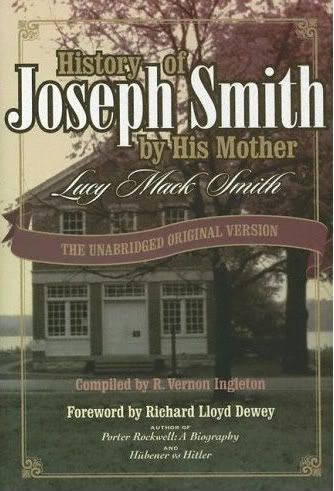
History of Joseph Smith by his Mother

In the early winter of 1844, shortly after the death of her son Joseph, Lucy Mack Smith sat down to write the history of the Restoration from the point of view of the mother of the Prophet. She had been approached by Church historian Willard Richards and the Council of the Twelve to provide details for the official History of the Church, and by others who were curious. As she told her son, William, she was tired of answering questions on the particulars of the coming forth of the Book of Mormon and other details of Joseph's life and she had “almost destroyed her lungs giving recitals about these things.” She “now concluded to write down every particular.” For this purpose, she engaged the services of Martha Jane Knowlton Coray to be her scribe. The result was a handwritten dictation of Lucy's reflections which survives today as the "Preliminary Manuscript.

Lucy's memoirs have gone through several versions as follows:

  • Preliminary Manuscript 1845
  • Coray revision 1845 ("fair copy")
  • Orson Pratt Edition 1853
  • RLDS Versions
  • Improvement Era Edition (serial, 1902)
  • Preston Nibley Edition 1954
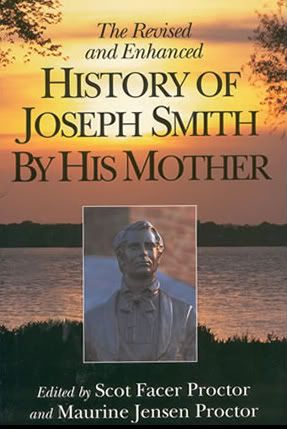
  • Proctor Edition 1996
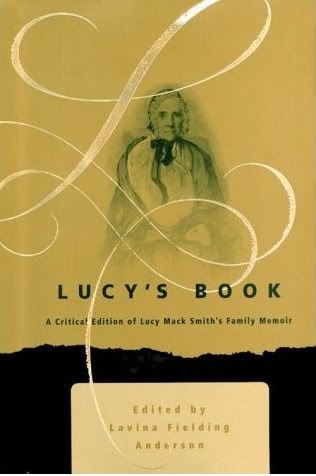
  • Lucy's Book, Lavina Fielding Anderson 2001
  • Ingleton Edition 2005

The history of each of these editions is fascinating. I'd like to recap some of the events in the publication of each. I have discovered that each of these reissuings of Lucy's story is unique and individual.

Preliminary Manuscript

This document includes approximately 210 pages of foolscap paper as well as several fragments and torn sheets. According to Joseph F. Smith, the manuscript was written from Lucy's memories, which she dictated to a scribe, Mrs. Martha Jane Knowlton Coray. Coray wrote with clear penmanship, excellent spelling, and little punctuation. The material follows a loose chronological order, with occasional corrections and additional notes added between the lines. Observers speculate that Martha wrote down Lucy’s dictation and then read it back to her for correction. It was copyrighted on 18 July 1845 by Lucy Mack Smith, which suggests that she read and approved the final version. The title page is as follows: "The History of Lucy Smith Mother of the Prophet...an account of the many persecutions, trials and afflictions which I and my family have endured in bringing forth the Book of Mormon, and establishing the church of Jesus Christ of Latter Day Saints." Martha supposedly retained the original copy of this book until she arrived in Utah with Brigham Young. The manuscript "resurfaced" in the 1960s in the LDS church archives.

In this raw, unedited manuscript, Lucy wrote a personal family history. Throughout its pages, she shares her feelings, includes intimate details, and often soliloquizes. Perhaps there are too many extraneous trivialities in the narrative. But the value of this manuscript is that it preserves Lucy's voice in a way that many of the later editions do not.

Coray Revision

Later in 1845, Martha Jane and her husband Howard, who had been one of Joseph Smith's clerks, worked to revise Lucy Mack Smith's manuscript. It has been suggested that “about one-fourth of the revised manuscript is not in the preliminary draft, while approximately ten percent of the earlier manuscript is omitted from the revised manuscript.” For example, Joseph Smith’s own version of the First Vision and Moroni’s first visit were included. Extracts from the "History of Joseph Smith" in the Times and Seasons were also used. The revised manuscript was commissioned and paid for by the Quorum of the Twelve. It was titled "History of Lucy Smith, Mother of the Prophet." A copy of this revision was given to Lucy and to the Quorum of the Twelve. Because of difficulties and persecution in Nauvoo, the manuscript was not published right then, but was taken along as Church leaders made their way West.

The value of this revision is that it gives an official history of the Church as sanctioned both by the mother of the Prophet Joseph Smith and the governing body of the Church at the time.

Orson Pratt Edition

By the time of Lucy Mack Smith's death on May 5, 1855, the Coray manuscript had been placed into the possession of her son, William Smith. Accounts differ as to who possessed it in the following years, but eventually it reached the hands of Isaac Sheen, a former LDS and RLDS newspaper editor who was living in Michigan. It was purchased from Sheen by Elder Orson Pratt, who was traveling East on his way to a mission in England. Pratt published the manuscript in Liverpool in 1853 under the title "Biographical Sketches of Joseph Smith, the Prophet, and His Progenitors for Many Generations." A secondary title page reads "History of Mother Smith, by Herself." In his preface, Pratt wrote:
"Most of the historical items and occurrences related have never before been published. They will therefore be exceedingly interesting to all Saints, and sincere inquirers after the truth, affording them the privilege of becoming more extensively acquainted with the private life and character of one of the greatest prophets that ever lived upon the earth."

A number of Orson Pratt's statements in the preface contained errors, primarily a statement that the book was written in the lifetime of the Joseph Smith and that he had read it with approval. Brigham Young opposed publication of Lucy's reminiscences, stating in the Millennial Star in 1855:
"There are many mistakes in the work… I have had a written copy of those sketches in my possession for several years, and it contains much of the history of the Prophet Joseph. Should it ever be deemed best to publish these sketches, it will not be done until after they are carefully corrected."

He also reportedly called it a "tissue of lies." But the book was very popular among the British Saints, and had already become available in Salt Lake City. Questions about the book were raised by Church historian and Lucy's nephew George A. Smith, who felt she had "considerably mixed up" the events she described. He and assistant historian Wilford Woodruff began writing inquiries to check the details of the book for accuracy.

In 1865, Brigham Young in a rather dramatic gesture orchestrated a recall of all the books which had been printed. The office of the First Presidency directed:
“We wish those who have these books to either hand them to their Bishops for them to be conveyed to the President’s or Historian’s Office or send them themselves, that they may be disposed of.”

In the Encyclopedia of Mormonism, Richard Lloyd Anderson describes this event in a rather more restrained fashion:
The first edition of Lucy's memoirs was recalled by Brigham Young. However, his goal was accuracy, not suppression, since he initiated a second edition. According to Wilford Woodruff's journal, the President charged the careful Woodruff and two Smith family members to "correct the errors in the History of Joseph Smith as published by Mother Smith, and then let it be published to the world."

A reproduction of the 1853 first edition was issued by Modern Microfilm Co., Salt Lake City, in 1965 with an introduction by Jerald and Sandra Tanner, and a printing by Arno Press and the New York Times was published in 1969.

RLDS Versions

An edition of Lucy Smith's history was published by the Reorganized Church of Jesus Christ of Latter Day Saints in 1880 as "Biographical Sketches of Joseph Smith the Prophet, and His Progenitors for Many Generations." It was republished in 1908 and in 1912 with notes by Heman C. Smith, and a paperback edition was printed by Herald Publishing House, Independence, Missouri, in 1969.

A preface to the RLDS version tells the story of how the 1880 publication was made possible after Brigham Young ordered the recall of the printed books:
"Under this order large numbers were destroyed, few being preserved, some of which fell into the hands of those now with the Reorganization. For this destruction we see no adequate reason; unless it be found in the fear that a plain story told by the mother of the first president of the church, might possibly convey views to the minds of its readers, opposed to the then ruling powers.

The present impracticability of giving a more extended and satisfactory history of Joseph Smith, under the supervision of the Reorganized Church; in connection with the fact that Elder E. W. Tullidge's work, "Life of Joseph, the Prophet," has been put upon sale, have determined the Board to publish this work without change in the text."

Thus the RLDS version is essentially the same as the Orson Pratt version, "with such additions as are deemed necessary, made by marks of reference and foot-notes. Nor do we vouch for the correctness of the statements made in the body of the work, being contented to let it pass with the statement that it is believed to be in the main correct." The RLDS version can be found online here.

Improvement Era Edition

After the recall of the 1853 publication, George A. Smith and Elias Smith were given the task of revising the history. In a journal entry, Wilford Woodruff said that Brigham Young "wished us to take up that work and revise it, correct it; that it belonged to the Historian to attend to it; that there was many false statements made in it, and he wished them to be left out, and all other statements which we did not know to be true, and give the reason why they are left out." As the historians worked on the manuscript, they realized that Lucy Smith's recollections were more accurate than they had thought. Names and events were found to be very reliable, and dates, when mistaken, were generally within a year or two of the precise time. Only a small amount of material was changed. Dates in the genealogical portion were corrected, grammar was improved, and statements that seemed unfavorable to the image of Joseph Smith or the Church were omitted. No indication was made where the text had been altered nor the reason.

The corrected version languished until 1901 when the Improvement Era received permission to publish Lucy Mack Smith's story in serial form. In November 1901 publication began, with an introduction by the new prophet and Lucy's grandson Joseph F. Smith. The series continued throughout 1902.

Preston Nibley Edition

The 1902 edition was further edited with notes and comments by Assistant Church Historian Preston Nibley in 1945 and published by Bookcraft of Salt Lake City under the title "History of Joseph Smith By His Mother, Lucy Mack Smith." The first paperback edition is the one I read when I joined the Church in 1979. There were many editions of the Nibley version. I have seen the following editions available for sale: 1945, 1954, 1956, 1957, 1958, 1979, 2000, 2004. In 2004 the Nibley version was published in an illustrated paperback edition by Covenant Communications Inc. with paintings by several well-known artists. A partial text can be found online here.

The Nibley version made Lucy Mack Smith's history available to large numbers of readers for the first time. The dates had been corrected and the history correlated well with established historical events.

Proctor Edition

Husband and wife team Scot and Maurine Proctor brought together for the first time the Preliminary version of Lucy Mack Smith's manuscript and the later, edited versions. In 1995 and 1996 they were permitted to study and typescript the original manuscript in the Church archives, and in 1996 published "The Revised and Enhanced History of Joseph Smith by His Mother." Their book was also serialized in the online Meridian Magazine.

The 1853 version was used in this book to supply structure and chapter divisions, and the Preliminary Manuscript was used to add a major source of text. The Proctors explain that in their edition, Lucy’s voice is heard more clearly and her sentiments and perceptions are explored more openly than ever before, because the Preliminary Manuscript is the foundation of the text.
"Where Lucy is incorrect in dates or names, corrections have been made in the text and the changes often footnoted. No attempt has been made to restate her sentences in more polished prose or improve her vocabulary. She stands well on her own and thus the edits are light. Where transitions or explanations are necessary and not available in the Preliminary Manuscript, the 1853 text has been used. However, to save the text from becoming tedious, every shift between the Preliminary Manuscript and the 1853 edition has not been noted. The motivation was to find Lucy buried in the material, be true to her voice, and at the same time create a book that was accessible and inviting to a wide audience."

In this vein, spelling and punctuation have been standardized to facilitate readability. Photographs of the places Lucy describes as they appear today are included to add a visual dimension to the story. In addition, maps have been added to give the reader a sense of location and proximity.

The Proctor edition will probably appeal to the general LDS reader because of its modern style and historical accuracy in an editorialized reading narrative. It preserves much of the essence of Lucy's conversational style and spiritual tone.

Lucy's Book

Lavina Fielding Anderson's version of the Lucy Mack Smith memoir is a remarkable achievement, surpassing all those which have gone before. It was published by Signature Books in 2001 and comprises 968 pages. In order to compare the Preliminary Manuscript with the 1853 edition, it is arranged in parallel columns. Significant variants from later printings are indicated in the editor's footnotes, with prefatory chapters that provide historical background and textual genealogy.

Anderson is critical of how the church hierarchy treated Lucy and her book. She writes:
"Overreaction is perhaps the most charitable way to characterize the rather obvious discrepancy between the staggering official denunciation and the relatively minor and infrequent errors (if indeed they are genuine errors) that Lucy actually makes... It is distressing to see the president of the church slander the mental competence of a seventy-year-old woman when the documentary record...shows otherwise. It is unpleasant to hear a man revered as a prophet sneer at the faithful mother of twelve...dismissing her as a sensation seeker and novelist. And it is particularly disappointing to hear him justify these behaviors by accusations that the book is a 'tissue of falsehoods,' an accusation that, on close inspection, is itself a falsehood."

Of this edition, reviewer Gary Topping wrote:
"As important as this text is for Mormon history, the editor rightly emphasizes its equal importance as a spiritual autobiography and as a primary source on women's domestic and larger cultural roles during the early republic."

The scholarly nature of the Anderson edition makes for more difficult reading. It is better suited for intense periods of study. This edition is of great interest to historians and useful for in-depth study of both the memoir itself and the wider Church history it encompasses.

Ingleton Edition

In 2005 Stratford Books published R. Vernon Ingleton's "History of Joseph Smith By His Mother, Lucy Mack Smith: The Unabridged Original Version." In 504 pages Ingleton has been able to present the Preliminary Manuscript as well as the corrections added later by church historians. He puts deletions from the Preliminary Manuscript in brackets and insertions in italics. A detailed preface makes sense of all the different versions and their copyrights.

R. Vernon Ingleton has done a commendable job of putting all the elements together to allow Lucy to tell her story in its entirety in an easy-to-read format. This edition is vital for those who are interested in comparing the differences in various versions without the many extra historical details and analysis that is evident in Anderson's version.


Lucy Mack Smith's memoir is a valuable part of Latter-day Saint history. It is a fascinating endeavor to trace its path over the last 165 years. Each revision and edition reveals the concerns and values of Church members and leaders. Lucy herself wished to make public many particulars of the restoration and her family to which she alone was privy. The Corays and the Quorum of the Twelve at the time of Joseph's death wished to expand the manuscript to include a more detailed history of the Church while minimizing personal family details deemed unimportant to the broader history. Orson Pratt was eager to acquaint as many Saints as possible with the private life and character of Joseph, the Prophet of the Restoration. Brigham Young was concerned with succession issues. He feared that Lucy's emphasis on lineal priesthood might undermine the Utah Church's authority. The RLDS, on the other hand, were eager to perpetuate such a record.

George A. Smith and Wilford Woodruff, and later Preston Nibley, were concerned with the historic accuracy of Lucy's record, and worked to correlate it with early Church history, especially regarding particular dates. But in modern times, the original words of Lucy Mack Smith were considered much more valuable than they had been in the past. Authors and readers began to value a competent and strong female voice and her perception of the Restoration. These modern versions have vied with each other in balancing readability with historical analysis. The Proctors have produced a popular synthesis of Lucy's history, Lavina Fielding Anderson has provided historical depth, and Vernon Ingleton has presented a way to compare and contrast the century and a half of the Smith memoir.

I write this post with the hope that it will assist in navigating among the different editions to help you choose which one will best suit your study of this vital female perception of our history.

Friday, September 5, 2008

More Longing For Home

While reading Eckhart Tolle's A New Earth, I encountered his explanation of alienation. He discusses a feeling described by some of the great twentieth-century writers such as Franz Kafka, Albert Camus, T.S. Eliot, and James Joyce.

"Alienation means you don't feel at ease in any situation, any place, or with any person, not even with yourself. You are always trying to get "home" but never feel at home."

Tolle calls this the "universal dilemma of human existence. This is a condition described by Christians as "homesickness for heaven." The idea is that since we are heavenly creatures, we don't and shouldn't ever feel completely comfortable here on a fallen earth. The book of Hebrews mentions this condition in the famous "faith" chapter:
These all died in faith, not having received the promises, but having seen them afar off, and were persuaded of them, and embraced them, and confessed that they were strangers and pilgrims on the earth. For they that say such things declare plainly that they seek a acountry. And truly, if they had been mindful of that country from whence they came out, they might have had opportunity to have returned. But now they desire a better country, that is, an heavenly: wherefore God is not ashamed to be called their God: for he hath prepared for them a city. (Hebrews 11:13-16)

Tolle claims to have an answer to this dilemma of human existence. His book details how a seeker can awaken to the inner soul and disassociate from the mind, or the ego. I appreciated many things about Tolle's rather new age thinking, and I wonder if it can be accomodated within Christian thought. Have you ever felt this "longing for home," this feeling of being a stranger upon the earth? Do you think scriptural teaching supports Tolle's proposition that humans can overcome their natural man and become integrated beings by getting in touch with the true self? Is this something we can accomplish while here on the earth, or will we always be a little homesick for our heavenly abode?

Thursday, August 28, 2008

My Week With the Vampires

I took a short break from blogging to have a marathon reading of the Twilight series--no, I won't be apologizing for it! I'm a reader of everything and anything, and there is very little that I don't enjoy in some way. This series was no exception. Just mark me down as another middle-aged woman making an escape into the thoughts of a pretty teen-aged girl with two immortally gorgeous men madly in love with her. These books were marginally better than the standard romance novel as they dealt with themes of good and evil and, interestingly, the theme of restraint. The "family" of good vampires Stephenie Meyer writes about have decided to live on the blood of animals rather than indulge their blood lust for humans. And Edward, the main heart-throb, valiantly holds back his all-consuming desire to gobble up his ingenue girlfriend, Bella.

I've been fascinated by the interest for these books among Latter-day Saint readers. Personally, I don't censor my children's reading--I'd rather discuss the disturbing parts with them--but occasionally if I find them bringing home trash I will apply my favorite test: Mom reads the spicy parts of the book aloud in the kitchen, embarrassing the teenagers so much that usually the book is immediately returned unread. Were I the type to censor, however, I'd probably include the Twilight series in my list of "inappropriate for Mormon teens."

Latter-day Saint reviews of Meyers' novels tout them as being clean and sex-free, but nothing is farther from the truth. In these books, desire is thinly veiled as blood lust. Although Edward resists, it is always on his mind, and drives the book from page to page. Beginning with the third novel, Bella begins to actively tempt Edward to consummate their relationship, both with physical sexual relations (so she can experience love as a mortal) and with blood-letting (so she can afterward become his immortal companion).

The goriness found in each of the books was something I found unpleasant. Though not enough to bother a generation raised on prime time TV, there were many graphic descriptions of war, cruelty to animals and a bloody childbirth rivaling scenes from The Exorcist.

Another reason I might restrict this series from my children is that I detest young adult literature that portrays parents as goof-balls. Bella's divorced parents are barely functional. After basically caring for her neglectful and emotionally immature mother during her childhood, Bella goes to live with her father, who seems unable to feed himself as well as being clueless as to her activities and blissfully unaware that Edward spends each night awake in his daughter's bed as she sleeps entwined in the vampire's cold arms.

I will say that the novels are engaging and interesting. Though the characters are one-dimensional, they have charm and personality. One of the criticisms of the Twilight series has been gender roles, and this is one that I looked for as I read. I found that in the end, I was not too disturbed by this aspect of the books. Yes, Bella is a young and annoying "fainting female" protagonist wooed by a 107-year-old male chauvinist. But in a literary sense, her lack of restraint is a foil for the continence practiced by the vampires. Her inability to sever her relationship with the other male love interest, the shape-shifter Jacob, may be irritating at times, but it contributes to this theme and adds conflict and tension to the story. In the final book, Bella has developed as a character and as a woman. She defends and stands by her choices despite the males' pressure. She discovers and gets in touch with her unique abilities. She is able to use her formidable force to protect her loved ones and repel the forces of evil, rather than depending on the male figures for rescue, as she did at the end of the first book.

In the end, I can't find myself being too critical, although Bella will never replace Buffy in the hearts of vampire afficionados.

Thursday, July 10, 2008

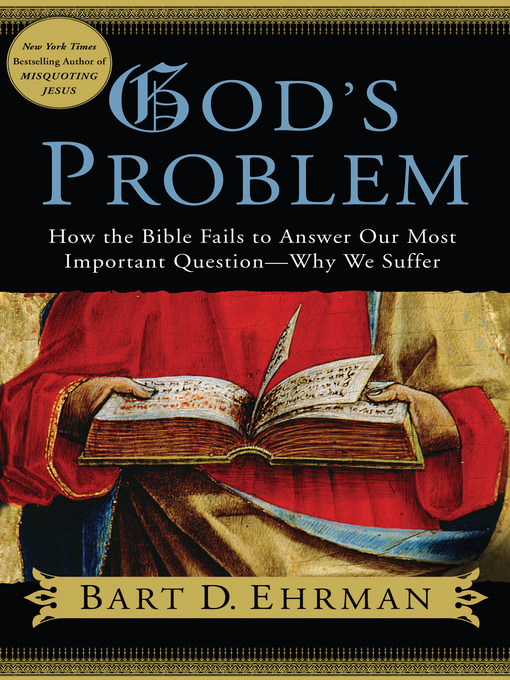
Bart's Problem, Or: How His Interpretation of the Bible Fails to Answer His Most Important Question

Now that I have finished reading God's Problem, I see that the entire work serves as an apology for why Bart Ehrman can no longer believe in the Christian faith. Ehrman, a fundamentalist born-again Christian, feels hurt and betrayed that the Bible is contradictory. Instead of seeing scripture as a collection of different people's attempts to make sense of God, (which is how I like to look at it), he points out its failure to present a cohesive answer to the question of why suffering exists. I can't help but feel that the man, not being able to fit the Bible to his fundamentalist theology, rejects it wholesale. He refuses to believe in a God who doesn't directly intervene in human affairs. He now self-identifies as an agnostic: "If there is a God, he is not the kind of being I believed in as an evangelical" (p. 125).

Instead of looking for a Deity that might more closely fit Biblical and philosophical thought, Ehrman completely rejects Christianity and uses the book as a soapbox to explain why there is no answer to the question of why God allows human suffering.

Since the problem is complex and there are many attempts by Biblical authors to address the question, it is not surprising that Ehrman's attempt fails. He has presented three main interpretations to the problem of theodicy and discussed each separately, pointing out the difficulties with each. I appreciate his efforts to make this subject understandable to the general reader. But in doing so, he has greatly oversimplified what philosophers have been grappling with for centuries. Perhaps there is more than one reason why God allows pain and evil to exist. (Come back tomorrow as I present an interesting LDS attempt to consolidate them!)

I also had issues with Ehrman's interpretation of the Bible. He jumps back and forth between what he presents (and ridicules) as the "Christian" view, and a more secular interpretation. Neither, in my opinion, is doctrinally correct. Just one example is his refusal to see a Messianic figure in any of the Old Testament writings, though the New Testament authors clearly present Jesus as the fulfillment of prophecy. A review of this book at Time magazine opines:
...his biblical expertise is a help and a hindrance, since his conceit is to
examine only explanations of suffering that appear in Scripture.
I would add that his conceit is to examine only his interpretation of what scripture has to say about the subject, ignoring those explanations presented by other theologians which he considers "pat," "simplistic," or "flawed." Having read Ehrman's Misquoting Jesus, which I felt was very thoughtful and enlightening, I was disappointed in this book.

Bart's problem may come down to one of human pride. Because he with his superior intellect and advanced Biblical training doesn't fully understand how a good, all-powerful God can coexist with a world that includes suffering, he assumes that God must therefore not exist.

Wednesday, July 9, 2008

I Don't Have a Problem With it...

Today I'm reading Bart Ehrman's God's Problem with the Exponent 2 group. I read another book of his, Misquoting Jesus, and reviewed part of it here for a Mind on Fire reading group. I adore this author for his zeal as a born-again Christian, seminary student and minister, and also for his later searching, questioning and doubting.

There are many problems with Christianity that I struggle with, but the one which led Ehrman out of traditional belief isn’t one of them. Not that it isn’t fascinating to read about Ehrman’s crisis of faith, because I can relate to this struggle.

He posits three assertions that all seem to contradict each other:

God is all-powerful

God is all-loving

There is suffering
Ehrman says that theologians and philosophers cannot reconcile all three. But for me, it makes sense that if suffering transforms us into the kind of being we need to become, God will allow this suffering because he loves us, and he will not use his power to take this suffering away.

Heb. 2:9-11 tells of how Jesus was made perfect through his suffering, and that we are sanctified the same way.

Now, I’m not finished with the book yet (just got it from the library yesterday!) but skimming through the part I haven’t read, I don’t see that Ehrman really addresses this view. The closest he comes is his notion of “redemptive suffering” where suffering can bring glory to God, or a greater good. He wonders why an all-powerful God could not have brought about the greater good in a different way.  He also covers the explanation I hear from Mormons all the time, about how God allows free agency, and he blasts that one pretty well.

As far as I have read in the book, he really hasn’t considered the view that suffering makes us saints (or gods, in the LDS view), and though suffering causes earthly pain and anguish, it really is the best way to make us more compassionate and perfected beings. 

I'll probably have more to say about this book as I get further into it.  Until then, please go visit Exponent 2 blog and participate in the discussion!

Friday, May 9, 2008

Dialogue on Polygamy

It's quite an interesting synchronicity that both of the articles on Mormon polygamy which appear in this quarter's Dialogue journal were prepared in advance of the events which took place among the FLDS in Texas. Thus, they do not specifically address the event, but they do join and contribute to an important dialogue about polygamy and Mormonism.

Ken Driggs is a lawyer who did a graduate degree in legal history at the University of Wisconsin Law School. His thesis discussed the legal rights of the FLDS at Short Creek in 1953. A portion of this thesis appeared in the Utah Historical Quarterly as "Who Shall Raise the Children? Vera Black and the Rights of Polygamous Utah Parents." Earlier this week a blog post appeared telling the tragic story of Vera Black's son Wilford. The boy was placed in custody at the age of 6, suffered from post-traumatic stress syndrome, stopped communicating with others, and was unable to live a normal life thereafter.

Ken's article, "A New Future Requires A New Past," discusses the recrafting of Mormon history by the mainstream Church, deemphasizing teachings such as polygamy, the "One Mighty and Strong," Mother in Heaven, Jesus' possible earthly marriage, and the United Order. I have discussed some of these subjects in my own blogging. I share with Ken a feeling of disorientation as the Church jettisons many of these beliefs but I recognize that modern-day Mormonism is easier for mainstream Christians to embrace as they enter the Church. Though Ken presents his views from a faithful perspective, he concludes his piece with a hearty, "And don't tell me the Church is never changing."

A second article, "Polygamy, Mormonism, and Me," was written by Carmon Hardy, an LDS historian who has written extensively on the topic of post-Manifest polygamy. His recent book, Doing the Works of Abraham: Mormon Polygamy, Its Origin, Practice and Demise came out in 2007 as part of the Kingdom in the West project spearheaded by Will Bagley. This piece was a bit more disappointing to me than the first. It is billed as part of a series "Avenues to Faith," which "looks at how historians, creative writers, administrators, educators and scriptural scholars have dealt with some of the classic problems in Mormon history." Thus I was expecting and hoping for some reasoned musings on how to fit our polygamous origins into a faithful Mormon paradigm. Instead, page after page of this article presented the classic story of an intellectual's exit from Mormonism. Though Carmon protests (too much!) that polygamy in itself did not threaten his religious convictions, the story is all too typical: LDS member encounters dissonance--loses faith when his prayers and questions are not answered--has a bad experience at Church archives--is interviewed by Church leaders (in his case by his BYU employers) and asked to explain his research--is asked not to pursue his research--leaves BYU and later the Church.

So Carmon provides little in the way of integration of polygamy as practiced in the early Church into present-day LDS thought. But he does, in the latter half of his essay, identify some of the problems we face. Many LDS members are not aware of the strong arguments for plurality which were presented to early members and the world at large. Men and women were told they would be stronger, healthier, and begin to live as long as the ancients through practices associated with plural marriage. They were told their exaltation depended upon the practice. Eugenic superiority, social gifts, and greater happiness were promised, and women were told they could thereby escape the curse of Eve. After the Manifesto, 20 years of equivocation by Church authorities is documented by Carmon Hardy's investigations. His research uncovered at least 200 and possibly up to 300 post-Manifest marriages between 1890 and 1910. These marriages can be shown to be approved by the upper eschelon of Church leadership and contracted among the most faithful of Church members. But once the Church began to move away from the practice of polygamy, the emphatic way that this was done is quite amazing. Unfortunately this included mistruth in public discourse--what Hardy terms "lying for the Lord."

The only glimpse the reader is given into Carmon Hardy's personal evaluation of this information is buried in a footnote: "though my dominant historical interest remains with those many-wived, patriarchal stalwarts of the old Church, I have found today's polygamist dissenters not only welcoming but as gentle and sincere a people on the whole as their nineteenth-century predecessors."

Once again, Dialogue: A Journal of Mormon Thought has provided timely material of interest to all within the Latter-day umbrella. The journal was mailed early this week and should be arriving in mailboxes even as you read this review. I was pleased this quarter to see the online version posted along with the mailing, making my online subscription convenient and accessible. Enjoy a peek at this issue by clicking the link on my sidebar.

Thursday, April 10, 2008

GoodReads and Me

I must admit, when I got my first invitation to join GoodReads, I was hesitant. Since I've been in Saudi, my reading has been...eclectic. I blame it on not having the access to books to which I am accustomed. I know there is a public library here in Riyadh, but I'm not sure if expats are allowed to check out books. And since I don't have a car or driving privileges, logistics of how to get there are complicated. I don't have a reliable post office address, so I haven't ordered any books on line for the entire 8 months we have been here! Books in most stores are written in Arabic, and at the bookstore the books in English are quite expensive. I have, however, tapped in to the active book exchanging that happens among the faculty at our university. But it means that I am at the mercy of reading whatever passes into my hands, from classics to pulp fiction.

It's OK for me--I truly can read anything that comes my way. But I didn't know if I wanted all my highbrow friends to see what I was reading. The first friend I added had written this about The Time-Traveler's Wife:

Getting through the foul language and the sexual references in this book was not enjoyable. It had been highly recommended to me but to be honest, I found very little to recommend in this book.

No way! I loved that book! I read it a few years ago, but...there was foul language in it? Oh well, guess I didn't notice that part...

Well, I've finally broken down and joined up. GoodReads is a great way to encourage reading and to discuss books. (Did I mention I love discussing books?) You just sign up, add your friends, and then put books you have read or want to read up on your account. I decided I didn't want to go back and add every single book I have ever read. (Too much work!) So I'll just review my books as I read them. And I'll stop trying to impress my friends with my choice of reading material.

If you would like to join my friends list, just send me your email here or at clbruno at hotmail.

Tuesday, February 12, 2008

Valentine's Day 2008, A Silver Stud

I hope DH doesn't feel offended, but I found someone to make my heart go "pitty-pat" this Valentine's Day. It's Poet Laureate and Pulitzer Prize winner Ted Kooser. (hat tip: Amelia) Some of you young male bloggers can pick up a few tips from this guy! Kooser admits that he started writing poetry as a young man with the goal of gaining female attention. In those years," he said, "I desperately needed some sort of a gimmick, for I was thin and pimply, my palms sweated, and my breath was sour from smoking the Chesterfields that despite the claims of magazine advertising had failed to make me irresistible. I got the idea that being a poet might make me attractive. It didn't occur to me for a long time that in order to earn the title of 'poet,' I ought to have written at least one poem. Being a poet was looking the part.

Oh, Mariachi Me

All my life I have wanted nothing so much
as the love of women. For them I have fashioned
the myth of myself, the singing troubador
with the flashing eyes. Always for them
my black sombrero with its swinging tassels,
this vest embroidered with hearts, these trousers
with silver studs down the seams. Oh, I am
Mariachi me, as I had intended. I am success
and the price of success, now old and dusty
at the edge of the dance floor, still smiling,
heavy with hope, clutching my dead guitar.
Ted Kooser, Valentine's Day 2006

He seems to have learned a lot since his early days! Now, he gives Valentine advice such as this: "Any kind of handwritten message to anyone else is a plus, even if it isn't a great work of art. Love letters are a wonderful gift, even when poorly written." BiV can only heartily agree. (Are you still reading, DH?) Kooser said men, in particular, fall back on the old standards: a dozen roses and a box of chocolates.

"That's OK, but my guess is a handwritten letter would convey a lot more. But I wouldn't want to deprive women of roses and chocolates." That Kooser understands the secret longings and fears women experience is obvious from this tidbit:
If you feel sorry for yourself
this Valentine's Day, think of
the dozens of little paper poppies
left in the box when the last
of the candy is gone, how they
must feel, dried out and brown
in their sad old heart-shaped box...
(Excerpt of Ted Kooser poem "If You Feel Sorry")

February 14th became a special day for this romantic soul, and in 1986, Kooser mailed one of his efforts, "Pocket Poem" to 50 female friends for Valentine's Day. Kooser continued the tradition (approved by his wife), and did it for the next 21 years. He spent time and money tenderly applying little red hearts to the cards, boxing them up and sending them to a different post office just so they could be postmarked from Valentine, Neb. Isn't that just too sweet for words?? Eventually, over 2,500 women received a yearly poem from the Nebraska poet.
If this comes creased and creased again and soiled
as if I'd opened it a thousand times
to see if what I'd written here was right,
it's all because I looked too long for you
to put it in your pocket. Midnight says
the little gifts of loneliness come wrapped
by nervous fingers. What I wanted this
to say was that I want to be so close
that when you find it, it is warm from me.
Ted Kooser, "Pocket Poem," Valentine's Day 1986

What I love most about Kooser's poems is that although he is a romantic, he appreciates depth and variety in women. The woman he describes in the poem "Selecting a Reader" is priceless, and she demonstrates that his definition of beauty is nuanced:
First, I would have her be beautiful,
and walking carefully up on my poetry
at the loneliest moment of an afternoon,
her hair still damp at the neck
from washing it. She should be wearing
a raincoat, an old one, dirty
from not having money enough for the cleaners.
She will take out her glasses, and there
in the bookstore, she will thumb
over my poems, then put the book back
up on its shelf. She will say to herself,
"For that kind of money, I can get
my raincoat cleaned." And she will.

Kooser's poems avoid over-sentimentality and often have unexpected twists. There's a dark, seductive, almost ravenous side to the poem "Barn Owl" that will give you the shivers...
High in the chaffy
Taffy colored haze of the hayloft,
Up under the starry nail-hole twinkle of the old tin roof
There in a nest of straw and bailing twine
I have hidden my valentine for you

A white heart woven of snowy feathers
In which wide eyes are welcome
Open to you as you climb the rickety ladder to my love

Behind those eyes lies a boudoir of intimate darkness, darling
The silks of oblivion
And set like a jewel dead center in the heart
Is a golden hook the size of a finger ring
To hold you always
Plumpest sweetheart mouse of mine.
(Here he is reading the poem aloud, in his adorable, self-deprecating manner: (KooserBarnOwl)

And yet, although Kooser has now passed the landmark of 60 years old, he retains the sweet shyness of youth, as evidenced in the poem, "Tracks:"
Using a cobbler’s shoe last
I found one summer at a yard sale,
and the heavy leather uppers
from cast-off boots, a jigsaw,
some wood, an awl and thread,
and a few evenings sitting alone
thinking of you, I have fashioned
a pair of red valentine shoes
with heart-shaped wooden heels.
Look for my tracks on your doorstep
where I stood with sore feet
through the evening, too timid to knock.

Kooser's Valentine postcards are now available to all in the form of his newly published book, "Valentines." A review describes it thus, "Kooser's valentine poems encompass all the facets of the holiday: the traditional hearts and candy, the brilliance and purity of love, the quiet beauty of friendship, and the bittersweetness of longing." I just can't get enough of these love poems. Will you read just one more?
After Years

Today, from a distance, I saw you
walking away, and without a sound
the glittering face of a glacier
slid into the sea. An ancient oak
fell in the Cumberlands, holding only
a handful of leaves, and an old woman
scattering corn to her chickens looked up
for an instant. At the other side
of the galaxy, a star thirty-five times
the size of our own sun exploded
and vanished, leaving a small green spot
on the astronomer’s retina
as he stood on the great open dome
of my heart with no one to tell.

So, guys, if you haven't already bought a diamond bracelet or box of chocolates, hie thyself to the nearest bookstore and pick up a copy of Kooser's book. Write your own ditty, be it ever so humble, and tuck it among the pages, where it will be cherished in years to come. And in the best of Kooser tradition, get an extra copy and send it to that older lady you home teach.

Monday, August 20, 2007

March

While you're waiting to hear from me, I thought I'd post a book review on the last book I read while in the States: March, by Geraldine Brooks. This is a great book for the light novel reader--not too difficult to read, but with some substance to it. Brooks has drawn her inspiration from Louisa May Alcott's Little Women, and has written the story of the absent father, Mr. March, who has gone off to aid the Union cause in the Civil War. She has loosely based this character on Louisa Alcott's own father, Bronson Alcott.

Bronson Alcott sounds like a man with whom I would love to become acquainted. He was a transcendentalist philosopher, educator, and abolitionist. He counted among his closest friends Ralph Waldo Emerson and Henry David Thoreau, and his name appears frequently in their letters and journals. It appears that Brooks had plenty of material to study in forming the character of Mr. March, as Bronson Alcott recorded his own life in 61 journals and his letters fill 37 manuscript volumes in the Harvard College Library.

Brooks has done a wonderful job of creating a life and voice for Mr. March. As a callow youth, he shows little thought for the evils of slavery, but he gradually encounters Negro slaves in the South and becomes enlightened. The book takes him through his marriage to Marmee, the loss of his fortune in attempting to advance the abolitionist cause, and his tortured decision to join the Union Army as a chaplain. While experiencing the horrors of war, he loses his innocence and becomes a tortured soul.

It is this character, portrayed near the end of the novel, who captured my imagination. The following excerpt from the novel recounts Mr. March's thoughts as he leaves the hospital and prepares to return home to his anxious family:

You go on. You set one foot in front of the other, and if a thin voice cries out, somewhere behind you, you pretend not to hear, and keep going.

But some steps require more effort than others. As I set my foot upon the path leading to that little brown house, I felt like an impostor. Surely, I had no business here. This was the house of another man. A man I remembered. A person of moral certainty, and some measure of wisdom, whom many called courageous. How could I masquerade as such a one? For I was a fool, a coward, uncertain of everything.

Had I been alone, I might have turned back then, melted away like the snow on that bright, mild morning, become a particle lost in the vast spate flowing through the landscape of war, so that my daughters could live with the unsullied memory of that other man, and not be obliged to know this inferior replacement.

But I was not alone. John Brooke had a firm grip upon my arm and the young Lawrence boy pranced brightly ahead of us, barely able to contain his excitement. He was carrying on as if he brought some bright-wrapped, welcome Christmas gift. If only he knew for what shoddy goods he was the forerunner. I pulled my muffler up high around my face, so as to hide the trembling at the corners of my mouth. Truly, walking up that path was an act of courage greater than any asked of me at war.

To those who have experienced uncertainty, and have faced their own weaknesses in the darker parts of their souls, this character will seem familiar. This novel builds in complexity when, at its apex, one comes to see the differing points of view of several of the characters, and that things are not always as they seem. I loved the shades that the author adds to Marmee. In Little Women, the mother is a paragon of virtue, but in life one can hardly live up to this standard. Here Marmee is shown as a noble, but real person. Without reservation, I would put this novel beside my copy of Little Women upon the shelf.

Tuesday, April 17, 2007

Little Purple Pansies

I joined the Church as a 19-year-old college student in North Carolina. Soon I received my first calling. I was to be the Primary chorister. I loved to sing, but this was extremely stressful. I didn't know how to conduct music, and I knew none of the Primary songs. The pianist helped me learn some basic patterns, and each week I would go to the basement of my dorm where the piano was located. With one finger I would painstakingly pick out the melody and teach myself the song, then practice conducting it. I'd make a poster, a visual, or a game. I'd spend several hours preparing, and the entire week worrying. One week the new song I was to teach was "Little Purple Pansies," a song not included in our current Primary book. I thought the words had a great message, and I still remember them:

Little purple pansies touched with yellow gold,
Growing in one corner of the garden old,
We are very tiny, but must try, try, try,
Just one spot to gladden, you and I.

In whatever corner we may chance to grow,
Whether cold or warm the wind may ever blow,
Dark the day, or sunny, we must try, try, try
Just one spot to gladden, you and I.

I had a wonderful visual/game for this song, and I knew all the words by heart so I wouldn't be bound to the book. Unfortunately I also had an entire row of 11-year old boys in the back. That day they decided to sing, "Little purple panties." The one song all year they sang at the top of their lungs. "Little purple panties touched with yellow gold...hahahahaha!" I had not choice but to continue with the song, as I knew no others. It was pure torture.

Perhaps because of this horrific experience, I now sometimes have reservations that one purple pansy in a tiny corner of the world can make any difference. I consider myself an idealistic person, and I'm involved in several "causes." But I often despair that my small efforts can have any influence in the world.

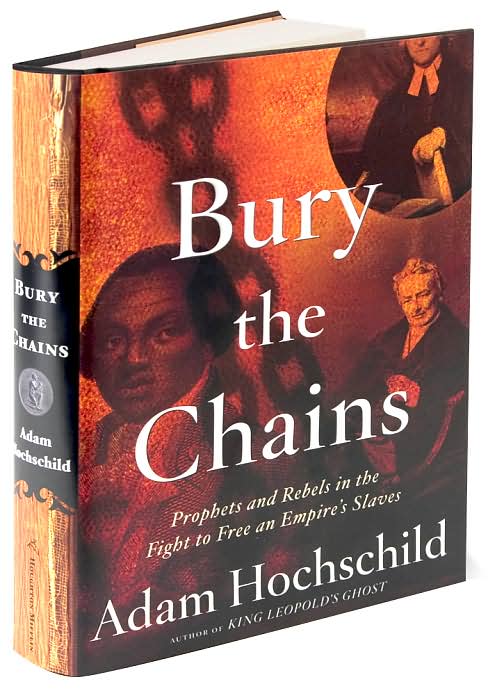
When John Remy introduced our Book Club selection for this month, Adam Hochschild's Bury the Chains, I was enthralled by his introduction. The book is about a small group of Quakers who started a movement which eventually resulted in the abolition of the trans-Atlantic slave trade. John says, "I’m not selling Quakerism here, folks. I’m selling idealism. In a generation or two, deeply entrenched, unjust attitudes can be reversed by the focused and passionated efforts of a few."

I got my book in the mail last week, and I've read the first three chapters. Although a history book, it is as readable as a novel, with a great story line and fascinating characters. I'm already enamored with John Newton, a man with a great love, great ambitions, and great weaknesses. In the first chapters, I've already encountered the doubts an idealist can experience as they run up against the status quo. Olaudah Equiano, a free black man in England, attempts but fails to rescue a friend of his who is seized and placed on a vessel bound for the West Indies.

"Equiano could paint his face and pass for white, at least in the dark; he could navigate skillfully through the white world's law courts and networks of influential people. But he was powerless to stop a black friend from being plunged back into slavery and tormented to an early death. Only a tiny minority of people in Britain openly oppposed slavery, and he and [Granville] Sharp (a lawyer) were almost alone in having actively tried to help its victims. He sank into a despair so bitter that he went to sea again and resolved "never more to return to England."

I feel deep in my soul that there are things we as individuals have promised the universe we will do. I think though we may try to escape, we will always have a profound interest and investment in these things, and be led to them over and over. I'm hoping as I read this book, it will rekindle within me a greater idealism and desire to discover and accomplish my vocation.

Wednesday, January 31, 2007

Misquoting Jesus Chapter 4

The most significant thought I absorbed from the reading of the book Misquoting Jesus was not stated overtly in Chapter 4, but once I learned this principle it permeated the rest of my reading. Bart Ehrman suggests throughout this work that the writers of the Christian books of scripture each have their own perpectives and valuable things to teach us. Textual criticism can bring us closer to the actual words of the authors and help reconstruct their understanding of the Christian faith. (p.14) Previous to my reading this book I approached the New Testament with a "harmonization" tactic, attempting to fit the ideas of the different authors into a cohesive whole. With Ehrman's instruction I see the value of taking each writer on his own terms and discovering their intent in writing. For example, Luke wishes to present Jesus as full of confidence in his divine mission, never losing control, never in anguish over his fate. (p. 143) This portrayal will necessarily conflict with an author such as Mark, who focuses attention on Jesus' agony. Mark emphasizes Jesus' distress and agitation at Gethsemane, his thrice-repeated prayer for the cup to be removed, and his despair on the cross. (p. 142)
Understanding this paradigm opens one up to studying the writers of the New Testament books with a deeper understanding. Their themes and motivations become more clear despite mistakes in transmission and the changes of scribes to try to harmonize the accounts and clarify the doctrine.

Chapter 4 discusses textual variations in detail. Several conclusions can be drawn from the fact that so many textual differences exist. Ehrman mentions three main conclusions drawn from a faith-based perspective:

1. From the tradition of Richard Simon, a French Catholic author: the Christian faith can not be based solely on scripture but requires the apostolic tradition preserved in the (Catholic) Church. (p. 102)

2 From Daniel Whitby's response to Mill's Apparatus: Errors are a result of the frailties of men, but "God would never allow the text to be corrupted to the point that it could not adequately achieve its divine aim and purpose." (p. 85)

3. Errors exist but textual criticism enables modern scholars to reconstruct the original words, so the foundation of faith is secured. A corollary to this view is that errors exist because of he multiplicity of manuscripts, but variations actually help us to discover more correct readings. (p. 105)

I am interested in these three faith-based perspectives, especially with respect to how the LDS church responds to textual variation. There is no attempt by Mormon writers to deny the existence of variation. The 8th Article of Faith states that we believe the Bible "as far as it is translated correctly," with an understanding that much of it has not been transmitted in it's original form. I've seen conclusions #1 and #2 above promulgated in LDS thought. Although we recognize errors in the scriptures, they are not so dire as to lead members away from salvation. Additionally, the Church has an apostolic tradition which will correct deviations which its membership needs to be aware of.

Besides the example of Joseph Smith, I have not seen any attempt by the Church to embrace textual criticism as a method of reconstructing the original autographs of Biblical authors. (Conclusion #3 above) Joseph did do some work in "reconstructing" texts, mainly by revelation and his understanding of what the texts meant to convey. But since that time I have seen little interest by LDS scholars to utilize textual criticism. Mogget's recent post on LDS Biblical scholarship is a point in fact.

Perhaps some of the others following this book discussion might wish to speculate whether the LDS Church might be able to benefit from textual criticism or what holds them back from doing so. (See also this review, which discusses further aspects important to Chapter 4.)