Showing posts with label writing. Show all posts

Monday, February 4, 2008

Eliza, Adam, and the Heavenly Mother

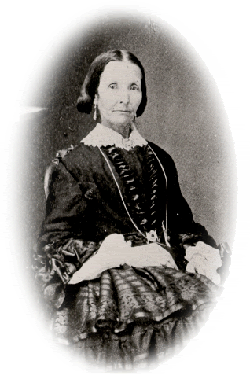
Eliza R. Snow holds a unique position in Mormon history. She never had children or a husband of her "own," though she was married to the first two LDS Prophets. Eliza became extremely influential in the early Church for a variety of reasons. Her situation with less family responsibility gave her free time to pursue her interests. Her calling as General Relief Society President saw her travelling among the Saints and gave her an authoritative position. Her proximity to Church leadership put her in firsthand touch with Church doctrine as it was developed. Finally, her considerable talent in writing gave her a voice among men and women alike.

We are all aware of Eliza's contribution to LDS belief through her poem, "The Eternal Father and Mother," which became the popular hymn "O My Father." The poem was frequently reprinted, put to a number of musical settings, and sung at formal as well as informal Church settings. Eliza popularized the concept of a mother God to such an extent that by 1873 Wilford Woodruff credited her poem as the source of the doctrine, identifying it as "a revelation, though it was given unto us by a woman--Sister Snow." [1]

The female bard Eliza treated many other principles of the Church in her poetry. One of her lesser-known poems, "The Ultimatum of a Human Life" [2] is of interest because it speaks of the Adam-God doctrine, once furiously debated, and now repudiated in the modern Church. "The Ultimatum" begins in a familiar LDS setting. The author is musing at twilight when a spirit guide appears to instruct her. This scene vividly recalls Lehi's dream in the Book of Mormon. Lehi's son Nephi likewise had the experience of entertaining an angel who had come to instruct him in religious principles. To a Mormon audience, this poetic convention gives the later instruction a powerful endorsement.

"What would'st thou me?" the seraph gently said:
"Tell me, and wherefore hast thou sought my aid?"

The author asks her spirit guide to explain the cause of suffering upon this earth and what will be the end result of human life--"its ultimatum in Eternity." The angel tells her that it is not necessary for her to know the secrets of the worlds on high, the Councils, decrees, organizations, laws formed by the Gods on high. These took place before her great Father came forth from their great courts to tread upon this new world and stand as it's royal head. Instead, the angel explains to her the ordeal and purpose of life. But in various places in the poem we learn more about this behind-the-scenes view of Eternity:

Adam, your God, like you on earth, has been
Subject to sorrow in a world of sin:
Through long gradation he arose to be
Cloth'd with the Godhead's might and majesty...
By his obedience he obtain'd the place
Of God and Father of this human race.

A second poem written by Eliza, "We Believe in Our God," was also included in the LDS collection of hymns until the year 1912. This poem described God as the "prince of his race," and identified him simultaneously as Adam, the Ancient of Days, and Michael the archangel.

We believe in our God, the Prince of his race,
The archangel Michael, the Ancient of Days
Our own Father Adam, earth's Lord as is plain,
Who'll counsel and fight for His children again.
We believe in His Son, Jesus Christ who in love
To His brothers and sisters came down from above,
To die, to redeem them from death, and to teach
To mortals and spirits the gospel we preach. [3]

In another poem, titled "To Mrs. ___ ," Eliza combines Adam-God with the couplet theology of godhood originated by her brother Lorenzo Snow:

...But now I’m but a child of dust;
Thanks, thanks to Him, in whom I trust,
I’m not without his wise direction,
His smiles, his guidance and protection.

Adam, our father--Eve, our mother,
And Jesus Christ, our elder brother,
Are to my understanding shown:
My heart responds, they are my own.

Perfection lifts them far from me,
But what they are, we yet may be,
If we, tho’ slowly, follow on,
We’ll reach the point to which they’ve gone. [4]

Clearly Eliza R. Snow agreed with and sought to promote the Adam-God doctrine preached by Brigham Young. Because acceptance of Adam as our Father and God implies Eve as our Heavenly Mother, some have connected this theory with the equally speculative Mother in Heaven axiom. [5] Why was the Heavenly Mother so readily absorbed into Mormon thought while Adam-God has died an ignomonious death? Joseph Smith and Brigham Young defended the concept of speculation, pondering, theorizing, and seeking the mysteries far more than is common today. Thus there were several speculative ideas preached by early Church leaders which were later refined or rejected outright by their successors. Van Hale has pointed out that Brigham Young said that his views were not official doctrine, nor mandatory for the Saints to believe. [6] Brigham and his prime supporter on Adam-God, Wilford Woodruff, experienced great opposition among their colleagues in the Twelve concerning the idea. [7] On the other hand, the Heavenly Mother idea was comforting, non-threatening and widely accepted. Every latter-day prophet has reaffirmed the existence of a Mother in Heaven. Indeed, the teaching has probably been challenged more in the past 5 years than in the 163 years since it was penned.

____________________________________________

[1] Wilford Woodruff quoted in Jill Mulvay Derr, "The Significance of 'O My Father' in the Personal Journey of Eliza R. Snow," BYU Studies 36:85-126.

[2] "Poems, Religious, Historical, and Political by Eliza R(oxy) Snow. Vol. II, Compiled by the Author," Latter-day Saints' Printing and Publishing Establishment, 1877, 5-10; http://www.celestial-orb.com/ultimatum.htm .

[3] Sacred Hymns and Spiritual Songs for the Church of Jesus Christ of Latter-day Saints, 11th Edition, revised in Liverpool, 1856, by Franklin D. Richards, Apostle; p. 375. See also the 25th edition, 1912.

[4] citation needed

[5] Blake Ostler has opined, "I view the notion of the mother in heaven as originating in a cultural overbelief (a mere ball that got rolling with a misunderstanding of an authoritative statement), was first elucidated as part of BY’s and Eliza’s Adam God doctrine, and then got baptized by Joseph F. Smith." Comment #10 at New Cool Thang blog. http://www.newcoolthang.com/index.php/2006/06/spirit-birth/258/

[6] "[The] subject ... does not immediately concern yours or my welfare ... I do not pretend to say that the items of doctrine and ideas I shall advance are necessary for the people to know." (Brigham Young, Historical Department of the Church [HDC], Oct 8, 1854). See this and other statements in "What About the Adam-God Theory?" by Van Hale at http://www.lightplanet.com/response/adam-god.htm

[7] Including, most notably, Orson Pratt. Brigham allowed Orson his judgment on the matter and gave him the freedom to express his opinions publicly without sanction or punishment.
Sunday, July 1, 2007

Writing a Life


"It’s the people who write, who last. If any woman out there has any inclination to to remembered in the future, the next few generations, she’d just better get busy and write out her story, her experiences." --Claudia Bushman

I haven't been very satisfied with the writing of my own story. I wish I had a more representative record of my life. I began journaling in 1974 when I was 14 years old. I had a diary all through my high school years. I was certain that when I was a teenager I had some intelligent thoughts. But reading back in my journal, I am not so sure. By what I wrote, it seems that I thought about nothing but boys. Many things happened during the years I was in high school. The Watergate scandal, and the resignation of President Richard Nixon. The war in Vietnam. Unrest on college campuses and the Kent State Massacre. Manned space flights to the moon. The first test tube baby. Affirmative Action and Title IX. Radioactive leak at Three Mile Island. I remember all these things happening, but I did not find them important enough to write down. Instead, here is a typical journal entry, written on the date of the fall of Saigon and the end of the Vietnam War:
30 April 1975
This morning I had a big fight with Mom because someone took my toothbrush and I refused to go to school without brushing my teeth. I finally used someone else's. Later we found out that Kenny had it in his room. Don't ask me why. Today I made up the math test I missed on logarithms. We had swimming fifth block. We had a boy in our gym class that was swimming with us--we all wondered what he was doing there. He was a good swimmer though, and pretty cute. After school, Kenny, Doug, Mark and I sat outside and fooled around with a magnifying glass trying to start some paper on fire. We did, a couple of times. A cop car came by and Mark sat on the fire. Doug kept putting his arm around me. I wonder if he likes me again?
Tonight was Allison's night to go somewhere with Dad but she wanted to see the movie "The Great Waldo Pepper." But all of the rest of us wanted to see it too, so we all went. It was starring Robert Redford!! He is the best actor and so cute!! The only other movie I want to see is "Tommy." It has Elton John (the singer) in it. I want to see him. He is the greatest!! And he sings the best songs!!

I joined the Church in 1979, when I was in college. For several years my journals are very saccharine and faith-promoting. I write a lot of quotes from the Book of Mormon and books I've been reading such as "Faith Precedes the Miracle." I did find one entry that gives an insight into what kind of person I had become as a Mormon:
30 Nov 1979
A very sad experience happened to me before I left for Christmas. I saw T. drinking coffee in the cafeteria. She is a member who has not been attending meetings lately. I went over to talk to her and asked why she was drinking coffee. She said the doctor told her not to drink any beverages except for coffee and tea. I mentioned that it might be better to just drink water. She was very upset with me. That night I received a package which contained a Book of Mormon, a D&C, and two Institute manuals. This note was with it: "I give these things to you and you can give them to someone else but just don't drive them up and down a wall and away from the Church as you have me. Don't approach me on campus and don't come down to the room to talk about it cause I will not answer the door."

Hopefully I learned something from this experience!

You've already had a few samples from my missionary journals. I probably did a fairly good job representing myself, the ups and downs, and the things I was learning during this time. Soon after my mission I married and started having children right away. I wrote very rarely. This is the time I really wish I had kept up my journal. It seems that during these years I only wrote when I was angry and overwhelmed.
1 Oct 1991
Thoughts are flying through my head like crazy--I can't get them down. The RS class and the article set off some kind of dissatisfaction in my mind. They seemed so basic and so boring--I tried to tell [a friend] how I felt but I didn't really feel like she understood me. She said they'd had that discussion in their family and they'd concluded that the Church had to gear materials to the new-convert-type member, or as she put it, "the least common denominator." I don't know why they can't include more meaty talks along with basic ones for new converts. I just feel so disappointed, jaded and cynical.

And then there are some entries about cars that break down, and financial troubles, and fights with the husband, and it sounds like I don't have a positive thought for the next ten years.

Now that I've started to blog, it looks like I may have fallen into the same trap. Though I am an active and faithful member of the Church, I tend to use my writing for airing my grievances. Apparently, I give the impression that I am an apostate or disgruntled member. I don't know quite how to remedy this. For when I read blogs that are supposedly encouraging and faith-promoting, all I can think is "Yawn!" I want to show the spiritual side of myself, but I refuse to write a bunch of smarmy pablum.

Unfortunately, Sister Bushman, my writings probably won't be of much interest to future historians. Neither am I representative of a twentieth-century Mormon woman. I'm just one of myriads of bloggers, sitting at a screen and pouring out the day's frustrations, hoping to make a couple of sympathetic connections and stay sane at the end of the day.