
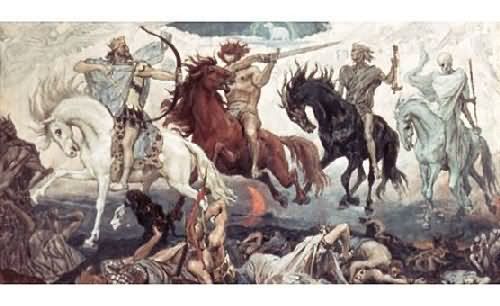
And I saw when the Lamb opened one of the seals, and I heard, as it were the noise of thunder, one of the four beasts saying, Come and see. And I saw, and behold a white horse: and he that sat on him had a bow; and a crown was given unto him: and he went forth conquering, and to conquer. And when he had opened the second seal, I heard the second beast say, Come and see. And there went out another horse that was red: and power was given to him that sat thereon to take peace from the earth, and that they should kill one another: and there was given unto him a great sword. And when he had opened the third seal, I heard the third beast say, Come and see. And I beheld, and lo a black horse; and he that sat on him had a pair of balances in his hand. And I heard a voice in the midst of the four beasts say, A measure of wheat for a penny, and three measures of barley for a penny; and see thou hurt not the oil and the wine. And when he had opened the fourth seal, I heard the voice of the fourth beast say, Come and see. And I looked, and behold a pale horse: and his name that sat on him was Death, and Hell followed with him. And power was given unto them over the fourth part of the earth, to kill with sword, and with hunger, and with death, and with the beasts of the earth.
I couldn't live another day without finding out what the Four Horsemen of the Apocalypse were supposed to represent. Sunday School class was no help at all. The white horse was confusing me. I didn't want to believe he was representative of a punishment, or an AntiChrist, or even unrighteous dominion. It seemed to me that white was symbolic of goodness and purity. But then, how did this horseman fit with the others? My own wisdom was not sufficient. I used Google, and read many interpretations which I could not quite accept. I tried prayer, and was impatiently waiting for a dream, a vision, or a voice in my head, when I remembered a quote from Joseph Smith about understanding the symbols in the scriptures. I looked it up, and here it is in it's entirety:
"I make this broad declaration, that whenever God gives a vision of an image, or beast, or figure of any kind, He always holds Himself responsible to give a revelation or interpretation of the meaning thereof, otherwise we are not responsible or accountable for our belief in it. Don't be afraid of being damned for not knowing the meaning of a vision or figure, if God has not given a revelation or interpretation of the subject." (Teachings of the Prophet Joseph Smith, p. 291.)
I decided to look for a scriptural interpretation of the meaning. Perhaps God had given the meaning to this symbolic passage. My first stop was D&C 77, which is a series of answers to questions about Revelation. It didn't seem to help much, but it did clarify that "
the first seal contains the things of the first thousand years, and the second also of the second thousand years, and so on until the seventh." I saw that the four horsemen were associated with the opening of the first four seals.
My next big break happened as I read a little further in Revelation and noticed this description:
Rev 14:14--
And I looked, and behold a white cloud, and upon the cloud one sat like unto the Son of man, having on his head a golden crown, and in his hand a sharp sickle. Then Revelation 19:11-12--
And I saw heaven opened, and behold a white horse; and he that sat upon him was called Faithful and True, and in righteousness he doth judge and make war. His eyes were as a flame of fire, and on his head were many crowns; and he had a name written, that no man knew, but he himself.There it was! The same scriptural symbols--a white horse, a crown, a conquerer--were used to represent Christ. I was vindicated. But I still didn't know why Christ was included in this particular set of four. He didn't seem to fit with the others.
More searching in the scriptures brought me to the obscure book of Zechariah. Did you know that the same four colored horses are mentioned in chapters 1 and 6? News to me. Zechariah even had the presence of mind to ask what these horses meant; and the angel answered that they were "they whom the Lord hath sent to walk to and fro through the earth." Prophets! I realized. Then it became clear to me that the horses were symbols of prophets who were sent to preside over the unveiling of Christ at the opening of each of the seals, or in the thousand year dispensations.
That would make Christ the horseman on each of the horses. I took yet another look to see if I could recognize Christ in these riders. The first was simple: a rider with a bow and a crown who went forth to conquer. The second horseman was sitting on a red horse. The red could represent the blood of Christ. This horseman had power to take peace from the earth. Sounded like Christ's words in
Matthew 10:34. The rider of the red horse also had a sword. As I turned back to the rider in Revelation 19 I read: "
And he was clothed with a vesture dipped in blood: and his name is called The Word of God. And out of his mouth goeth a sharp sword, that with it he should smite the nations: and he shall rule them with a rod of iron: and he treadeth the winepress of the fierceness and wrath of Almighty God. And he hath on his vesture and on his thigh a name written, KING OF KINGS, AND LORD OF LORDS." This perfectly described the second rider, and identified him with Christ.
The next rider had been identified by many scriptural scholars as "Famine," and this interpretation seemed to fit so well that at first it was hard to see how it might represent the Savior. However, the scales he had in his hands could also represent judgment, and the famine could be a spiritual famine; a hunger for the "Word of God," or Christ. Reading again in Revelation 19 revealed that the horseman "in righteousness he doth judge..."
The final rider had a name: Death. And Hell followed with him. So how did this horseman represent Christ? As I read about how power was given to them to kill with sword, hunger, death, and beasts, I recognized a connection with the rider of Revelation 19 who made war with the kings of the earth, slaying them with the sword and filling the mouths of the fowls with their flesh. This Messiah image, though not as comfortable to us as the loving Good Shepherd, is nonetheless an important scriptural aspect of his reign.
And so this week I have become acquainted with the four horsemen of the Apocalypse--all representative of Christ. This Messiah is revealed to the peoples of the earth by prophets, or the four different colored horses. And if you have made it through this post, you are ready for next week's Sunday School lesson, since my ward is a little bit ahead. I'd love to hear how your Sunday School teacher spins this chapter! Send me a comment.


 Posts
Posts


