Showing posts with label Sunday School. Show all posts

Sunday, January 10, 2010

Everything You Need is in the Manual

A Church News article published this weekend instructs Church teachers to stick to official sources in preparing their lessons. "Everything you need — and more — is in your manual," it proclaims. This type of emphasis concerns me greatly.

Friday, January 8, 2010

Chosen or Posin' ? Abraham, Buffy, and Other Choice Spirits

OT SS Lesson #2 -- originally posted at Mormon Matters

This was an interesting lesson to read after last year's brou-ha-ha over an alleged "generals in the war in heaven" quote. On the 25th of February 2008, the Church issued an official statement from the Office of the First Presidency to all General Authorities, Area Seventies, Stake Presidents, Mission Presidents, District Presidents, Temple Presidents, Bishops and Branch Presidents which read:

A statement has been circulated that asserts in part that the youth of the Church today “were generals in the war in heaven . . . and someone will ask you, ‘Which of the prophet’s time did you live in?’ and when you say ‘Gordon B. Hinckley’ a hush will fall, . . . and all in attendance will bow at your presence. [You were held back six thousand years because you were the most talented, most obedient, most courageous, and most righteous.]”*

This is a false statement. It is not Church doctrine. At various times, this statement has been attributed erroneously to President Thomas S. Monson, President Henry B. Eyring, President Boyd K. Packer, and others. None of these Brethren made this statement. Stake presidents and bishops should see that it is not used in Church talks, classes, bulletins, or newsletters. Priesthood leaders should correct anyone who attempts to perpetuate its use by any means, in accordance with “Statements Attributed to Church Leaders,” Church Handbook of Instructions, Book 1 (2006), 173.


Although this is not Church doctrine, I don't see much which distinguishes it from the following quotation in our approved Sunday School Lesson #2:

Monday, September 22, 2008

Sampling the School of the Prophets


Today I wrote a post for Mormon Matters discussing the School of the Prophets in the time of Joseph Smith and how different our religious education is today. For many years now I have tired of the same 4-year round of scripture pablum which is offered in our Sunday Schools.

Learning the Bible in the original languages is a pastime which has intrigued me and which I have attempted on my own. I've often wished we could include some Hebrew and Greek studies into our Sunday School classes. Lest any think that doing this might prove too hard for the average member, I want to present an example of what this might look like, and get your opinion on whether you think a run-of-the-mill Gospel Doctrine teacher could handle teaching such material. The following comes from Jeff A. Benner's Biblical Hebrew E-Magazine, September 2008, Issue #046.

Biblical Word of the Month - Eleph אלף

The oxen likewise and the young asses that till the ground shall eat savory provender, which hath been winnowed with the shovel and with the fork. (ASV, Isaiah 30:24)

In the verse above is the Hebrew noun אלף (eleph, Strong's #504) meaning oxen. Oxen are the largest of the Ancient Hebrews' livestock and were most frequently used for plowing the fields, usually in pairs. An older ox would be yoked to a younger one in order for the older one to teach the younger through association. This same noun is also found in Judges 6:15 where it is translated as "family." In a family, the children learn from the parents, in the same manner as the oxen, through association.

The verbal root of this word is אלף (A.L.Ph, Strong's #502) and means "learn," but more literally, to learn through association, as can be seen in the following verse.

Make no friendship with a man that is given to anger; And with a wrathful man thou shalt not go: Lest thou learn this ways, And get a snare to thy soul. (ASV, Proverbs 22:25)

As oxen are "very large" animals, the word אלף (eleph) is also used for a "thousand," a "very large" number. (While this is the same word discussed previously, Strong's dictionary has assigned this word the number 505 when used for a "thousand.") From this aspect of the noun, a second verb is formed. Normally, Hebrew nouns are derived out of verbs, however on occasion, a verb is derived out of a noun, this verb is called a demonstrative verb. The demonstrative verb formed out of אלף (eleph) is אלף (A.L.Ph, Strong's #503) meaning to "give a thousand." In summary, the Hebrew word אלף can be;


  1. A verb meaning to learn by association.

  2. A noun meaning oxen, a large beast, which learns through association.

  3. A noun meaning family, through the idea of association.

  4. A noun meaning a thousand, a large number.

  5. A verb meaning to give a thousand.


One other note about the word eleph, it may be the origin of the word elephant, a "very large" beast.

________________________________

(If you are a Latter-day Saint who does not know what the "Strong's numbers" above refer to, shame on you! Or shame on your religious educators who have not taught you about such a valuable learning tool in gospel study!)

I can picture a very engaging lesson from the previous information, including unique Latter-day Saint teachings such as the importance of the family and the need for good associations. I can also imagine facilitating some interesting discussion on the large numbers of "thousands" of people in the Bible and the Book of Mormon and what the Hebrew meaning of this word might suggest.

I think these are the kinds of things Brother Joseph and his compatriots in the School of the Prophets were learning when they hired Joshua Seixas to teach them Hebrew for ten weeks--two hours a day and five times a week. Just learning the one word "Berosheit" inspired Joseph to redefine the nature of God and the creation account.

What do you think? Could learning a few Hebrew words inspire a bit of prophecy in your ward? Or do we need to go over the importance of the keystone in an arch one more time?

Monday, August 11, 2008

Teaching to the Women

I just had the most fascinating experience in a BYU student ward.

I'm visiting with my daughter in Provo, and I attended Church with her ward yesterday. After Sacrament Meeting, she urged me to attend her Social Relations class. It was taught by the Bishop's wife, and they were going to discuss the Temple. Several couples in the ward plan to be married by the end of the month, and some will be going on missions. Sister R took it upon herself to prepare them for this major event that they would soon be experiencing.

I knew things would be different when I saw that she had her temple packet with her on the table. Sister R gave the most amazing presentation I have ever seen. I found myself wishing that a video would be made and sent around to show all teachers of the Temple Prep class how it was done. She unapologetically described each part of the Temple experience, from the symbolism of entering past the first "gate" with your Temple recommend (which she waved in the air), to how to recover your new name if you forget it. She had some of the young men in the room squirming as she explained a relatively new policy that you could wear your bra under your garment top, or your underwear underneath the bottoms in the case of periods or yeast infections. Everything was presented in a faithful, testimony-building, no-nonsense way. The young people were enthralled. And what's more, she presented her remarks to the women.

Although the class consisted of an equal amount of college-aged young men and women, her remarks were completely female oriented. Continually she referred to your escort as "she," talked about the woman who would lay her hands on your head, discussing the authority she held, and the woman who would take you through the veil. Sister R's husband, the Bishop, who was sitting in the back of the room, stood several times to add to her remarks, and twice noted that, "for the men, of course, they will have a male escort," and similar clarifications.

I was fascinated by this turn-around in teaching style. The Bishop seemed just a tad annoyed that his wife was presenting a female perspective on the Temple to a mixed audience. But I was eating it up! Although the men don't always realize it, this is the experience we women have each Sunday as we are presented a male view of the scriptures, a male view of the priesthood, a male view of life. I contrasted the experience with last Sunday's SS lesson, in which I was taught about Alma, Amulek, and male missionary work with never a thought to how a woman might fit in to the scene. Sister R's lesson, on the other hand, had the females in the room actively engaged in their relationship to the temple and the males in the periphery.

This was a great object lesson to both men and women on how teaching directed to a particular gender tends to marginalize and silence the other. Try it! As an experiment next time you teach, style the lesson so that it is addressed entirely to the female gender. Does this make a difference in how males are included?

Optimally we will come closer to a style in our teaching which will include all of our audience, males and females, single and married, parents and childless, old and young. Let's strive for this ideal!

Sunday, July 20, 2008

Baurak Ale and the Bloggernacle

When I joined the Church in 1979, the Doctrine and Covenants contained, in places, some code words for some of the early leaders of the Church. Members were taught that these code names were used to hide the identities of Joseph Smith and some of his associates so they would not be used in lawsuits against the Church. A short time before I left on my mission in 1981, the new triple combination became available. In this new printing, the code names had been changed to the real name. Now, a student of the Doctrine and Covenants will no longer encounter "Barauk Ale," "Mehemson," or "Horah," but Joseph Smith, Martin Harris, or John Whitmer.

I think these names are fascinating--not in a Hugh Nibley sort of way, but because it interests me to speculate on who chose the names and why they were assigned to certain people. Oliver Cowdery's code name was "Olihah," which seems to be a sort of Book-of-Mormonization of his real name. Imagine using this type of secret code in the Bloggernacle--if you wanted to criticize someone, you could just call him "Stevihah." That way, everyone would know who you were talking about, but he wouldn't be able to sue you!

Other names seemed to be combined from two different Biblical characters: WW Phelps was referred to as "Shalemanasseh." Just look how well that technique fits when we apply it to fmhLisa. Since she hasn't told her mother about her blogging yet, she really needs a code name. How about "Debezebel?"

Then there's the name (title?) Baneemy. This code was such a secret that no one was quite sure who it referred to! Several men claimed to be Baneemy, including Charles B. Thompson (who published a periodical titled "Baneemy's Organ") and Lyman Wight. To solve the problem, Orson Pratt interpreted the word to mean "mine elders." We might get the same problem by publishing a statement such as this:

"Mulapul is far and away the most intelligent and talented writer in the Bloggernacle."
I remember in the pre-1981 era, Sunday School D&C classes used to love to speculate about the use of these names. Did they show off Joseph Smith's knowledge of Hebrew? Were they proof that he knew the name of Enoch's father before the discovery of the Dead Sea Scrolls? I'm afraid that some of you younger bloggers may have missed the fun. In fact, I wonder if some of you are even aware of these nicknames. Know ye, or know ye not? Feel free to date yourselves in the comments.

Yours,
Borihah in Vern-ale

Saturday, June 7, 2008

Conversion: Alma vs. McConkie

In our Sunday School discussion this week the lesson manual asks the following: "Throughout his address to the people in Zarahemla, Alma spoke of experiencing a “mighty change” of heart and being “born of God” (see Alma 5). We often use the word conversion when we speak of this experience. What does it mean to be converted? Is conversion a single event or a process?" Our class was unable to come to a consensus on this question. What do you think? Have you experienced conversion? For you, was it a single event, or a process?

When I read Alma 5, it seems to describe a born again experience much like that extolled by the evangelical Christians. I myself had a "born again" experience at age 18. Though I was raised in a Christian home with a father who was a Protestant minister, this was an experience during which I came alive to the things of the Spirit. For me it was a single event, though there has been a process of sanctification including my decision to join the LDS church and the development of testimony of several aspects of the Gospel.

Elder Bruce R. McConkie taught:

“Except in … unusual circumstances, as with Alma (Mosiah 27), spiritual rebirth is a process. It does not occur instantaneously. It comes to pass by degrees. Repentant persons become alive to one spiritual reality after another, until they are wholly alive in Christ and are qualified to dwell in his presence forever” (Lesson 22: “Have Ye Received His Image in Your Countenances?”, Book of Mormon Gospel Doctrine Teacher’s Manual, (1999),98)

When this quotation was read during our class, I felt that it referred more to the process of sanctification than what Alma is describing in Alma 5. Somehow I doubt that my spiritual rebirth is "unusual." I've heard many Mormons, converts and lifelong members, describe a mighty change as a single experience which they can pinpoint.

But I wonder if McConkie deserves more credence than I have heretofore supposed. In a recent FHE, we were speaking to our teenaged daughters about their testimonies of the Book of Mormon. They felt uncomfortable with the admonition of Moroni to pray about the book. They insist that as long as they have been aware, they have known the Book of Mormon was a true scriptural record, and that to pray about it would be a lack of faith. They relate better to a process-oriented approach, where they continue to learn more about the scriptures and develop more skill in applying them to their lives. In their case, and in that of many life-long members, is "conversion" unnecessary?

I continue to worry about this, for the Lord told Alma:
Marvel not that all mankind, yea, men and women, all nations, kindreds, tongues and people, must be born again; yea, born of God, changed from their carnal and fallen state, to a state of righteousness, being redeemed of God, becoming his sons and daughters; And thus they become new creatures; and unless they do this, they can in nowise inherit the kingdom of God.

Wednesday, May 7, 2008

What if the "Sunday School Answers" Were...

First, do no harm

Be kind

Help others


I see nothing but good coming from praying, reading the scriptures, and keeping the commandments. But it seems to me that these things give us an inner focus, while a main thrust of Jesus' message as Messiah was how we treat others. Since our primary concentration during Church instructional periods often centers around improvement of the self, we groom our members to become paragons of personal righteousness who may be lacking in their living of the social gospel.

I first realized this when driving to Salt Lake City from Provo to pick up my parents from the airport. They were arriving to attend my temple marriage, or rather, the reception and ceremonies surrounding my temple marriage, since they were nonmembers. Our car broke down on the way there. It was a Sunday, and the highway was crowded with Mormons in suits and dresses, presumably on their way to Church related activities. None stopped for a young couple in distress. Back in 1981 no one carried cell phones, and we waited for about an hour and a half before a man in blue jeans and smoking a cigarette stopped his truck to assist us. The young convert BiV, just off her mission, was disillusioned that all of the fine Latter-day Saints of Utah would pass by while the "Samaritan" was the only one to stop.

I particularly feel a lack of empathy when members justify not giving to the less fortunate in their own circle of influence because they already pay their fast offering; or because they've decided that the bums don't deserve it, are too lazy to get a job, or will spend it inappropriately anyway!

I know there are many things we do as Latter-day Saints that come under the category of "service." In the past few years I've seen service projects under the auspices of the Relief Society increase. A popular service lately has been putting together kits to go to schools, or to people in different parts of the world who have been devastated by natural disasters. I don't want to say these aren't good things! Recently at BYU Women's Conference, thousands of LDS women were urged to make a difference in the world by putting together hygiene, school and infant kits made of items donated by different large corporations. These will be shipped abroad to fulfill humanitarian needs. I don't want to denigrate this type of service. It's hard to put together a service activity for a large number of people to do in this kind of context. I guess I just want to point out that this is a service that is removed from personal contact. It's just right for an internet generation who is one step removed from real face-to-face contact with other human beings. I see too many sisters who put together humanitarian kits, all the while gossiping about others in the ward.


Some things I've seen in the Church that I think foster other-focused living of the gospel: We were living in Texas in 2001 during Hurricane Allison. Our home came through OK, but there were homes in our ward and stake which were completely destroyed. On Sunday we showed up for sacrament meeting and the members of the Bishopric were dressed in jeans. They dismissed the meetings and sent the members out to shovel out homes, rip up carpet, collect belongings and prepare food. We started at the homes of members and spread out to the entire neighborhood. I have never seen the youth work harder or feel more fulfilled. Their faces were absolutely glowing with health, exertion, and pure joy in service. These same members were so touched by this experience that a few years later when New Orleans was flooded they organized parties to drive down and spend their weekends assisting with the efforts there. They brought with them food, shovels, and everything they needed to be completely self-sufficient while they were there plus contribute in a major way.

Mormons are actually quite good at this. But huge disasters don't happen every day. What can we do to symbolically dismiss our members from Sacrament Meeting to go out and make a difference in the small disasters of people's lives? How can we send our members home from Sunday School not only to pray and read their scriptures, but to see the people around us and be kind to them?

Wednesday, March 19, 2008

Letters From a Learned Man

Part 4 of a series on Martin Harris and the Anthon Transcript
(For the whole series, click here)

It seems like I've taken a long time just to say that Martin Harris was in possession of a copy of some of the characters from the Book of Mormon and that he consulted some of the leading candidates of the day who might have been able to authenticate them. Now the time has come to more fully examine Professor Anthon's account of Martin Harris' visit. Extant are two letters in which Charles Anthon replied to enquiries about his encounter with Harris. I will reproduce them in their entirety and then discuss what they reveal about Mormon history and scholarship.

1. This letter was written to Eber D. Howe, Editor of the Painesville Telegraph (1822–1835), author, and publisher of Mormonism Unvailed. On February 9, 1834 Howe wrote to Charles Anthon about Mormon claims that he had authenticated Book of Mormon characters. Anthon answered in a response dated Feb. 17, 1834:


New York, Feb. 17, 1834
Dear Sir -

I received this morning your favor of the 9th instant, and lose no time in making a reply. The whole story about my having pronounced the Mormonite inscription to be "reformed Egyptian hieroglyphics" is perfectly false. Some years ago, a plain, and apparently simple-hearted farmer, called upon me with a note from Dr. Mitchell of our city, now deceased, requesting me to decypher, if possible, a paper, which the farmer would hand me, and which Dr. M. confessed he had been unable to understand. Upon examining the paper in question, I soon came to the conclusion that it was all a trick, perhaps a hoax. When I asked the person, who brought it, how he obtained the writing, he gave me, as far as I can now recollect, the following account: A "gold book," consisting of a number of plates of gold, fastened together in the shape of a book by wires of the same metal, had been dug up in the northern part of the state of New York, and along with the book an enormous pair of "gold spectacles"! These spectacles were so large, that, if a person attempted to look through them, his two eyes would have to be turned towards one of the glasses merely, the spectacles in question being altogether too large for the breadth of the human face. Whoever examined the plates through the spectacles, was enabled not only to read them, but fully to understand their meaning. All this knowledge, however, was confined at that time to a young man, who had the trunk containing the book and spectacles in his sole possession. This young man was placed behind a curtain, in the garret of a farm house, and, being thus concealed from view, put on the spectacles occasionally, or rather, looked through one of the glasses, decyphered the characters in the book, and, having committed some of them to paper, handed copies from behind the curtain, to those who stood on the outside. Not a word, however, was said about the plates having been decyphered "by the gift of God." Every thing, in this way, was effected by the large pair of spectacles. The farmer added, that he had been requested to contribute a sum of money towards the publication of the "golden book," the contents of which would, as he had been assured, produce an entire change in the world and save it from ruin. So urgent had been these solicitations, that he intended selling his farm and handing over the amount received to those who wished to publish the plates. As a last precautionary step, however, he had resolved to come to New York, and obtain the opinion of the learned about the meaning of the paper which he brought with him, and which had been given him as a part of the contents of the book, although no translation had been furnished at the time by the young man with the spectacles. On hearing this odd story, I changed my opinion about the paper, and, instead of viewing it any longer as a hoax upon the learned, I began to regard it as part of a scheme to cheat the farmer of his money, and I communicated my suspicions to him, warning him to beware of rogues. He requested an opinion from me in writing, which of course I declined giving, and he then took his leave carrying the paper with him. This paper was in fact a singular scrawl. It consisted of all kinds of crooked characters disposed in columns, and had evidently been prepared by some person who had before him at the time a book containing various alphabets. Greek and Hebrew letters, crosses and flourishes, Roman letters inverted or placed sideways, were arranged in perpendicular columns, and the whole ended in a rude delineation of a circle divided into various compartments, decked with various strange marks, and evidently copied after the Mexican Calender given by Humboldt, but copied in such a way as not to betray the source whence it was derived. I am thus particular as to the contents of the paper, inasmuch as I have frequently conversed with my friends on the subject, since the Mormonite excitement began, and well remember that the paper contained any thing else but "Egyptian Hieroglyphics." Some time after, the same farmer paid me a second visit. He brought with him the golden book in print, and offered it to me for sale. I declined purchasing. He then asked permission to leave the book with me for examination. I declined receiving it, although his manner was strangely urgent. I adverted once more to the roguery which had been in my opinion practised upon him, and asked him what had become of the gold plates. He informed me that they were in a trunk with the large pair of spectacles. I advised him to go to a magistrate and have the trunk examined. He said the "curse of God" would come upon him should he do this. On my pressing him, however, to pursue the course which I had recommended, he told me that he would open the trunk, if I would take the "curse of God" upon myself. I replied that I would do so with the greatest willingness, and would incur every risk of that nature, provided I could only extricate him from the grasp of rogues. He then left me.

I have thus given you a full statement of all that I know respecting the origin of Mormonism, and must beg you, as a personal favor, to publish this letter immediately, should you find my name mentioned again by these wretched fanatics.

Yours respectfully, CHAS. ANTHON.


2. The second letter was in response to a letter from Reverend Dr. Thomas Winthrop Coit who was Rector of Trinity Church in New Rochelle, New York from 1839-1849. Having heard the Mormon claim that Anthon had actually validated Joseph Smith's "translation" of the Book of Mormon but had torn up the alleged affidavit before Harris could leave with it, Rev. Coit wrote to Anthon requesting a statement from him about his involvement in the affair. Anthon responded on April 3, 1841 with the following:

New York, April 3d, 1841.

Rev. and Dear Sir:

I have often heard that the Mormons claimed me for an auxiliary, but, as no one, until the present time, has ever requested from me a statement in writing, I have not deemed it worth while to say anything publicly on the subject. What I do know of the sect relates to some of the early movements; and as the facts may amuse you, while they will furnish a satisfactory answer to the charge of my being a Mormon proselyte, I proceed to lay them before you in detail.

Many years ago, the precise date I do not now recollect, a plain looking countryman called upon me with a letter from Dr. Samuel L. Mitchell requesting me to examine, and give my opinion upon, a certain paper, marked with various characters, which the Doctor confessed he could not decypher, and which the bearer of the note was very anxious to have explained. A very brief examination of the paper convinced me that it was a mere hoax, and a very clumsy one too. The characters were arranged in columns, like the Chinese mode of writing, and presented the most singular medley that I ever beheld. Greek, Hebrew and all sorts of letters, more or less distorted, either through unskilfulness or from actual design, were intermingled with sundry delineations of half moons, stars, and other natural objects, and the whole ended in a rude representation of the Mexican zodiac. The conclusion was irresistible, that some cunning fellow had prepared the paper in question for the purpose of imposing upon the countryman who brought it, and I told the man so without any hesitation. He then proceeded to give me the history of the whole affair, which convinced me that he had fallen into the hands of some sharper, while it left me in great astonishment at his simplicity.

The countryman told me that a gold book had been recently dug up in the western or northern part (I forget which), of our state, and he described this book as consisting of many gold plates, like leaves, secured by a gold wire passing through the edges of each, just as the leaves of a book are sewed together, and presented in this way the appearance of a volume. Each plate, according to him, was inscribed with unknown characters, and the paper which he handed me, a transcript of one of these pages. On my asking him by whom the copy was made, he gravely stated, that along with the golden book there had been dug up a very large pair of spectacles! so large in fact that if a man were to hold them in front of his face, his two eyes would merely look through one of the glasses, and the remaining part of the spectacles would project a considerable distance sideways! These spectacles possessed, it seems a very valuable property, of enabling any one who looked through them, (or rather through one of the lenses,) not only to decypher the characters on the plates, but also to comprehend their exact meaning, and be able to translate them!! My informant assured me that this curious property of the spectacles had been actually tested, and found to be true. A young man, it seems, had been placed in the garret of a farm-house, with a curtain before him, and having fastened the spectacles to his head, had read several pages in the golden book, and communicated their contents in writing to certain persons stationed on the outside of the curtain. He had also copied off one page of the book in the original character, which he had in like manner handed over to those who were separated from him by the curtain, and this copy was the paper which the countryman had brought with him. As the golden book was said to contain very great truths, and most important revelations of a religious nature, a strong desire had been expressed by several persons in the countryman's neighbourhood, to have the whole work translated and published. A proposition had accordingly been made to my informant, to sell his farm, and apply the proceeds to the printing of the golden book, and the golden plates were to be left with him as security until he should be reimbursed by the sale of the work. To convince him more clearly that there was no risk whatever in the matter, and that the work was actually what it claimed to be, he was told to take the paper, which purported to be a copy of one of the pages of the book, to the city of New York, and submit it to the learned in that quarter, who would soon dispel all his doubts, and satisfy him as to the perfect safety of the investment. As Dr. Mitchell was our "Magnus Apollo" in those days, the man called first upon him; but the Doctor, evidently suspecting some trick, declined giving any opinion about the matter, and sent the countryman down to the college, to see, in all probability what the "learned pundits" in that place would make of the affair. On my telling the bearer of the paper that an attempt had been made to impose on him and defraud him of his property, he requested me to give him my opinion in writing about the paper which he had shown to me. I did so without hesitation, partly for the man's sake, and partly to let the individual "behind the curtain" see that his trick was discovered. The import of what I wrote was, as far as I can now recollect, simply this, that the marks in the paper appeared to be merely an imitation of various alphabetical characters, and had, in my opinion, no meaning at all connected with them. The countryman then took his leave, with many thanks, and with the express declaration that he would in no shape part with his farm, or embark in the speculation of printing the golden book.

The matter rested here for a considerable time, until one day, when I had ceased entirely to think of the countryman and his paper, this same individual, to my great surprise, paid me a second visit. He now brought with him a duodecimo volume, which he said was a translation into English of the "Golden Bible." He also stated, that notwithstanding his original determination not to sell his farm, he had been induced evidently to do so, and apply the money to the publication of the book, and had received the golden plates as a security for payment. He begged my acceptance of the volume, assuring me that it would be found extremely interesting, and that it was already "making great noise" in the upper part of the state. Suspecting now that some serious trick was on foot, and that my plain looking visitor might be in fact a very cunning fellow I declined his present, and merely contented myself with a slight examination of the volume while he stood by. The more I declined receiving it, however, the more urgent the man became in offering the book, until at last I told him plainly, that if he left the volume, as he said he intended to do, I should most assuredly throw it after him as he departed. I then asked him how he could be so foolish as to sell his farm and engage in this affair; and requested him to tell me if the plates were really of gold. In answer to this latter inquiry, he said, that he had never seen the plates themselves, which were carefully locked up in a trunk, but that he had the trunk in his possession. I advised him by all means to open the trunk and examine its contents, and if the plates proved to be of gold, which I did not believe at all, to sell them immediately. His reply was, that. if he opened the trunk, the "curse of heaven would descend upon him and his children.' "However," added he, "I will agree to open it, provided you take the 'curse of Heaven' upon yourself, for having advised me to the step." I told him I was perfectly willing to do so, and begged he would hasten home and examine the trunk, for he would find that he had been cheated. He promised to do as I recommended, and left me, taking his book with him. I have never seen him since.

Such is a plain statement of all I know respecting the Mormons. My impression now is, that the plain looking countryman was none other than the prophet Smith himself, who assumed an appearance of great simplicity in order to entrap me, if possible, into some recommendation of his book. That the prophet aided me by his inspiration, in interpreting the volume, is only one of the many amusing falsehoods which the Mormonites utter relative to my participation in their doctrines. Of these doctrines I know nothing whatever, nor have I ever heard a single discourse from any of their preachers, although I have often felt a strong curiosity to become an auditor, since my friends tell me that they frequently name me in their sermons, and even go so far as to say that I am alluded to in the prophecies of Scripture!

If what I have here written shall prove of any service in opening the eyes of some of their deluded followers to the real designs of those who profess to be the apostles of Mormonism, it will afford me satisfaction equalled, I have no doubt, only by that which you yourself will feel on this subject.

I remain, very respectfully and truly, your friend,

CHAS. ANTHON.


These two letters are rich with information about early Church history. The tidbit which fascinates me the most is Anthon's description of the translation process, as explained to him by Martin Harris. It adds more to our understanding of how Joseph Smith's contemporaries perceived the translating was done. W.W. Phelps explained that the translation was done "through the aid of a pair of Interpreters, or spectacles — (known perhaps, in ancient days as Teraphim, or Urim and Thummim) ..." [1] Some have disagreed with Phelps' speculation and supposed that the "Urim and Thummim" referred to the Seer Stone that Joseph later used in the translation process. [2] But Anthon's letter makes it clear that in 1828 Harris was describing the means of translating the Book of Mormon as a large pair of spectacles. David Whitmer explained that the "Interpreters" (spectacles) were taken from Joseph as a punishment after he and Martin Harris lost the 116 pages of manuscript of the Book of Mormon. Later Joseph was allowed to recommence the translation using a Seer stone. [3] Accounts of the translation done with the use of the Seer stone abound. Isaac Hale explained that the translation was done by use of the Seer Stone without the physical presence of the plates. Joseph placed his seer stone in a hat and the translation would appear. [4] Emma Smith's description of the process agrees with her father's, saying that Joseph translated with his face buried in a hat. [5] David Whitmer's account adds detail to this idea, explaining how the characters appeared one at a time. [6]

Anthon's letters thus help to clarify how the translation of the Book of Mormon was done. The 116 manuscript pages were translated using a large pair of spectacles. The portion of the plates which comprises our Book of Mormon was translated by the use of a Seer Stone. Since the various accounts call both the spectacles and the Seer Stone(s) by the words "Interpreters" and "Urim and Thummim," [7] I would speculate that these two terms might loosely be used to refer to any divine instrument of translation.

I will leave you now with this one interesting example of how the Anthon letters contribute to our understanding of Mormonism. Perhaps my readers may wish to add comments with other insights from the above letters.

To be continued....

____________________________________________________

[1] W.W. Phelps, Evening and Morning Star, vol. 1, no. 8, (Independence, Missouri, January 1833) p. 2.

[2] This confusion has resulted from the accounts of some of the early Saints which concatenate the Urim and Thummim, the Interpreters, and the seer stone. For example, Oliver Cowdery, who joined in the translation effort in the winter of 1828 exults: "These were days never to be forgotten — to sit under the sound of a voice dictated by the inspiration of heaven, awakened the utmost gratitude of this bosom! Day after day I continued, uninterrupted, to write from his mouth, as he translated, with the Urim and Thummim, or, as the Nephites would have said, 'Interpreters,' the history, or record, called 'The book of Mormon." (Oliver Cowdery, Messenger and Advocate, (Kirtland, Ohio, 1834), vol. 1, no. 1, p.14.)

[3] In an 1885 interview, Zenas H. Gurley, then the editor of the RLDS Saints’ Herald, asked David Whitmer if Joseph had used his "Peep stone" to do the translation. Whitmer replied: "... he used a stone called a 'Seers stone,' the 'Interpreters' having been taken away from him because of transgression. The 'Interpreters' were taken from Joseph after he allowed Martin Harris to carry away the 116 pages of Ms [manuscript] of the Book of Mormon as a punishment, but he was allowed to go on and translate by use of a 'Seers stone' which he had, and which he placed in a hat into which he buried his face, stating to me and others that the original character appeared upon parchment and under it the translation in English." (Elder Z.H. Gurley holograph in LDS Church archives, cited by Richard S. Van Wagoner in "Joseph Smith: The Gift of Seeing," Dialogue: A Journal of Mormon Thought, 15:2 (Summer 1982), p. 54.)

[4] ""The manner in which he pretended to read and interpret, was the same as when he looked for the money-diggers, with a stone in his hat, and his hat over his face, while the Book of Plates were at the same time hid in the woods." (Affidavit of Isaac Hale dated March 20, 1834, cited in Rodger I. Anderson, Joseph Smith’s New York Reputation Reexamined, (Salt Lake City: Signature Books, 1990), pp. 126-128.)

[5] "In writing for your father I frequently wrote day after day, often sitting at the table close by him, he sitting with his face buried in his hat, with the stone in it, and dictating hour after hour with nothing between us." (History of the RLDS Church, 8 vols., Independence, Missouri: Herald House, 1951, "Last Testimony of Sister Emma," 3:356.)

[6] "Joseph Smith would put the seer stone into a hat, and put his face in the hat, drawing it closely around his face to exclude the light; and in the darkness the spiritual light would shine. A piece of something resembling parchment would appear, and on that appeared the writing. One character at a time would appear, and under it was the interpretation in English. Brother Joseph would read off the English to Oliver Cowdery, who was his principal scribe, and when it was written down and repeated to Brother Joseph to see if it was correct, then it would disappear, and another character with the interpretation would appear." (David Whitmer, An Address to All Believers in Christ, Richmond, Missouri: n.p., 1887, p. 12.)

[7] In 1823 Joseph Smith equated the Urim and Thummim with the spectacles: "...there were two stones in silver bows—and these stones, fastened to a breastplate, constituted what is called the Urim and Thummim--deposited with the plates; and the possession and use of these stones were what constituted “seers” in ancient or former times; and that God had prepared them for the purpose of translating the book." (JS-H 1:35) By 1835 the term "Urim and Thummim" was added to the revelation published as D&C 10 (verse 1), and thereafter, was used to refer to both the Nephite interpreters and the seer stone(s) by Joseph Smith and numerous other people. Joseph Knight, Sr., an early member of the Church and a close friend of Joseph Smith, equates the Urim and Thummim with the Seer stone: "Now the way he translated was he put the urim and thummim into his hat and darkened his eyes then he would take a sentance and it would appear in brite roman letters then he would tell the writer and he would write it then that would go away the next sentence would come and so on. But if it was not spelt rite it would not go away till it was rite, so we see it was marvelous. Thus was the hol [whole] translated." (Cited in Dean Jessee, "Joseph Knight's Recollection of Early Mormon History," BYU Studies, vol. 17:1 (Autumn 1976), p. 35.)


Tuesday, March 18, 2008

Assessing the Alphabets

Part 3 of a series on Martin Harris and the Anthon Transcript
(For the whole series, click here)

Before I get to my next post, I'll take some time to respond to John F. and Sanford's questions on my last one. Keep in mind that I am completely out of my depth here, and feel free to correct or add to my thoughts.

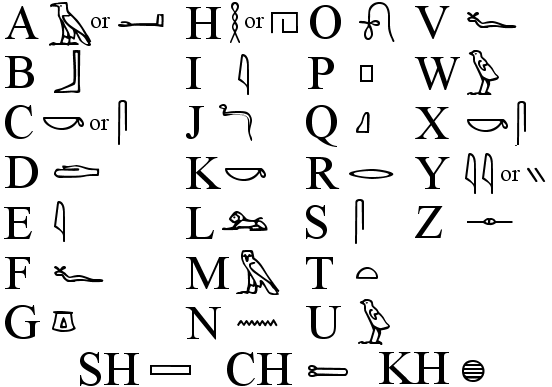
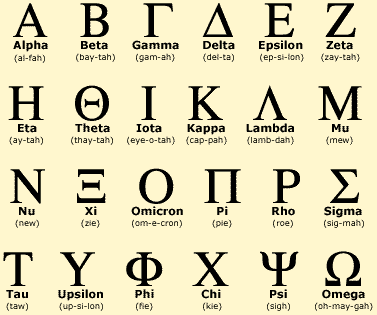
In the Martin Harris account of his visit to Professor Anthon that we have in the JS-H, he asserts that Anthon verified the letters as true characters from the "Egyptian, Chaldaic, Assyriac, and Arabic" languages. Historians have shown that Anthon had at least a rudimentary knowledge of these languages, enough to recognize the alphabets when he saw them. Let us assume that Martin Harris was correctly recalling the languages mentioned by Anthon. We should be able to see some correlations with these ancient alphabets and the JS characters. Below I will post some charts of the alphabets, so we can compare them with the "Caractors Document."

EGYPTIAN HIEROGLYPHICS


CHALDEAN ALPHABET


Ancient Assyrian (Akkadian) differs somewhat from modern Assyrian (Neo-Syrian). Akkadian was in use until about 750 BC, and was gradually replaced when writing began to be done on parchment, leather and papyrus rather than clay tablets. Aramaic gradually replaced the Ancient Assyrian because of the technological breakthrough in writing. It is sometimes assumed that Martin Harris meant to say "Aramaic" rather than "Arabic" in his report of Anthon's words because the Arabic language did not come into usage until after Lehi's group left for the New World, and would not have been represented on the plates. Arabic is descended from Aramaic and first appeared about 512 AD.

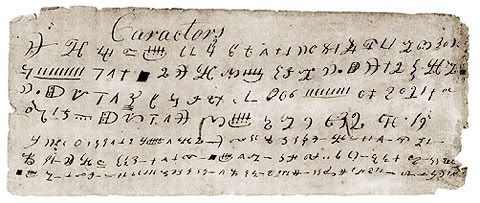
Now, here again is the "Caractors Document:"


Do you see any correlations here? I don't. It's especially disappointing to see the lack of similarity to Egyptian. In his 1834 letter to E.B. Howe, Anthon denied that the characters he saw included Egyptian, but rather wrote that he saw "Greek and Hebrew letters, crosses and flourishes, Roman letters inverted or placed sideways..." Doesn't this seem more descriptive of the characters to you?? (See especially Greek letters alpha, eta, lambda, tau, and upsilon.)


This post is intended to be a simplistic view of the alphabets as discussed by the major players in the Anthon drama. Other authors have gone into further depth on the relation of the characters to different scripts. [1] I do indeed have a working theory as to how the assertions of Martin Harris came about, but there are a few more points to cover before I get into my conclusions.

______________________________________________________________

[1] Here are only a few samples the many which are available on line.

Apologetic Sources:

Ariel L. Crowley, The Anthon Transcript: A Series of Articles in
The Improvement Era, Jan. - Mar., 1942.

Russell Littlecreek, Evidence for Reformed Egyptian. This is really cool. Click on the letters in the "Caractors Document" and you are taken to a possible corresponding Egyptian Hieratic or Hieroglyph. (Keep in mind as you do this that Professor Anthon would not have had complete knowledge of all these characters.)

John Gee, Some Notes on the Anthon Transcript:Review of Stan and Polly Johnson. Translating the Anthon Transcript.

Stanley B. Kimball, A Visit With Dr. Hayes, Sunstone, July 2002, pp. 12-13

Critical Sources:

Richard Stout, A Singular Discovery: The Curious Manuscript, Mitchill, and Mormonism. (scroll down and read about the close resemblance between the "Caractors" and Tironian notes!)

Monday, March 17, 2008

Credentials of the Columbia Professor

Part 2 of a series on Martin Harris and the Anthon Transcript
(For the whole series, click here)

In this post, I would like to explore the credentials of the learned men consulted by Martin Harris. Harris was highly motivated to find a qualified scholar to verify the translation of the characters Joseph Smith gave him. He was being asked to contribute a hefty sum toward the publication of the Book of Mormon. In August 1829 he would mortgage his home and farm to Egbert B. Grandin to secure payment on the printer's contract. Later, when the mortgage note fell due, the home and a portion of his 240 acre farm were sold for $3,000. "Mr. Harris was to take the characters to the East and through the country in every direction, and on his way he was to call on all who were professed linguists to give them an opportunity of showing their talents in giving a translation of the characters." [1] Many sources confirm that Martin Harris visited the following men on his trip to Philadelphia, Utica, Albany, and New York City. [2]

1. Luther Bradish
Luther Bradish was a special trade emissary of U.S. Secretary of State John Quincy Adams in 1820. He was sent to Asia as a semi-official agent on a special mission to the Sublime Porte in Constantinople concerning an American trade treaty with the Ottoman Empire, during which time he learned Arabic. Following his stay in Constantinople, Mr. Bradish was the guest of the celbrated Mohammed Ali Pasha, viceroy of Egypt, who provided him an escort to Jerusalem. It is speculated that he may have been the first American to visit the Holy City. He later traveled throughout Turkey, Egypt, Syria, Tunisia, and Europe where he studied the "language, manners, and antiquities" of those nations. Other travels included Smyrna, Malta and Gibraltar, the West Indies, South America, England, Scotland, Ireland, the uper cataracts of the Nile, the Red Sea, Beirut, Adrianople in Bulgaria, Hungary, Vienna, Italy, Switzerland, Germany, France, Holland, Denmark, and even Moscow and St Petersburg in Russia. Having been elected to the state legislature in Albany as a Whig in 1827, Bradish lived at Utica in 1828. Harris was aware of Bradish's travels and may even have known Bradish himself since Bradish had relatives around Palmyra. [3] It is believed that Harris went to see him in his home in Utica, a stopping place on the Erie Canal, proceeding from there to Albany. [4] Despite Bradish's experiences with the culture and languages of the Middle East, he was apparently unable to venture an opinion on the characters. He told Harris that there was not enough "to make anything out."

2. Samuel Latham Mitchill
Samuel Mitchill's early studies were in the classics. After receiving his medical and scientific training in New York and Edinburgh, he was appointed to the chair of natural history, chemistry, and agriculture at Columbia College in 1792. In addition to teaching, he was twice in the U.S. House of Representatives, 1801-1804 and 1810-1813; a senator from 1804-1809; professor, College of Physicians and Surgeons in New York, 1807-1826; and an organizer and a vice-president of Rutgers Medical College during its brief existence, 1826-1830. When book or product promoters of that era wanted the ultimate testimonial in their advertisements, the most auspicious name they sought was that of Samuel Latham Mitchill, a walking encyclopedia and "chaos of knowledge" whose very name could silence critics and command awe & respect. It was "Dr. Mitchill" to whom Americans turned for the final word on everything from ancient American ruins to natural history, medicine or agriculture. In the upstate New York farming journal, "The Plough Boy" - just the sort of publication a prosperous Palmyra farmer like Martin Harris would read - the references to "Dr. Mitchill" and his pronouncements are almost countless, including numerous letters to and from Mitchill (together with occasional lengthy addresses) whenever a final authority on some matter was required. "There is not in the United States," wrote the editor, "a more scientific man than Dr. Mitchill - there is not, perhaps, a more useful man. . . . whose amiable disposition in connection with his real science, his ardent thirst for philosophic attainments, and his invaluable labours in the vineyard of human improvement, render him at once the ornament of his country, and the benefactor of mankind." [5] Samuel Mitchill would also have been a name known to Harris for his service in state and national legislatures from 1791 through 1813. He was also considered learned in science, history, higher education, medicine, and land development. Mitchill's name appeared as a recognized authority in Palmyra's newspapers at least fifteen times between 1821 and 1826. [6] Mitchill translated books from the Spanish, German, Latin, Dutch. He also could read Greek and decipher ancient Oriental tongues. [7] Dr. Mitchill was a noted antiquarian who studied Egyptian and Babylonian artifacts. He had a great interest in the history of the American Indian. Dating from his appointment in 1798 as a commissioner to purchase land in western New York from the Six (Indian) Nations, he was known as an authority on native Americans. His speculations on their origins appeared in several publications before 1820. [8] Martin Harris soon discovered that Mitchill's expertise on ancient America was of no help in identifying the characters from the gold plates. Mitchill declined giving any opinion about the matter, but did write a letter of introduction referring Martin Harris to Professor Charles Anthon whom he thought might be able to assist in the endeavor. [9]

3. Charles Anthon
Charles Anthon was admitted to Columbia College while still a boy. At the age of thirteen, young Anthon "was awarded so many distinctions that his name was withdrawn from competition." He was recognized as a genius by the age of fourteen. The state supreme court accepted him to the bar at twenty-two years of age. One year later he became adjunct professor of Greek and Latin at Columbia College. He was also proficient in French and German. He became well known in educated circles for his edition of Lempriere's A Classical Dictionary. [10] While preparing for the bar he had adopted the habit, which he retained for many years, of rising at 4 a. m. and devoting the early hours of the morning to his literary labors. A liberal allowance of his day was devoted to the study of languages. This was the quintessential "nerd," not a man of vanity or imprecision. [11]


These three men were among the prominent scholars in the U.S. in 1828, and if anyone could have translated an Ancient American document written in "reformed Egyptian," these would have been the men to consult. But the state of Egyptian studies at the time was in its infancy. Jean Francois Champollion, a brilliant young linguist in France, began his attempt to decipher the Rosetta stone in 1808. Some bits of the writing, primarily numbers and some names, had been tentatively identified by scholars and linguists, who were still unsure whether hieroglyphics were a phonetic or ideographic written language. In 1821, Champollion had a breakthrough in which he recognized that hieroglyphics were primarily a phonetic written language. The next year he was able to present the idea to the French Acadamie des Inscriptions. [12] It has been proven that Charles Anthon was current on the research done by Champollion. Champollion's two-volume work, _Precis du Systeme Hieroglyphique_ (1824), was in Anthon's possession and at least a full year prior to the visit by Martin Harris, Anthon had studied and cited his findings. [13] Despite this, in 1828 Champollion had several years of work ahead to be able to actually read and understand hieroglyphics. He died suddenly of a stroke in 1832, at age 42. His study of Egyptian grammar was published in 1836, and his Egyptian dictionary in 1842 - both many years after Martin Harris's encounter with Charles Anthon. Until these books were published posthumously, no one was considered fluent in Egyptian hieroglyphics.

From this information, historians have made varied conclusions on the ability of Charles Anthon to verify the characters shown him by Martin Harris. After my study of this subject, I am convinced that Anthon certainly had the ability to recognize and identify Egyptian hieroglyphics, if not to actually translate a text. In addition, he was well conversant with a number of other ancient languages. I would not be surprised if Mitchill and possibly Bradish also had this ability. It is highly doubtful in my mind that Anthon told Harris that the characters consisted of "Egyptian, Chaldaic, Assyric, and Arabic" lettering, as he reported.

I have already noted in my last post that the Caractors document we now have differs from the Anthon Transcript that Martin Harris brought with him to show to the scholars. But the characters on both documents came from the Book of Mormon translation. So I will assume that the charactors we now have matched those that Charles Anthon was viewing. Even with our modern knowledge of Egyptian and other Near Eastern languages, we are unable to make sense of them. More implications for the believing Latter-day Saint will be covered in my subsequent posts.


__________________________________________________

[1] Lucy Mack Smith, from Scot Facer Proctor and Maurine Jensen Proctor editors, _The Revised and Enhanced History of Joseph Smith By His Mother_, Bookcraft, 1996.

[2] See Elden Watson's Timeline of Book of Mormon events for a detailed view of Martin Harris' trip East.

[3] Stanley B. Kimball, "The Anthon Transcript: People, Primary Sources, and Problems," Brigham Young University Studies 10 (Spring 1970): 330.

[4] Joseph Smith, Sr., Pomeroy Tucker, and John Gilbert said that Harris consulted Bradish en route to New York City. (Fayette Lapham, "The Mormons," 7 (May 1870): 307; Pomeroy Tucker, _The Origin, Rise, and Progress of Mormonism_, New York: D. Appleton and Company, 1867, 42; "Memorandum of John H. Gilbert," 8 Sept. 1892, Palmyra, New York.) W. W. Phelps indirectly supported that claim when he said that Harris took the characters to Utica, Albany, and NYC. (15 Jan. 1831 letter to E. D. Howe in _Mormonism Unvailed_, Painesville, OH, 1834, 273.)

[5] "The Plough Boy," issue for Saturday, September 8, 1821 [III:15], p. 112.

[6] "Samuel Latham Mitchill," Dictionary of American Biography, 13:69-71. Mitchill was consulted on the translation of other ancient documents such as the "Detroit Manuscript" in 1823.

[7] Horace Coon, _Columbia: Colossus on the Hudson_, (New York, 1947).

[8] Richard Stout, A Singular Discovery, Part 2.

[9] Charles Anthon, Letter to Eber D. Howe dated Feb. 17, 1834.

[10] "Charles Anthon," Dictionary of American Biography, 1:313-14.

[11] Rick Grunder

[12] Bonnie Lach Oswald, Joseph Smith, Charles Anthon, and the Egyptian Translations, Meridian Magazine.

[13] Sidney B. Sperry, Answers to Book of Mormon Questions, p. 59 (citing the work of Stanley H.B. Kimball)

Sunday, March 16, 2008

Sigils From a Sealed Book

Part 1 of a series on Martin Harris and the Anthon Transcript
(For the whole series, click here)

This week in SS we discussed 2 Nephi 27 (Isaiah 29) where a book comes forth from the dust and is presented to a learned man who cannot read it. The book is then delivered to one who is not learned. The teacher made the usual parallel in Church history when Martin Harris takes characters from the Gold Plates to learned professor Charles Anthon of Columbia University. As Martin Harris tells the story, Anthon first gives him a certificate of authenticity, verifying that the translation is correct, and that the characters are true representatives of Egyptian, Chaldaic, Assyriac, and Arabic writing. (JS-H 1:64-65)

As always when this story is discussed, I wondered idly what qualifications Professor Anthon had that qualified him to make these statements, and why he seemed so sure of the translation when the study of the ancient Egyptian language was in its infancy in 1828.

In response, I've written a post which is quite long, so I'll break it up into sections and post it over the rest of the week. Many of you may be familiar with these facts, since they are available on the net, but I'd like to discuss them and see what people think. Let's start with the Anthon transcript itself.

The Anthon Transcript was a sheet of paper upon which Joseph Smith copied sample "reformed Egyptian" characters from the plates of the Book of Mormon. In the winter of 1828, Martin Harris showed these characters, along with a translation, to at least three scholars in the eastern United States, including Dr. Samuel L. Mitchell, described as a "Magnus Apollo" because of his extensive and broad learning; and Charles Anthon, an acclaimed classicist and lover of antiquities at Columbia College. No one knows what happened to the sheet of paper Martin Harris had in his possession. (Perhaps it is now languishing somewhere along with the 116 lost manuscript pages! :) ) We do have several clues which help us learn more about the Anthon Transcript.

First, Charles Anthon wrote at least two letters describing Martin Harris' visit. I will discuss these letters in their entirety in a forthcoming post. However, in both of these letters Anthon included a description of the paper which was shown him:

"This paper was in fact a singular scrawl. It consisted of all kinds of crooked characters disposed in columns, and had evidently been prepared by some person who had before him at the time a book containing various alphabets. Greek and Hebrew letters, crosses and flourishes, Roman letters inverted or placed sideways, were arranged in perpendicular columns, and the whole ended in a rude delineation of a circle divided into various compartments, decked with various strange marks, and evidently copied after the Mexican Calender given by Humboldt, but copied in such a way as not to betray the source whence it was derived." [1]

"The characters were arranged in columns, like the Chinese mode of writing, and presented the most singular medley that I ever beheld. Greek, Hebrew and all sorts of letters, more or less distorted, either through unskilfulness or from actual design, were intermingled with sundry delineations of half moons, stars, and other natural objects, and the whole ended in a rude representation of the Mexican zodiac." [2]

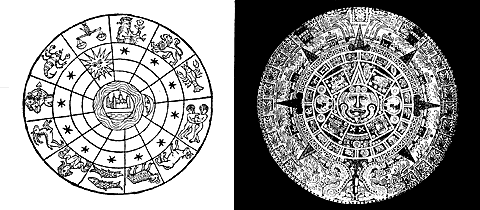
As I read these narratives, I was taken by the description of the Mexican-looking "circle divided into various compartments."
Pictured at left are a pictorial horoscope chart and a Mexican calendar stone. A Mexican calendar stone was rediscovered in 1791 and Anthon, with his fascination for antiquities, would surely have been familiar with it. But to me the description seems reminiscent of the hypocephalus which Joseph Smith would later obtain from Michael Chandler and include as Facsimile #2 in the Pearl of Great Price Book of Abraham. However, Chandler did not obtain his mummies until 1833, and did not bring them to Kirtland until 1835. Actual historical events and coincidences of this period seem so fantastic that Joseph's metaphysical claims almost pale in comparison.

The Community of Christ possesses a handwritten text which is known as the "Caractors Document." This fragment contains seven horizontal lines of characters apparently copied from the plates, as seen in the image below:


The characters are written on a piece of paper measuring 8 by 3¼ inches. The paper appears to be of the same quality and appearance as that on which the manuscript of the Book of Mormon was written. David Whitmer, who once owned the document, claimed that it was this text that Martin Harris showed to Charles Anthon. [3] But the Caractors Document in no way corresponds with Anthon's description. The characters are not arranged in vertical columns, and there are no images of moons or stars. Neither is there evidence of a circular figure.

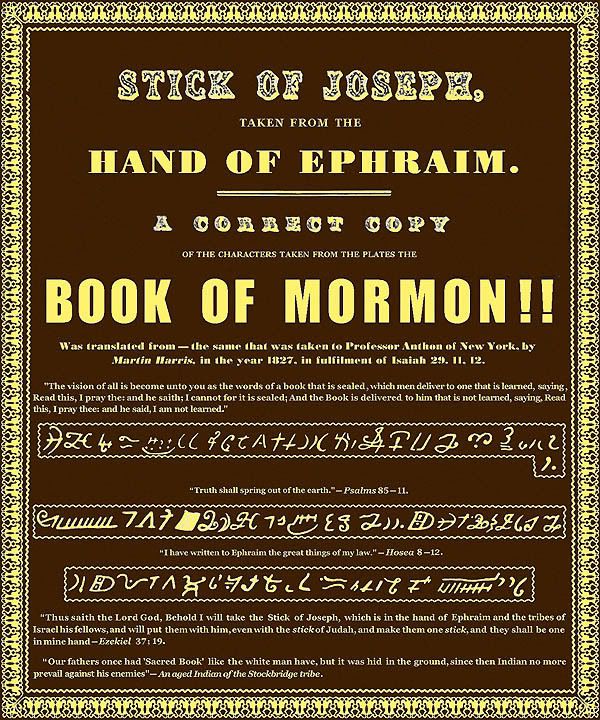
Though this document is not the original, it almost certainly represents characters either copied from the plates in Joseph Smith's possession or copied from the document carried by Harris. Twice in late 1844, after the Prophet's martyrdom, portions of these symbols were again published as characters that Joseph Smith had copied from the gold plates. Characters appeared in the December 21 issue of the Mormon newspaper The Prophet. Also, in 1844 the Latter-day Saints published a broadside with the title "Stick of Joseph" which contained supposed characters copied from the plates. [4] These are somewhat different from the Anthon transcript. We don't know who prepared this 1844 sheet.

Considering that we have this sample of the "Reformed Egyptian" characters, I would think that Mormon linguists would be interested in attempting to translate them and match them with the corresponding Book of Mormon text. And indeed I found a few attempts to do this by several authors. Back in 1942 Ariel Crowley, an LDS attorney from Boise, presented evidence that the characters might be of Egyptian origin. He discussed Chaldaic, Assyriac, and Arabic in relation to hieratic and demotic Egyptian, and Martin Harris's report that Anthon mentioned those languages when he reviewed the transcript. He also presented 194 pairs of photographs comparing characters from the Anthon Transcript with similar or identical characters in recognized Egyptian works such as the Book of the Dead and the Rosetta Stone. [5]

In 1970 Carl Hugh Jones published another serious study of the characters. [6] Jones identified more than 224 characters from the various available sources, and assigned reference numbers to each. Though he felt linguistically unprepared to do so himself, he felt that he had found evidence for an alphabet of between 20 and 32 letters and was confident that a translation could be made. Jones also did some work matching certain of the characters with various Oriental and Mexican scripts.

Community of Christ adherent Blair Bryant claims to have found correlation between the Caractors document and the Book of Mormon title page. [7]

Lastly, Stan and Polly Johnson argue that the Anthon transcript corresponds to Ether 6:3–13 in the present Book of Mormon. [8]

Apologist John Gee is more pessimistic about the possibility of translation of the characters. He postulates that the characters came from the text Joseph was then translating--the 116 missing manuscript pages. Additionally Gee feels that the sample of letters is not large enough to render decipherment feasible. [9] Even so, I would be interested to see a comparison of the claims of Martin Harris with those of Charles Anthon. Harris says that Anthon identified Egyptian, Chaldaic, Assyriac, and Arabic figures in the sample that was given him. Anthon writes that he saw recognizable though deformed Greek, Hebrew, and Roman letters. Can we tell, by a study of the Caractor Document, which of these languages are represented?

In this age of computer assisted research, I am baffled as to why cryptographic studies have not yielded results in this area. Unfortunately, to date no Mormon "Robert Langdon" has cracked the code of the Anthon Transcript. Do my readers still think the characters are in fact authentic? Do Latter-day Saints retain faith that translation might one day be done?

In 1980 a document surfaced which more closely resembled Anthon's specifications and appeared to be the original Anthon Transcript. But in 1987, Mark W. Hofmann admitted that he had forged it. The forgery certainly fits the picture I have in my mind of the Anthon transcript! But what does it say about the state of our linguistic study of the characters that Latter-day Saints were so easily fooled?


___________________________________________

[1] letter written by Charles Anthon to Eber D. Howe dated Feb. 17, 1834. Originally published in Eber D. Howe, _Mormonism Unvailed_, 1834, chapter xviii. The letter appears in full in B. H. Roberts, _A Comprehensive History of the Church, Century One_ (Brigham Young University Press, Provo, UT: 1965), pp. 102-104.

[2] letter written by Charles Anthon to Rev. T. W. Coit dated April 3, 1841. Originally published in Rev. T. W. Coit, _Gleanings By The Way_, 1841. The letter appears in full in Roberts, _CHC_, pp. 104-107.

[3] A photograph of the characters was published in a 1908 history of the Reorganized LDS Church. Twenty-two years later LDS historian B. H. Roberts published a new photograph of the same document in his Comprehensive History of the Church. There is little question that this transcript was at least part of the material presented to Anthon to display characters copied from the gold plates.

[4] BYU Studies, vol.20, no.4, p.325

[5] Improvement Era, Feb 1942

[6] “The ‘Anthon Transcript’ and Two Mesoamerican Cylinder Seals, Newsletter and Proceedings of the Society for Early Historical Archaeology 122 (Sept. 1970): 1–8. An online FARMS article New Light: "Anthon Transcript" Writing Found? mentions the study and laments, "Issues that Jones raised remain today a challenge not yet taken up by scholars."

[7] See Blair Bryant's Caractors Translation.

[8] Stan and Polly Johnson, _Translating the Anthon Transcript_ (Parowan, Utah: Ivory Books, 1999)

[9] Some Notes on the Anthon Transcript by John Gee


*

Sunday, February 24, 2008

5 LDS Interpretations of the Isaiah Passages that Should Not be Perpetuated

I promised some posts on upcoming Book of Mormon Sunday School lessons. But I have to warn you, I've been in a blue funk lately. So I suspect my thoughts are neither inspiring nor fit for Sunday School consumption. But maybe it will help you know what not to say.


LDS Sunday School students will soon take a quick leap through 13 chapters of Isaiah which are quoted by Nephi in 2nd Nephi chapters 12-24. All too often, some uniquely Mormon interpretations are given to these chapters which merit a critical analysis. In this post I present five Mormonisms which I believe hinder a deeper and more accurate understanding of Isaiah's writings.

1. 2 Nephi 12:2,3 Popular LDS commentary on this verse identifies it as Isaiah's vision of people from many lands coming to Salt Lake City, Utah.

Many prophecies of Isaiah are dual and can be applied to more than one time, situation or people. I am aware that latter-day prophets and apostles have related this verse to the Salt Lake temple or even to the Conference Center from which the word of the Lord is issuing forth in these days. However, if we insist too strongly on this Mormon-centric view, we can miss the primary application which this verse has to the millennial reign of the Messiah. The word "mountain" as used in the Bible is a metaphor for "nation," "government," or "political system." In verses 2 and 3 Isaiah is speaking of the millennial condition when Christ shall establish the political Kingdom of God upon the earth. This will be established "in the top of the mountains," or in other words "as the head of the nations."

2. 2 Nephi 12:3 Isaiah wrote that the word of the Lord will come from Jerusalem, and the law will come from Zion, the New Jerusalem, located in Jackson County, Missouri. There will be two distinct centers of influence for God's people.

This may be, but verse 3 should not be used as a proof-text. Here we have a synonymous chiastic parallel where

the Law = the Word of the Lord, and
Zion = Jerusalem (one and the same)

The chiastic structure of this phrase indicates that Isaiah equated Zion with Jerusalem (the one located in Israel!) If we accept this, we will be able to learn more about Zion as it relates to the ancient City of David.

3. 2 Nephi 12:9 In the Book of Mormon, verse 9 is clarified by adding the word "not" to the following statement: "And the mean man boweth [not] down and the great man humbleth himself [not], therefore forgive him not."

This verse actually makes much more sense in its original context, without the extra "not" added in the Book of Mormon version. Verse 8 speaks of idols which are found throughout the land. And the mean (common) man and the great (important) man boweth down (to these idols). This version makes more sense coming as it does right after the description of people worshipping idols, the work of their own hands.

4. 2 Nephi 12:13-17 Some Mormons still insist that this passage is an example of the restoration in the Book of Mormon of passages that were lost in the Old Testament. As noted in footnote 16a, “The Greek (Septuagint) has ‘ships of the sea.’ The Hebrew has ‘ships of Tarshish.’ The Book of Mormon has both, showing that the brass plates had lost neither phrase.”

Pike and Seely have shown the challenges of accepting this interpretation. I love the poetry of the passage and find that the addition of the extra phrase and other interjected words spoils the beauty of the chiastic tripled bicola. Isaiah used poetic conventions frequently to emphasize his points. The Book of Mormon addition does not enhance the poetic structure of the passage, but instead inhibits it. The Greek "ships of the sea" and the Hebrew "ships of Tarshish" are probably different translations of one original phrase and it is not necessary or preferable to include both. Observe the perfection of the Masoretic text with the pattern of w- (conjunction) + al (preposition "upon") followed by kol- ("all/every") and then two words (here in English translation):
For the day of the LORD of hosts shall be

upon every one that is proud and lofty,
and upon every one that is lifted up; and he shall be brought low:


and upon all the cedars of Lebanon, that are high and lifted up,
and upon all the oaks of Bashan,


and upon all the high mountains,
and upon all the hills that are lifted up,


and upon every high tower,
and upon every fenced wall,


and upon all the ships of Tarshish,
and upon all pleasant pictures (fine craft)


and the loftiness of man shall be bowed down,
and the haughtiness of men shall be made low;


and the LORD alone shall be exalted in that day.

(if all this fascinates you, there is a well-reasoned apologetic view here. But I stand by my opinion.)

5. 2 Nephi 14:1 The Mormon speculation on this verse goes as follows: With so many men killed in war, righteous single priesthood holders are in short supply. Thus, plural marriage is reinstituted, with many women stating they will support themselves in order to receive priesthood covenant protection.

My examination of the Hebrew of this verse makes me confident in translating "one man" as "a certain man." The verse thus teaches that in the latter day seven women (symbolic number of completeness, denotes the covenant people) shall take hold of a certain man (guess who that would be?) and ask him "let us be called by thy name," which will take away their reproach (effects of atonement). In my view this verse is Messianic and has nothing whatsoever to do with polygamy.

Update: Our SS teacher gave 2 of these very interpretations while presenting the lesson! How about yours??


*

Monday, February 11, 2008

Enough About Keystones!


I'm getting bored with the obligatory lesson every time we begin a study on the Book of Mormon which involves the teacher drawing a very poor diagram of an arch on the board and explaining the importance of a keystone. This year we are subjected to the convention twice, once in Sunday School Lesson #1 and now in the JS Manual Lesson #4.

Just FYI on keystones: A keystone is the architectural piece at the crown of a vault or arch and marks its apex, locking the other pieces into position. Although a keystone is important, it serves primarily an aesthetic purpose. Some say that a keystone is not as important structurally as the voussoirs, since the removal of any of the voussoirs would cause the arch to collapse but this is not necessarily true of the keystone. A keystone is not the main load-bearer in an arch. The stresses are greatest at the bottom and least at the top. The forces along the center line are horizontal, so an arch can work perfectly well with an even number of voussoirs, and no keystone at all!

Joseph Smith's statement that the Book of Mormon is the keystone of our religion is no more than a figurative and not strictly legitimate use of the term to suggest that the book is the central supporting element of the larger structure of the Church. In our lessons we are stretching the metaphor to the point of being grossly inaccurate. (Besides that, I like to think of Christ as the central element.)

Now I wouldn't have any problem if a qualified architect or mason came to SS prepared to discuss the intricacies of archwork and new applications we could bring to the metaphor. For example, here's an interesting definition:

The keystone is the block without which the structure is not whole; it receives and joins forces of upwardly-reaching members of an arch and creates a structure that soars with lightness yet with solid integrity and strength. The integrative strength of the keystone is a natural one that does not depend for its function on massiveness but rather works because everything falls into place around it and is strengthened and brought together by it, making all the components work together. A keystone is synergistic, yielding a structure that is stronger than the individual parts would be if they were merely stacked together, one on top of the other. It exists to unite structural elements.

But I think I'd rather just drop the overemphasis on this old chestnut. There are more fascinating things in this lesson to discuss. Tomorrow I will blog about one of them.