In a 1991 address, BYU President Rex E. Lee noted that compared to any other kind of law--including statutory, regulatory, or judge-made common law--constitutional law is very difficult to make or change.
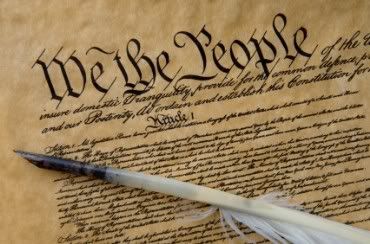
"The central feature of the American Constitution is that with only one exception [the Thirteenth Amendment, prohibits slavery], its provisions are confined to limiting the powers of government... The Constitution contains some fairly obvious, though not always specific, prohibitions concerning what government--federal, state, or local--can do to its citizens. Some of the most prominent are protections for the criminally accused, such as the privilege against self-incrimination, protection against unreasonable searches and seizures, the right to counsel, and jury trial."
Lee goes on to discuss how spreading the powers of government among several separate entities and by making each a competitor with the others makes it less likely that these entities can gain the power to become oppressive. Without the Constitution and the rights that were guaranteed to us, the Mormons would not have survived as a people. This was the only nation and the only set of laws under which the Lord could have restored his Church.
Despite its strength, Latter-day Saints have been warned that one day the Constitution would be found in danger. The Prophet Joseph Smith thus prophesied in his famous "hanging by a thread" speech; and more than half of his successors repeated the admonition. I am well aware that Joseph's declaration has been quoted every time a tax increase comes along, or a failure to collect the garbage on time, or during a boundary dispute with a neighbor, as Lee so humorously puts it.
But today we have before us two Constitutional issues which deeply concern the Latter-day Saints. The first is the actions of the Texas legal system against the FLDS at the Yearning for Zion ranch. The second is the ruling of the California Supreme Court that a ban on gay marriage violates its constitution.
These two issues are of extreme importance to Mormons as they strike to the heart of the Proclamation on the Family. In the coming week I plan to discuss each issue, examine the Constitutional issues at stake, and probe the responsibilities of Mormons to engage these topics. I find it interesting that despite their relevance, the Church hierarchy has seen fit to combat one, while doing everything possible to distance themselves from the other.
How deeply should the Church be involved in these Texas and California legal battles? There are at least two perspectives. One view points out that the Church represents itself as non-partisan and should not throw its weight and the tithing money of its diverse membership into political issues. Another position is that the Church must take a stand on moral matters. The Joseph Smith prophecy is instructive in this regard:
"When the Constitution of the United States hangs, as it were, upon a single thread, they will have to call for the Mormon elders to save it from utter destruction; and they will step forth and do it." –Brigham Young, JD 2:182, February 18, 1855
"I believe that it is the destiny of the Latter-day Saints to support the Constitution of the United States. The Prophet Joseph Smith is alleged to have said—and I believe he did say it—that the day would come when the Constitution would hang as by a thread. But he saw that the thread did not break, thank the Lord, and that the Latter-day Saints would become a balance of power, with others, to preserve that Constitution. If there is—and there is one part of the Constitution hanging as by a thread today—where do the Latter-day Saints belong? Their place is to rally to the support of that Constitution, and maintain it and defend it and support it by their lives and by their vote. Let us not disappoint God nor his prophet. Our place is fixed." -Melvin J. Ballard, Conference Report, April 1933, p. 127.
What part will we have in the coming days and months, in supporting the Constitution of the United States? What form might this support take? Please comment with your opinion, and come back for Parts 2 and 3 of this discussion.


 Posts
Posts


