I finally got a laptop for a fairly decent price! I am thrilled to death. But the only problem is, we are unable to get internet access just yet. Here in Riyadh, one must wait for a residence permit (iqama) in order to do just about anything. If you don't have your iqama, you cannot open a bank account, get a telephone, internet access, or even get paid by your employer! I'm about to die waiting.
I don't even have a computer at work yet, so I'm having to snitch little periods of time here and there on other people's. I have many things I want to tell all of my loyal readers, but I'll just have to wait a bit longer.
If you want to know all the boring details of my personal life, I'm trying to put them up a little at a time in diary form on my other site, Behind the Infamous Veil. But keep checking here as I'm hoping to give you some nice interesting posts about the fascinating culture I'm encountering here.
Tuesday, September 18, 2007
A Computer at Last!
Monday, August 20, 2007
March
While you're waiting to hear from me, I thought I'd post a book review on the last book I read while in the States: March, by Geraldine Brooks. This is a great book for the light novel reader--not too difficult to read, but with some substance to it. Brooks has drawn her inspiration from Louisa May Alcott's Little Women, and has written the story of the absent father, Mr. March, who has gone off to aid the Union cause in the Civil War. She has loosely based this character on Louisa Alcott's own father, Bronson Alcott.
Bronson Alcott sounds like a man with whom I would love to become acquainted. He was a transcendentalist philosopher, educator, and abolitionist. He counted among his closest friends Ralph Waldo Emerson and Henry David Thoreau, and his name appears frequently in their letters and journals. It appears that Brooks had plenty of material to study in forming the character of Mr. March, as Bronson Alcott recorded his own life in 61 journals and his letters fill 37 manuscript volumes in the Harvard College Library.
Brooks has done a wonderful job of creating a life and voice for Mr. March. As a callow youth, he shows little thought for the evils of slavery, but he gradually encounters Negro slaves in the South and becomes enlightened. The book takes him through his marriage to Marmee, the loss of his fortune in attempting to advance the abolitionist cause, and his tortured decision to join the Union Army as a chaplain. While experiencing the horrors of war, he loses his innocence and becomes a tortured soul.
It is this character, portrayed near the end of the novel, who captured my imagination. The following excerpt from the novel recounts Mr. March's thoughts as he leaves the hospital and prepares to return home to his anxious family:
You go on. You set one foot in front of the other, and if a thin voice cries out, somewhere behind you, you pretend not to hear, and keep going.
But some steps require more effort than others. As I set my foot upon the path leading to that little brown house, I felt like an impostor. Surely, I had no business here. This was the house of another man. A man I remembered. A person of moral certainty, and some measure of wisdom, whom many called courageous. How could I masquerade as such a one? For I was a fool, a coward, uncertain of everything.
Had I been alone, I might have turned back then, melted away like the snow on that bright, mild morning, become a particle lost in the vast spate flowing through the landscape of war, so that my daughters could live with the unsullied memory of that other man, and not be obliged to know this inferior replacement.
But I was not alone. John Brooke had a firm grip upon my arm and the young Lawrence boy pranced brightly ahead of us, barely able to contain his excitement. He was carrying on as if he brought some bright-wrapped, welcome Christmas gift. If only he knew for what shoddy goods he was the forerunner. I pulled my muffler up high around my face, so as to hide the trembling at the corners of my mouth. Truly, walking up that path was an act of courage greater than any asked of me at war.
To those who have experienced uncertainty, and have faced their own weaknesses in the darker parts of their souls, this character will seem familiar. This novel builds in complexity when, at its apex, one comes to see the differing points of view of several of the characters, and that things are not always as they seem. I loved the shades that the author adds to Marmee. In Little Women, the mother is a paragon of virtue, but in life one can hardly live up to this standard. Here Marmee is shown as a noble, but real person. Without reservation, I would put this novel beside my copy of Little Women upon the shelf.
Thursday, August 16, 2007
Bored in Vernal is now Behind the Infamous Veil
I would like to say goodbye to all my blog friends for a while. Tonight we unhook the computers and pass them on to our two college girls. They will depart tomorrow for BYU-Idaho and Utah State Logan, respectively. I have the weekend to finish cleaning this place out and we will fly out of Utah early on Monday morning. I don't know how long it will take once we get to Riyadh to buy a new computer and get hooked up. Don't give up on me! I'm sure I'll be back to blogging soon.
Wednesday, August 15, 2007
Fantasy Bonds in Eternal Marriages
This was another session I attended at Sunstone Symposium. It was given by Michael Farnsworth, EdD, an educational psychologist who recently retired from the marriage and family relations dept. at BYU Idaho.
The words "fantasy bonds" were, in my opinion, a little misleading in this presentation. Michael was using the terminology given by Robert Firestone to roleplays that husbands and wives develop in their marriages. Fantasy bonds are culturally defined duties that people begin to act out in their marriages. They can eventually become bonds which hold the couple back from intimacy.
Michael said that intimacy is an acquired taste--many cannot stand the passion that true intimacy brings. When we fear our own and others' energies, we can form fantasy bonds as a psychological defense to marital distress. Mormon women have a great tendency to slip into this role-playing behavior. Once a young wife enters into the pattern, all her decisions are made for her. She will have many children, she will not work outside the home, she will hold Church callings, etc. Michael warns of three dangers to this reaction, and I have observed these myself.
1. The relationship can become superficial
2. The marriage partners are embroiled in continual conflict
3. One of the partners surrenders their voice
Thus, Michael suggested that personal identity has to be established before relationship identity can be formed.
The respondent to this talk was Ronda Callister, PhD and professor of organizational behavior at Utah State. She presented the point of view that developing a resilient identity is the work of a lifetime. She said that had she waited until personal identity was established before she was married, it would have been a very long time! Then she shared some steps she had taken in developing a resilient identity and encouraging intimacy in her marriage.
I enjoyed this presentation but I found it very difficult to listen to, since I neither see myself as having a very well-developed sense of identity nor much intimacy within my marriage.
Sunday, August 12, 2007
Blake Ostler on Spiritual Experiences
Blake Ostler's presentation at the Sunstone Symposium went a lot different than I thought it would. I didn't expect Blake to be as understandable, down-to-earth, and personal as he was. Blake spoke about LDS testimony and spiritual experiences--and he wasn't dry at all. In fact, near the beginning of his talk, he told of an experience he had when he was age 15. Sitting in the high school gym, a girl he didn't know well sat next to him, and he was prompted to tell her that God wanted her to stop thinking about suicide. This turned out to be an important message, since she was already planning the act. Blake argued that spiritual experiences are real. (Well, he actually says, "attacks claiming that such experiences are not trustworthy because they are merely ephemeral emotions are based on a caricature and unjustified reduction." It is Blake, after all.) Blake testified that it is not irrational for us to believe and trust our spiritual feelings. He also preached a "radical inclusivism," where we are called to be open to the spiritual experiences of others, including evangelicals. He cautioned that we should recognize that our experience does not mean that we know anything, that we should not feel morally superior because of it, and that we should remain open to doubt. He explored the idea that spiritual experience cannot be produced at will. He concluded that religious experience has no meaning without a life lived in pursuit of this knowledge.
Blake's presentation seemed to generate a great deal of controversy among the audience. The respondent, Bill Heersink from Salt Lake Theological Seminary, praised Blake for his "holistic view of humans that doesn't try to divorce the mind and soul," but nevertheless disagreed with his definition of spiritual experience. Several of the questions at the end likewise asked for further clarification. One young man in particular questioned Blake's view of spiritual experience. The young man told of an experience of his own in the MTC. He prayed to know his status regarding a girlfriend and was given a strong confirmation that he would marry the girl. When she later "Dear Johnned" him, it was devastating.
I was quite surprised to hear Blake respond that the young man's experience was not a valid one, since it had later been proved to be false. I thought Blake's answer went against his explanation of "radical inclusivism" earlier in his talk. Blake saw his own experience in high school to be valid since the girl was actually thinking of suicide, but the young man's experience was different since he did not end up marrying his girlfriend.
I believe this is a problematic way of looking at spiritual experience. Encounters with the Divine tend to be nebulous and not easily interpreted. I would be much more willing to see the young missionary's experience as a real manifestation of the Holy Spirit, sent for comfort and aid at a difficult time. Perhaps the interpretation was in error, but the experience was undeniable.
I appreciated and agreed with the points in Blake's presentation. I found it comforting to hear such an erudite and intellectual assertion that we can "know with a surety" the reality of the Spirit in our lives. However, I was quite put off by the application of his own principles in his response to the young returned missionary. I would like to see a greater acceptance of spiritual experience within and among religions.
Spirituality at Sunstone
In this post I'd like to address the issue brought up by Snarkimus Prime in his continuing attacks upon me regarding spirituality at Sunstone. There are two areas of interest to me: People, and Programs.
People
Snarky seems to object to the presence at Sunstone of many former Mormons. Some of the more infamous among these are the Toscanos, Janice Allred, Lavina Anderson, Richard Dutcher, Will Bagley. These people have been excommunicated or left the Church due to their exploration of Mormon topics through their art, be it writing or film.
Saturday, August 11, 2007
Snarker, be Damned: Another Sunstone Testimony
I finally have internet access again (!)and Snarker be damned, I am going to post my little heart out about how wonderful and spiritual it was. I believe that the types of talks and panels at Sunstone have the power to touch the questioning and questing among us in a way that speaks to our souls.
On Thursday, the Mormon Women's Forum presented a panel titled "Image and Reality: The Many Faces of Mormon Women. Janice Allred led the panel and explained that the concept of face invites us to consider several contrasting pairs that define face: appearance vs. reality, public vs. private, open vs. hidden, engaged vs. withdrawn, present vs. past, and ideal vs. real. Each of the panelists addressed how Mormon women negotiate the tension between the ideal and the reality of their own lives. Since I was one of the panelists, I'll post my remarks here for your edification!Virginia Woolf wrote: "a woman must have money and a room of her own if she is to write fiction." I identify with this statement because I realize that in order to accomplish great things, one must have the means and the space. I sometimes wonder if, within Mormonism, a woman can find "a room of her own." From the time a Latter-day Saint girl or boy is very young, words of testimony are whispered in their ears. They memorize all 12 Articles of Faith and are taught songs of faith and assurance. The Young Women stand each week and recite a motto describing the ideal girl. An active teenage girl who attends Church services, Mutual, and Seminary goes to Church 10 or more hours a week. She is interviewed by her Bishop twice a year to assess her worthiness. Often, this young woman will marry at a fairly young age and begin Church and family responsibilities before she has ever really lived on her own.
These can all be wonderful influences. They tend to produce women who have lived clean, decent lives; who have not mired themselves in addictions. These women are trained and prepared to keep clean and organized homes and to raise upstanding families. Are they missing anything from never having had a room of their own?
I think our strength as a culture is that we tend to develop the public face of our people superbly. As a young wife, I had learned how to present that face to the ward and to the world. I was well-spoken, well-groomed, energetic. I had the skills to run a Parent-Teacher Organization or to speak in public. This picture shows 6 of my eventually 8 children. As you can see, I sewed matching dresses for these girls. I did it three times a year: Christmas, Easter, and Pioneer Day.
But the public appearance was very different from the private reality.
At times I found friends I could share the tough realities of my life with. But in my experience, the Mormon world was not conducive to such confidences. As a Latter-day Saint, I felt compelled to put on a good face for the world. To my non-member friends and neighbors, I felt that I needed to show them how happy being a member of the Church made me. I couldn’t reveal any marital problems, for that would put a bad light on our “eternal family” rhetoric. I didn’t feel free to complain about the pressures of having 8 children, because it might invalidate my reasons for having such a huge family. Among the other LDS women, I felt some competition and equal pressure to maintain the image of perfection. Especially when I was a young mother, I didn’t realize that other Mormon women might also be struggling.
Putting forth a good face is also an inherited trait in my family. To illustrate this, I’d like to share a story my mother wrote in her family history. She tells of going to see a Broadway musical review with her sisters. Since they knew someone in the production, they were invited to go backstage. They left their seats during the final number and were ushered back behind the curtains to watch the chorus line finale. They saw the dancers with big, bright smiles upon their faces while they faced the audience. But when they turned their backs on the crowd, the girls’ faces would relax into a frown or a scowl of concentration. By the time they turned back around, they had their smiles pasted back on. My mother compared this chorus line to her family. She said that in public, they always had to have their smiles on.
I wrote a poem (some of my blog readers will remember this!) which expresses the liminality I have felt as I have attempted to please my family, my Church, and especially my husband without being able to fully celebrate the nontraditional parts of myself. It’s called, “I Put on Black.”
I put on black,
My head I bow.
You like me now.
You like me now.
I put away my chartreuse scarf,
And colored things I used to wear.
My second piercings now are bare,
I gel down my unruly hair.
I do not have a lot to say.
My makeup now is quite subdued.
I seem to cook a lot of food,
I don’t go swimming in the nude.
I nod and murmur when I should,
I shut my mouth, my thoughts I still,
My questions and my quirks I kill--
My secret longings none can fill.
The ward is suddenly so kind.
I’m not as different now, you see!
A call has been extended me
To teach Relief Society.
Sedately I walk down the aisle,
The Bishop’s wife sits by my side,
She nods at me; you smile with pride,
I feel a tearing deep inside.
I clean the toilets and the hall,
Read stories to my sweet sunbeams.
We never argue now, it seems.
I wonder where I put my dreams.
Your temple marriage now is safe,
You hold my hand that wears the ring.
I never dance, I never sing,
You would not notice such a thing.
I’m all in black,
I’ve kept my vow,
You like me now,
You like me now.
But this is what
You do not see:
I don’t like me,
I don’t like me.
When my family moved to the small, provincial town of Vernal, Utah two years ago, I discovered blogging. I felt I had found “A room of my own,” where I could present my innermost thoughts and feelings, ideas I’ve long held, but didn’t always align with the perfect Mormon woman. On my blog, I call myself “Bored in Vernal,” a feminist, pacifist, disgruntled, yet fully active Latter-day Saint. I’ve found the cyberworld to be a place where I can explore the real me among those with a Mormon background. I’ve found that I can’t leave the Church behind. It is a deep and inextricable part of me. Yet there are some policies, procedures and doctrines that, in order to be authentic, I must take exception to. Even at the ripe old age of 47, I’m still trying to find myself. Right now, it’s almost like I live a double life. I find myself saying things at Church, then saying the polar opposite on my blog. Which do I really believe? At the time I say these things, I feel I am representing myself accurately. I’m so confused. What are my true feelings? Who am I?
One of the objectives of this panel was to explore how Mormon women negotiate the tension between the roles and expectations of Mormon culture and the reality of their own lives. I pondered this as I read a recent novel entitled “Snow Flower and the Secret Fan.” The book is about nineteenth-century China and a group of women in Jiangyong, a far flung area in the rural countryside. These traditional Chinese females experienced the binding of the feet at age 7, early marriage, and a secluded life thereafter. While embracing the expectations of their culture, the women of this community developed practices which enabled them to survive. To meet their needs for community, the women contracted with other females—either “sworn sisters” or “old sames.” The novel is based on factual evidence that these women developed a secret system of writing by which they could communicate. It was called “nu shu,” and was kept secret for over a thousand years.
I believe that women such as myself who find tension between traditional Mormon roles and their own personal paradigms must find some way to relieve the strain. What practices will they develop which will enable them to survive and flourish? Will it be online communities such as blogging, or email groups? As wards become more accepting of diversity, will they find kindred spirits within the ward with whom they can commiserate? Or will these women find fulfillment in jobs outside the home, retaining their cultural roles only while at home and at Church?
Through the Proclamation on the Family, the Church has shown its commitment to traditional roles for women. Within our illustrious history, though, there have been some few opportunities for women, even within this type of culture, to find “a room of their own.” I’m thinking of women such as Ellis Shipp, who was sent back East by Brigham Young to obtain a medical degree. She practiced and taught medicine in Utah while bearing ten children. Women like Minerva Teichert, who went to Chicago to take art lessons as a “set apart” missionary of the LDS church. She married, raised a family, cooked and helped with the ranch while painting prolifically throughout her life. I’m thinking of Relief Society sisters who collected grain for humanitarian service, wrote their own manuals, maintained their own budgets and buildings. I urge that we continue to draw upon these, and many other examples of women who embraced their cultural roles within Mormonism yet broadened the definition of womanhood to find a room of their own from which to reach out and touch the world.
Stay tuned! I'll be posting much more of my experiences from Sunstone.
Thursday, August 9, 2007
Greetings from the Sunstone Symposium!
A big Bronx cheer to those who believe "Symposia" are evil. I just felt the Spirit stronger than I have in the past year. This year's event is off to a great start.
I just attended this evening's presentation by Helen Whitney, creator of the PBS special "The Mormons." She told the story of the making of the film with some behind-the-scenes stories and commentaries. "Why did I choose to examine these quirky, strange, and scary Mormons?" she asked. She explains that she feels an affinity to the spiritual and is fascinated with radical religious commitment. Mormonism is not just a Sunday religion, as we all know. It is all-encompassing. Helen began her three-year process of preparing this documentary with a bit of knowledge about the Mormons: "I knew they were smart, funny, they weren't polygamists, and they lived in other places outside of Utah," she explains. At the end of the odyssey, she says that she can't imagine tending to family, career, and belonging to such a faith--"my head just hurts."
I was extremely impressed by all the work that went into making this documentary. Whitney has crafted her new-found knowledge and thousands of hours of interviews into an art form. It was fascinating to listen to her explain how and why she chose the music, the art work, and the interviews that would be included. She explained that access is always a problem for a documentary film maker. She would not have been able to make the film without gaining the trust of the LDS Church. Why was the Church so open to a film it would not have any control over? Helen postulates that the Church has a reputation for being very closed. Michael Purdy, the Church representative with whom she worked on this project, wanted to change this perception.
I especially liked Whitney's discussion of gathering the interviews. She wanted to get her subjects to strip away the religious jargon. She was concerned that the speakers would be too boring. She said that dissidents were the most interesting. Historians seemed too attatched to one little piece of the picture and the faithful were unable to move past their trite jargon. I thought in view of this situation that her final result was remarkably balanced.
Whitney's "surprise" interviews included Betty Stevenson (inner-city convert), and Marlin Jensen. The higher up you go, she noted, you must abandon all hope of fresh, unrehearsed answers. Not so with Jensen. He was authentic and interesting. "The Church would be well-advised to use him as the public face of Mormonism," she quipped. On the other hand, she was disappointed with Boyd K. Packer's interview, blaming herself as much as him. She saw him as having made some strong statements in the past, and she wanted him to expand upon what he had written. Instead, she felt that he did not own what he had said.
What touched me about Whitney's presentation was her excitement about Joseph Smith as a powerful and complex leader. She cautioned Mormons not to strip him of his boldness and ruthlessness. She labeled Joseph "postmodern" and described him as "experimenting with his many selves." She said that we should judge his narrative by its power to change lives and people's willingness to believe it. Whitney challenged Mormons to see Joseph as a fascinating prophet-puzzle. She urges us to own our beliefs and be less defensive.
After the presentation, I felt inspired by the admiration of a non-member who sincerely investigated Mormonism and found it a passionate, intriguing religion. The session was opened and concluded with hymn singing directed by Ardean Watts. How I wish every chorister in the Church could take lessons from Ardean! He conducted with a flair, almost dancing in his excitement, and all eyes were upon him. We sang with gusto.
Kevin Barney has an open thread on the Symposium at BCC--check it out for more observations on the event.
Tuesday, August 7, 2007
My Summer Reading
Lean Mean Thirteen by Janet Evanovich
I've read all 13 Stephanie Plum novels. This one is the same as the others--a light read with amusing portions, but containing smutty language and adult situations. Absolutely no redeeming value.
Dialogue Magazine
I almost always sit down and read my Dialogue the minute it arrives. My favorite article in this issue was Cetti Cherniak's "The Theology of Desire" (Part 2 in a series). Loved her discussion on artists and all those who exercise creative agency. Another great piece was Wrathall's "Trial of Faith." Wrenching.
Religious Literacy by Stephen Prothero
Written in the same vein as "Cultural Literacy" by Hirsch, Prothero makes a great case for the need for familiarity with world religion. Go here to test your religious literacy!
The Secret of Lost Things by Sheridan Hay
This novel's themes of loss, power, love and impairment resonated with me. How can we regain the things we lose, or cope with never finding them again? Which of our secrets are destructive, and which are necessary?
Lucy's Book by Lavina Fielding Anderson
I wanted to read this to get Lavina's take on the changes that were made to this memoir in it's various publications, and on Lucy's role in the early church. I haven't been disappointed! I'm still working my way through this one--I've had to renew this library book twice. That never happens! When I get some extra $$$ I will add this to my collection.
Harry Potter and the Order of the Phoenix by J.K. Rowling
I have to reread the last two Harry Potter's before the new one comes out, so I can remember what is going on! I just finished all 870 pages of #5--now, can I read #6 by Friday night??
Sunstone Magazine
I've finished the latest issue of Sunstone--Enjoyed reading Margaret Toscano's "Are Boys More Important Than Girls?" I heard her give this talk at last year's Symposium. To read it online, click on the Sunstone link!
Harry Potter and the Half Blood Prince by J.K. Rowling
I'm done with Book 6 and now I've refreshed my mind on all the events of the previous Harry Potter books. I still can't believe Dumbledore really died in this book. I'm ready for Book 7 to come out, and I sure hope it explains Snape's treachery and why he was so trusted by Dumbledore!
Ysabel by Guy Gavriel Kay
Another fun summer read. This book combines fantasy with a bit of Celtic and Roman history. It's entertaining, but nothing special. This book is supposed to be more contemporary than his other works. I think I'll try his earlier fantasy novels. His Fionavar Tapestry series and "The Last Light of the Sun" are international bestsellers.
Harry Potter and the Deathly Hallows by J.K. Rowling
I read it! and I'm not telling.
Snow Flower and the Secret Fan by Lisa See
I read this novel of nineteenth-century China for a Book Club group. I'm driving all the way to Highland to reunite with some friends I knew in Houston. We will spend the night and discuss the book. This one's worthy of a blog post, too!
Sunday, August 5, 2007
A Room of My Own
The concept of face invites us to consider several contrasting pairs that
define face: appearance vs. reality, public vs. private, open vs. hidden,
engaged vs. withdrawn, present vs. past, and ideal vs. real. What are the
stereotypes about Mormon women and how well do these images represent
actual Mormon women? What are the roles and expectations that Mormon
culture scripts for women and how do Mormon women negotiate the tension
between these ideals and the reality of their own lives? How do these ideal
images affect the ways Mormon women shape their own identities?
Virginia Woolf wrote: "a woman must have money and a room of her own if she is to write fiction." I identify with this statement because I realize that in order to accomplish great things, one must have the means and the space. I sometimes wonder if, within Mormonism, a woman can find "a room of her own." From the time a Latter-day Saint girl or boy is very young, words of testimony are whispered in their ears. They memorize all 12 Articles of Faith and are taught songs of faith and assurance. The Young Women stand each week and recite a motto describing the ideal girl. An active teenage girl who attends Church services, Mutual, and Seminary goes to Church 10 or more hours a week. She is interviewed by her Bishop twice a year to assess her worthiness. Often, this young woman will marry at a fairly young age and begin Church and family responsibilities before she has ever really lived on her own.
These can all be wonderful influences. They tend to produce women who have lived clean, decent lives; who have not mired themselves in addictions. These women are trained and prepared to keep clean and organized homes and to raise upstanding families. Are they missing anything from never having had a room of their own?
I think our strength as a culture is that we tend to develop the public face of our people superbly. As a young wife, I had learned how to present that face to the ward and to the world. I was well-spoken, well-groomed, energetic. I had the skills to run a Parent-Teacher Organization or to speak in public. This picture shows 6 of my eventually 8 children. As you can see, I sewed matching dresses for these girls. I did it three times a year: Christmas, Easter, and Pioneer Day.
But the public appearance was very different from the private reality.
At times I found friends I could share the tough realities of my life with. But in my experience, the Mormon world was not conducive to such confidences. As a Latter-day Saint, I felt compelled to put on a good face for the world. To my non-member friends and neighbors, I felt that I needed to show them how happy being a member of the Church made me. I couldn’t reveal any marital problems, for that would put a bad light on our “eternal family” rhetoric. I didn’t feel free to complain about the pressures of having 8 children, because it might invalidate my reasons for having such a huge family. Among the other LDS women, I felt some competition and equal pressure to maintain the image of perfection. Especially when I was a young mother, I didn’t realize that other Mormon women might also be struggling.
Putting forth a good face is also an inherited trait in my family. To illustrate this, I’d like to share a story my mother wrote in her family history. She tells of going to see a Broadway musical review with her sisters. Since they knew someone in the production, they were invited to go backstage. They left their seats during the final number and were ushered back behind the curtains to watch the chorus line finale. They saw the dancers with big, bright smiles upon their faces while they faced the audience. But when they turned their backs on the crowd, the girls’ faces would relax into a frown or a scowl of concentration. By the time they turned back around, they had their smiles pasted back on. My mother compared this chorus line to her family. She said that in public, they always had to have their smiles on.
I wrote a poem which expresses the liminality I have felt as I have attempted to please my family, my Church, and especially my husband without being able to fully celebrate the nontraditional parts of myself. It’s called, “I Put on Black.”
I put on black,
My head I bow.
You like me now.
You like me now.
I put away my chartreuse scarf,
And colored things I used to wear.
My second piercings now are bare,
I gel down my unruly hair.
I do not have a lot to say.
My makeup now is quite subdued.
I seem to cook a lot of food,
I don’t go swimming in the nude.
I nod and murmur when I should,
I shut my mouth, my thoughts I still,
My questions and my quirks I kill--
My secret longings none can fill.
The ward is suddenly so kind.
I’m not as different now, you see!
A call has been extended me
To teach Relief Society.
Sedately I walk down the aisle,
The Bishop’s wife sits by my side,
She nods at me; you smile with pride,
I feel a tearing deep inside.
I clean the toilets and the hall,
Read stories to my sweet sunbeams.
We never argue now, it seems.
I wonder where I put my dreams.
Your temple marriage now is safe,
You hold my hand that wears the ring.
I never dance, I never sing,
You would not notice such a thing.
I’m all in black,
I’ve kept my vow,
You like me now,
You like me now.
But this is what
You do not see:
I don’t like me,
I don’t like me.
When my family moved to the small, provincial town of Vernal, Utah two years ago, I discovered blogging. I felt I had found “A room of my own,” where I could present my innermost thoughts and feelings, ideas I’ve long held, but didn’t always align with the perfect Mormon woman. On my blog, I call myself “Bored in Vernal,” a feminist, pacifist, disgruntled, yet fully active Latter-day Saint. I’ve found the cyberworld to be a place where I can explore the real me among those with a Mormon background. I’ve found that I can’t leave the Church behind. It is a deep and inextricable part of me. Yet there are some policies, procedures and doctrines that, in order to be authentic, I must take exception to. Even at the ripe old age of 47, I’m still trying to find myself. Right now, it’s almost like I live a double life. I find myself saying things at Church, then saying the polar opposite on my blog. Which do I really believe? At the time I say these things, I feel I am representing myself accurately. I’m so confused. What are my true feelings? Who am I?
One of the objectives of this panel was to explore how Mormon women negotiate the tension between the roles and expectations of Mormon culture and the reality of their own lives. I pondered this as I read a recent novel entitled “Snow Flower and the Secret Fan.” The book is about nineteenth-century China and a group of women in Jiangyong, a far flung area in the rural countryside. These traditional Chinese females experienced the binding of the feet at age 7, early marriage, and a secluded life thereafter. While embracing the expectations of their culture, the women of this community developed practices which enabled them to survive. To meet their needs for community, the women contracted with other females—either “sworn sisters” or “old sames.” The novel is based on factual evidence that these women developed a secret system of writing by which they could communicate. It was called “nu shu,” and was kept secret for over a thousand years.
I believe that women such as myself who find tension between traditional Mormon roles and their own personal paradigms must find some way to relieve the strain. What practices will they develop which will enable them to survive and flourish? Will it be online communities such as blogging, or email groups? As wards become more accepting of diversity, will they find kindred spirits within the ward with whom they can commiserate? Or will these women find fulfillment in jobs outside the home, retaining their cultural roles only while at home and at Church?
Through the Proclamation on the Family, the Church has shown its commitment to traditional roles for women. Within our illustrious history, though, there have been some few opportunities for women, even within this type of culture, to find “a room of their own.” I’m thinking of women such as Ellis Shipp, who was sent back East by Brigham Young to obtain a medical degree. She practiced and taught medicine in Utah while bearing ten children. Women like Minerva Teichert, who went to Chicago to take art lessons as a “set apart” missionary of the LDS church. She married, raised a family, cooked and helped with the ranch while painting prolifically throughout her life. I’m thinking of Relief Society sisters who collected grain for humanitarian service, wrote their own manuals, maintained their own budgets and buildings. I urge that we continue to draw upon these, and many other examples of women who embraced their cultural roles within Mormonism yet broadened the definition of womanhood to find a room of their own from which to reach out and touch the world.
Saturday, August 4, 2007
Calling You Out
It's a new meme by Johnny who is supposed to be studying, but instead is taking frequent breaks to comment on people's blogs and bother those who should be packing.
Here are the rules:
(1) Explain an issue that you are most passionate about.
(2) Why should all others (ignoramuses that disagree with you) accept your position?
(3) Why do the rest of us (ignoramuses who disagree with you) just not get it?
Well, everyone who blogs knows that I am passionate about pacifism and Mormon feminism. But I think I'll respond on a different issue today. I am passionate about gifted education. Because of all our moves, my children have attended a combined total of 15 different schools plus about 5 years of home schooling. We have seen a wide range of programs for gifted children. (BTW all 8 of my children have tested gifted, no big surprise with their family background.) We've encountered four different types of gifted education:
1. The children are divided according to ability and the gifted classes work ahead of their grade level.
2. The gifted children are identified and placed in magnet schools
3. The children attend regular classes and are pulled out of class a few hours a week to attend supplementary programs.
4. There is no gifted program--the children are mainstreamed and enjoy a maximum interaction with their peers of all abilities.
For some reason there are ignoramuses who believe that the gifted children should remain in the regular classroom as examples for the rest of the students, helping them with their homework, tutoring them, running errands for the teacher and otherwise frittering away their public education time. These children learn to do the work, which is way too easy for them, quickly and with a minimum of effort. They seldom have homework or work up to their potential.
My position is that children should be allowed to work at the highest level they are capable of attaining. In a public school situation this is best achieved by putting them with others of the same capabilities, either in a self-contained classroom or a magnet school. Yes, this is segregation according to ability. I have seen amazing results with such classes.
You should accept this position because if Americans wish to be competitive in the worldwide arena we need to give our gifted students every opportunity to advance in their studies. This is not possible in a crowded classroom of 30 students at different levels. The teacher must spend most of the time on those who do not understand and need to be brought up to grade level.
Many of you just do not get it. You want the money spent on education to go to your mediocre or special needs student. You want my well-behaved child in the classroom to influence others for good. The gifted children have parents who disproportionately help in the schools and in the classrooms. You would like to spread this assistance around.
My focus is the best education for the gifted child because my children are gifted. Would my ideas change if my children were not in this demographic? Probably not. Separating the children by ability makes better teaching possible for all.
I tag J G-W, JohnR, M&M, Téa , and Amelia.
Friday, August 3, 2007
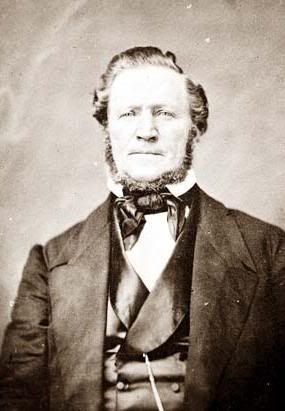
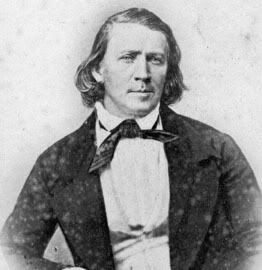
Brigham's Advice to Women and Men
As reported by Wilford Woodruff:Many other remarks were made & while addressing the females Said Sisters if you expect to call me Br Brigham I want you to be Cleanly. Keep your faces, hands & skin Clean from head to foot your Clothes dishes & Houses clean Also your Children & teach them manners, & when you mix up Bread don't have a dozen flies in your tray.
I know that the women generally rule there Husbands & the Children their Mothers. But when A woman under takes to rule me I want Her to be so secret about it that I Cannot Catch Her at it. Now I do not want the Brethren from my remarks to abuse there wives but treat them kindly: Do there Heavy luging but dont wash there dishes as some men do."
How are we all doing?
Wednesday, August 1, 2007
Postmodern Ideas for the LDS Church
Recently, Christian bloggers have been discussing the effects of postmodernism on their congregations. (Hat Tip: DMI Dave) For example, this article notes that our society is undergoing a shift to a completely different way of thinking--from left-brained, logical, analytical patterns to whole-brained or bi-lateral thinking. This type of thinking includes and embraces the right-brain intuitive and creative influences. The postmodern generation has been trained in the classroom to use the right brain in their learning activities. Schools have increasingly incorporated the inquiry approach to problems and have engaged in cooperative learning paradigms.
As they encounter the Church as adults, these 18 to 30 year-olds use postmodern thinking in solving difficulties and ambiguities. I believe that as this generation takes its place in local Church leadership, there will be more creative problem-solving at the grass-roots level and less reliance upon tradition. Rather than memorizing and quoting from the Church Handbook of Instructions, these leaders will increasingly use their right brain and intuitive powers.
An example of this type of thinking in the LDS Church can be found in a recent post at Mormon Rhetoric. Here Natalie makes some interesting suggestions on the subject of ward boundaries. Not being part of the postmodern generation, I had never even considered that ward boundaries could be formulated using criteria other than geography. But she makes a great case for approaching problems such as transient communities and weak youth programs. In other areas of the Church, one can see Ward Councils using cooperative principles rather than rigid hierarchical structures. (Warning: Sometimes this attempt may resemble the cartoon above!) Nonetheless, this is an exciting development.
The evangelical churches have concluded that in order to stay vital they must learn how to think postmodernly without sacrificing key principles.
Do you see that the LDS Church could benefit from postmodern thinking? What do you identify as key principles that should not be sacrificed if the Church begins to take a more right-brained or bi-lateral approach?
Tuesday, July 31, 2007
An Auspicious Anniversary
Hieing to Kolob has been in existence for one year today! Come and wish me a happy anniversary and you may be the 20,000th visitor.
Update: My blog has passed the 20,000 mark in its first year. Yippee!! And thanks to all of my loyal readers. Stay with me for another year of exciting adventures.
Sunday, July 29, 2007
Bored Leaves Vernal
I'll blurt it out really fast, and maybe it will be easier--We're moving to Saudi Arabia.
I sure don't have a problem moving--I've done it almost every two years since I've been married. I've lived in Ohio, Illinois, Massachusetts, Tennessee, Indiana, Missouri, Hawaii, Nevada, California, Texas, and Utah. I've even been out of the country--a mission to Quebec and frequent visits to Mexico when we lived on the border. But this is a different challenge than ever before.
Do you know what was the first thing I worried about when I found out this move was definite? You guessed it--my screen name will have to change. I'm fascinated by the fact that this one small thing is bothering me so much. This past year that I have been "Bored in Vernal" I have forged a new identity. I've had a difficult time integrating into the small conservative Mormon community of Vernal, and I've made friends blogging. In doing so, I've been able to reveal myself in ways that were unprecedented in my real life. I haven't been afraid to be outspoken and authentic. Of course, I don't anticipate that my blogging will change in any way, but I've grown attached to the Bored in Vernal moniker.
The second thing that bothers me is the unknown quantity of the country to which I will be moving. Here in the U.S. we are unacquainted with the culture, geography, and religion of the Middle East. I'm afraid of being a woman in Saudi. The move was initiated by my husband, who will be a library director at a university in Riyadh. After DH accepted the offer, I made inquiries and was fortunate to land a job with the associated but segregated women's college. Although the men's campus has an Olympic-sized pool and a swimming program, the women are not allowed to appear in swimming suits. So instead of coaching swimming (my area of expertise), I will be teaching aerobics and health and possibly other areas of physical education. Yikes. Do the women play soccer, basketball, volleyball? I don't know. I love aerobics, but if that is the only P.E. the women are allowed, I will be seriously irked.
Religion is another area of concern. When I tried to look up the Church in Saudi, I was shocked to see that there were 0 (yes, zero) Latter-day Saints in the country. Since then I have discovered that although the Church has no official presence, there is actually a ward in Riyadh. Can I say that on the internet? Will I get caught by the religious police? If I thought I was oppressed within Mormonism, will I be able to survive an even stricter religious authority? Interestingly, I have no problem with cultural differences such as wearing an Abaya or a head covering when not on the compound. But I wonder how I will react to not being able to drive or ride a bicycle. Worse, how will DH react? Will he embrace the male dominated culture?
Lastly, we must divest ourselves of our worldly possessions. So far, I've done quite well with this. We had our first yard sale yesterday. The piano went, the bikes, most of the furniture, a bunch of junk. Next Sunday Tom Kimball will come out and cart away all of the books. I'm sure it will get harder when I start having to part with keepsakes, swimming trophies and ribbons, genealogy notebooks. I don't know what to do with years of scrapbooks for 8 children. It will be hard to pare it down to 2 suitcases each.
Perhaps I have nothing to worry about. As you can see, they do have McDonalds. Now if there is a WalMart nearby, I may be just fine.
Wednesday, July 25, 2007
Missionary Road Trip
22 Feb 1982
Today was the wildest day! We got up at 4am to finish translating an article we needed to get to the Elders by 7:00. They were going to go to the recording studios today to get it put on tape. At 7:00 as we were finishing the last sentence, the phone rang. We didn't answer it, because we knew it would be the Elders and we wanted them to think we were on our way. So we rushed out the door, I put my coat on over my pajamas and Sister Bird threw on Elder DelRey's sweatpants. When we got to Jonquiere, they had left.
Well, we hadn't gotten up at 4 in the morning for nothing, so we drove up to Alma, where they were supposed to meet the other Elders. An hour's drive. In we walked into Elder Patterson and Ewart's apartment in our lovely attire! We had missed the other Elders by 3 minutes. So off we went to St.-Felicien, another 2 hour drive.
The Elders were supposed to meet at Guy Bouchard's shop, but we must have missed them again because the shop was closed. We knew Guy lived somewhere near, but his name wasn't in the phone book. We finally went to City Hall and they told us the nearest recording studio was in Roberval, another hour's drive. So we headed down the street, intending to go to Roberval, when suddenly we saw Guy Bouchard standing in the middle of the street! This was no coincidence, just another instance of God's guiding hand upon our lives. He came up to our car and said, "What are you doing here?"
Well, it turned out they were recording in his house, just down the street. He had gone to get a microphone and that's why he was standing in the middle of the street. He must have thought we were kind of strange to drive all the way up to St.-Felicien, give the manuscript to the Elders, then leave right away. But we couldn't stay--even for 5 minutes--because we didn't want to take off our coats!
Questions by my 25-year-older self:
1. What were Elder DelRey's sweatpants doing in our apartment?
2. Why didn't Guy Bouchard, a native French speaker, do the translation rather than two American sister missionaries?
3. What was so important about the translation that we had to drive a 6-hour round trip to deliver it? Obviously it wasn't as important to the Elders as to us!
4. Whose idea was this?
5. Who drove?
Another opportunity to look ridiculous on the large screen at the final judgment.
Monday, July 23, 2007
What Pioneers Kept and Left Behind
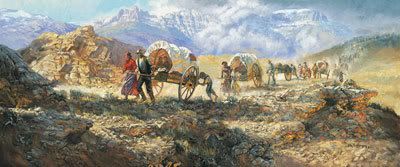
When the Mormon pioneers left to cross the plains, they could take very little with them. They left behind most of their worldly possessions and packed their wagons and handcarts with clothing, bedding, and provisions. But there were a few things tucked away in the corners that were too valuable to leave behind. It's interesting to see what what was taken and what was left behind, and to speculate on what is revealed about their characters by the items they just couldn't live without.
The first 1847 Pioneer Company included Orson Pratt. He took with him some specially ordered scientific instruments which had been brought over from England by John Taylor. The elite, fast-moving, well-equipped, exploring band of pioneers were not just taking themselves to the valley, they were charting a road that the Saints and others would use for more than twenty years. For this they needed sextants, a circle of reflection, artificial horizons, barometers, thermometers, and telescopes. The Mormons became a part of what is now known as the "Great Reconnaissance" of the Far West. (O. Ned Eddins)
When one pioneer woman, Bathsheba Smith, packed her trunk for the journey into western territory, she carefully selected what to take and what to leave behind. Deep in the corner of her single trunk she placed her paints, paper, and brushes wrapped in cloth. She added her lace-making tools and fibers to make the beautiful delicate lace for which she was famous. These tools of art she placed beneath the folds of a quilt made by her mother for her wedding day. In a concrete sense, Bathsheba Smith was blending the old and the new by preserving the past and welcoming the future. When she once again took up her paints, this time in Utah, she would paint the story of the journey. (Martha Sonntag Bradley)Bathsheba Smith kept a diary and sketchbook for most of her life, including drawings of prominent members of the Latter Day Saint community. Among the best known is a profile of church president Joseph Smith, Jr. Bathsheba impresses me with her determination to take the tools of her art with her. There were others who brought blacksmith tools and other items to facilitate everyday living, but Bathsheba's effort to preserve culture seems to go beyond this.
Other women seemed to have a similar desire. Sometimes at night, camp women would place their scanty domestic belongings around their campfire to approximate their "parlors" back home. They also arranged the interiors of their covered wagons to be as homelike as possible. They hung mirrors, pictures, and lamps, spread carpets, and placed other belongings to this end. In fact pioneer women generally did everything they could to preserve their traditional role and image and the niceties of civilization, domesticity, and a semblance of home while westering. (Wallace Stegner, The Gathering of Zion)Though the Saints were forced to leave their beautiful Temple in Nauvoo, they took some things from the Temple to remind them of that sacred edifice. The Nauvoo Bell originally hung in the temple in the 1840s. The Saints removed the bell in 1846 when they were forced to leave and placed it in a local Protestant Church. One stormy night in 1847 a group of men gathered in secret and without horses pulled a wagon to the Church and lowered the 1500 pound bell. They pushed and pulled the wagon by hand to the edge of the Mississippi River and carefully concealed it in the water. Andrew Lamoreaux and his brother, David, were chosen to bring the bell to Utah with their families, concealing it in their wagon with their provisions. During their journey, they rang the bell to signal daybreak and departure and to warn that night sentries were on duty. Today it hangs on Temple Square in Salt Lake City and signals the top of each hour and special occasions. (Melanie Cooper)
Are you aware of any other items that the Mormon pioneers brought with them on their journey across the plains?
Sunday, July 22, 2007
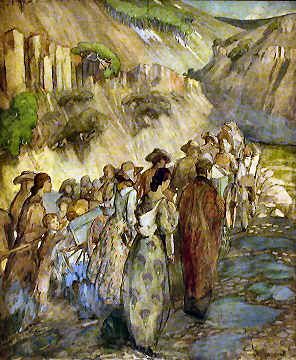
To Be A Pioneer
This may surprise some of you, but I am completely and totally enthralled by the Mormon Pioneer story. Any song, story, film, or talk dealing with the pioneers can reduce me to tears. Many of my children refuse to sit next to me in Sacrament meeting on Pioneer Day. When the story of Mary Goble Pay is retold, I begin to cry at the Platte River, and by the time her mother dies between the Little and Big Mountains at the entrance of the Salt Lake Valley, my eyes and nose are red and blotchy and my sobs and sniffles are so loud and wet they can be heard throughout the chapel.
I'm a convert, and have no Mormon Pioneer ancestors, so I don't know what it is about their story that has grasped my heart so strongly. I suppose it's the epic, archetypal, "Hero's Journey" that I relate to. I won't go back to Joseph Campbell and try to compare his elements of a hero's journey with our pioneers, but I do want to name some of the facets of the Mormons' trek that resonate with me.
First, the journey starts with the death of their Prophet and all of their hopes and dreams for a new Zion of peace and safety. The pioneers are willing to enter an unknown wilderness because of their faith and belief in something outside of themselves.
Next, they are cast out of their homes and must divest themselves of treasured possessions. This is just wrenching for me. It symbolizes the worldly things we must cast aside as we take our spiritual journey. I suppose I must find this difficult in my own life, as the tale of pianos and china left by the side of the trail holds such pathos for me.
The tales of selfless sacrifice along the way are an important element of the story. Some of these have been embellished to the point of legend, but are important to us as a people. These include Mary Fielding Smith's determination to beat the captain of her wagon train to the valley (and the anointing of her ailing ox); Robert Parker who went back to find his young son carrying his wife's red shawl; and the young men who carried some of the Martin Handcart Company over their last crossing of the Sweetwater and suffered the effects the rest of their lives. These stories highlight our better nature and remind us of the courage and cooperation we must maintain as we help each other toward our goal of eternal life.
I love these stories of bravery and faith. They strengthen me and encourage me to continue my journey. I've got a journey coming up ahead of me in the next few months that may be as difficult as that faced by the pioneers. I hope I'll be found as courageous as they were.
Monday, July 16, 2007
Thomas Parkin's Challenge to the Bloggernacle
A general challenge to the bloggernacle:
Write posts centered on Brigham Young quotes that you like as least as often as around those that offend your sensibilities.
I loved Thomas Parkin's comment (#17) in the recent BCC thread "Can Women Sin?" And I've decided to take up his challenge. I agree with Parkin that "Brigham Young speaks in a language that we no longer understand. We are probably not capable of getting past our own prejudices to read him well. His language is not only of his time but is idiosyncratic to himself." However, there are many things that Brigham said which are fabulous. He is so sure of himself, so forthright. Here are a few quotes I really like from Brigham:
Now I say the women have great influence. Look at the nations of the earth. Any nation you like, no matter which, and you enlist the sympathies of the female portion of it and what is there you cannot perform?
...The mothers are the moving instruments in the hands of Providence to guide the destinies of nations. Let the mothers of any nation teach their children not to make war, the children would grow up and never enter into it. Let the mothers teach their children "War, war upon your enemies, yes, war to the hilt!" and they will be filled with this spirit. Consequently, you see at once what I wish to impress upon your minds is, that the mothers are the machinery that gives zest to the whole man, and guide the destinies and lives of men upon the earth.
We see in this quote Brigham's tendency to hyperbole. But women really do have great influence, and his turn of phrase tends to inspire and call to action. After reading this, I am ready to go forth and add zest to my family, to fill our home with the spirit of accomplishment and great aspirations.
Another quote which inspires me is this:
It is your right, wives, to ask your husbands to set out beautiful shade and fruit trees, and to get you some vines and flowers with which to adorn the outside of your dwellings; and if your husbands have not time, get them yourselves and plant them out.
Since my husband is one who "has not time" (nor, I might add, the inclination) to set out beautiful plantings or mow the yard, I've done just as Brigham suggests, do it myself. Early in my marriage I was always waiting upon the husband to come home and fix the disposal or caulk the bathtub. As Brigham says, it is my right to ask my husband to help with these things to beautify the home and make it functional. But if he has not time, I now do it myself!
Brigham's no-nonsense, get-it-done attitude is oftentimes useful and motivational. It recalls the Mormon pioneer spirit of sturdiness and self-reliance. It is fairly obvious that he exaggerated to make his point. He had his own brand of humor. To wit: "To mind your own business incorporates the whole duty of man." This Prophet was a know-it-all and could be overbearing, but had a firm sense of what was right and a determination to live according to the dictates of his Father in Heaven. "It is the business of a Latter-day Saint, in passing through the street, if he sees a fence pole down, to put it up; if he sees an animal in the mud to stop and help get it out."
I hope Thomas Parkin has enjoyed this post. I now have a free ticket for a BY post centered on quotes that offend my sensibilities!
Sunday, July 15, 2007
Nuclear Issues in North Korea
With my oldest daughter serving a mission in South Korea, I've been particularly concerned with the nuclear threat in nearby North Korea. Since 2003, when North Korea withdrew from the Nuclear Nonproliferation Treaty and restarted its reactor, activities in the country have been a concern.
This morning, encouraging news has been reported. The sole operating reactor has reportedly been shut down, apparently in response to U.S.-backed sanctions placed upon the country by the United Nations Security Council. These sanctions were put into place after North Korea's nuclear test in October 2006. U.N. inspectors are to verify the shutdown later today. In response to this action, North Korea will receive a large oil shipment. Disabling of the facilities will continue as economic sanctions are lifted.
This news is very welcome. It's encouraging to see an example of a peaceful solution to tensions among the nations. I'm not always confident that sanctions are enough of an incentive for countries to dismantle their nuclear programs. It remains to be seen if North Korea will cooperate fully. But I'm thrilled that things are moving in a positive direction.
Thursday, July 12, 2007
The Heroine's Journey
The Hero's Journey is a basic pattern found in important myths throughout the world, as described by Joseph Campbell. The fundamental structure of this journey has been described as follows:
1. A call to adventure, which the hero has to accept or decline
2. A road of trials, regarding which the hero succeeds or fails
3. Achieving the goal or "boon," which often results in important self-knowledge
4. A return to the ordinary world, again as to which the hero can succeed or fail
5. Application of the boon, in which what the hero has gained can be used to improve the world
Many historic, religious, and literary figures, such as Moses, Odysseus, Joseph Smith, and Abraham Lincoln follow this hero prototype. I think that the Temple endowment casts all of the Lord's covenant people into this hero role, and follows many of the particulars on the Hero's Journey found in Campbell's book "The Hero with a Thousand Faces."
Many men, and especially those at the tail end of their adolescence, can visualize themselves as a participant in the Hero's Journey. Young women, on the other hand, can find it difficult to accept an image of themselves as powerful and competent, and so they reject "hero/ine" as a model of their journey. In recent years, there has been more literature with heroine as protagonist, especially in the young adult field. Motion pictures, however, have lagged behind, and Mormon culture in particular is sadly lacking in providing heroines as role models.
I would love to see more Mormon women heroine role models. When I think of Mormon women who we encourage our daughters to emulate, I cannot think of a one who strongly models the Hero's Journey. Many of them are known for their association with a powerful husband (Camilla Kimball or Patricia Holland). Others who seem ideally placed as models for women have been disappointing. I am thinking particularly of our recent General Relief Society Presidents. Name recognition and visibility has been quite low. (Try this: Name all of the Presidents of the Church in your lifetime. Now name all the General RS Presidents in your lifetime. Can you even name the current one?)
Are any of my readers aware of Mormon heroines suitable for emulation by Mormon women? What are their accomplishments? Do they reflect a Hero's Journey, or is their journey a modified one due to their gender? How well are these heroines known Church-wide?
Wednesday, July 11, 2007
Number Three--False
For those of you who are wondering which of my Eight Random Facts was false--it was number 3. I did not major in math in college. Fooled you all! My actual major was P.E. and Recreation Management. I was the President of the Swim Team my Junior year. I was the President of the Rec Club my Senior Year--we enjoyed camping, rappelling, white water canoeing, and a week long backpacking trip in the Florida Keys at Spring Break that year. After graduation and a mission I went to BYU and did graduate work in Educational Psychology.
I am indeed a Born Again Christian. At age 17 I experienced the power of God for the first time and invited Christ to be my Savior. At age 19 I joined the Mormon Church. My father is a Protestant minister--a very liberal one. When I was growing up, he was the pastor of a congregation of the United Church of Christ in Massachusetts. His parishioners did not know that he practiced polyamory--that was a "family secret." Despite the fact that my dad was a preacher, we did not pray or read scriptures in our home and religion did not touch me personally until I was in college.
About the "D" grade--I am actually pretty good at keyboarding, so I figured I didn't have to go to class very often. Big mistake.
Monday, July 9, 2007
In Which We Are Trained To Be Nice
I am appalled and concerned about the recent trend on the Bloggernacle to avoid controversy and to be nice at all costs. This went so far today as Times & Seasons taking down their post about the impropriety of the Marriott hotel chain being involved in questionable activities. On this chain, there were heated comments presenting both sides of an argument of concern to all of us as members and friends of the LDS Church. I realize that Times & Seasons strives to present a faithful aspect of Mormonism. In the past, I think they have done an admirable job of being balanced and fair while faithfully discussing issues of concern to LDS of a more intellectual bent. On occasion, they have found it necessary to delete comments, moderate the discussion, or close the comment forum down when they felt things were out of control. I think these actions are sometimes necessary in maintaining the tenor they would like to present at T&S. But in my opinion, deleting the entire thread is censorship akin to the type I have found unacceptable in the Mormon Church.
LDS members are trained to be nice at all costs. One will rarely find a satisfying intellectual discussion in any of our meetings, because we do not wish to tread on toes or cause waves. We will keep things inside of ourselves to the point of explosion, because we've been trained to be nice. Perhaps this is valuable in a ward setting. After all, we must closely associate with the members of a ward over an extended period of time. We must socialize with them, teach their children, work with them and attend meetings together.
But the Bloggernacle is an excellent forum for the expression of our true feelings. We can tell it like it is. We don't have to worry about official Church disapproval or repercussions. (at least so far...) We can discuss things that may not be welcome in our ward or even in our own homes. We are also able to participate at our comfort level. If the discussion gets too heated for our taste, we can be gone at the click of a mouse. The only thing we need to remember is that our position is only one view of the world. Others will have different ideas. These differing positions are not an indication of the faithfulness or unfaithfulness of any participant.
The blogger MCQ has opined: "At their most basic level, blog posts are expressions of ideas. The ideas are those of the poster originally, then those ideas are added to or modified by the subsequent comments. They become unique expressions, a preserved moment in time, and can never be perfectly duplicated once they are gone. These ideas deserve a spot in the marketplace, to stand or fall in the court of opinion. By their very nature they do not imply the endorsement of all who are permabloggers on a particular site, and anyone is free to voice their agreement or disagreement with them explicitly in the comments. Based on the above, there is no affirmative reason, in my mind, to ever delete them. Moreover, there is a grave danger in doing so. It is a disservice to all of us when deletions take place, because it robs us all of the opportunity to learn from the ideas that were expressed there."
I have always regretted actions of the Church which tend to censor or force members not to publish on their personal conjectures. I am more of the opinion of Gamaliel, when he says in the Book of Acts: "Refrain from these men, and let them alone: for if this counsel or this work be of men, it will come to nought: But if it be of God, ye cannot overthrow it; lest haply ye be found even to fight against God." There were many things I did not agree with on the T&S thread. However, reading the discussion of the topic helped me form my own opinion. A more restrained restatement of the problem can be found at BCC (Sustaining Our Leaders, Sustaining One Another, by Mark Brown). But I found nothing wrong with the original post. That the discussion became heated and out of control is only an indication that the respondents possessed strong feelings on the subject. Such strong feelings should have a place to be expressed while feeling free to remain affiliated with the Church.
That is the value of the Bloggernacle to me. I can always attend my local ward when I am looking for niceness.
Saturday, July 7, 2007
Eight Random Facts I'll Bet You Didn't Know
Yeah, I got tagged by that Dumb Meme 8 Random Facts. But the person who tagged me is a brand new friend, J G-W and I like him a lot, so I'll do it. But let's try to make it a little bit interesting...
1. Jimmy Carter described himself as a Born Again Christian, notably in the first Playboy magazine interview of a U.S. Presidential candidate. Bored in Vernal is also a Born Again Christian. (she has never appeared in Playboy)
2. Synchronized Swimming was added to the Olympic Games in 1984. Some of the girls on the Olympic team attended the same competitions I did when I was a synchronized swimmer in 1970-1977.
3. I love the program "MathMovesU" which is being promoted by Apolo Ohno to help kids enjoy mathematics. Why? I majored in math in college.
4. I have something in common with Billy Graham's son, Franklin. My father was also a Protestant minister.
5. Like Bill Clinton, I tried marijuana, but I didn't inhale.
6. I got a D in keyboarding at BYU. I don't know any other celebrities who have accomplished this feat.
7. I had seats at Cougar Stadium on the 50 yard line in 1984--the year the BYU football team won the National Championship. I also know and can sing every word of "Rise and Shout."
8. Six of the above facts are true. One is false. I betcha can't guess which one it is!!!