What a privilege it was this weekend to attend the FMH Bloggersnacker and meet some of the great women bloggers of our time! I've admired these women online for quite a while, and I must say they are even more extraordinary in person. Our hostess was FMHJanet, who provided us the venue in one of those older Utah homes which I absolutely adore. The "Eliza R. Snow" of the blogging world graced us with her presence--none other than FMHLisa along with her green jello dish.
The food was a smorgasbord provided by Mormon women anxious to impress each other with their cooking prowress. Whoever made those peanut butter brownie type thingies, that was my favorite. Ham, fried chicken, hummus, dips, taquitos, Greek olives, homemade bread, (and other things that I don't know the names of, but you can find here), I tried it all. I became an unabashed "Cafeteria Mormon" for the evening. For your viewing pleasure is the following picture of our feast:
That picture truly does not do justice to the succulent food that was available for our tasting pleasure. So I'm also posting this sensuous photograph of breasts and green jello which I am considering for submission in one of the more upscale food magazines:
The infant, four babies, and 14-year-old daughter were all well-behaved and charming. A few men were daring enough to join this event. FMHJanet's husband seemed quite happy to remain in the kitchen much of the time, though he wasn't wearing his apron. MarkIV made an appearance, conversing comfortably with all the ladies. And one of the bloggers' young husband made a good showing for himself when he found himself seated in the midst of an explicit conversation about tandem nursing and midwifery.
My favorite quote from the evening came from FMHLisa when the talk turned to early Mormon women and their gatherings. She surveyed the group and remarked, "If we were living back then, we'd already be speaking in tongues by now!"
I could only spend 2 1/2 hours at the Bloggersnacker, and they flew by like I had only been there 15 minutes. I'm so glad I met you all, and I'm looking forward to our continued association.
Sunday, April 29, 2007
FMH Bloggersnacker
Friday, April 27, 2007
Exclusive Interview by Jana Remy
I happpened upon this great opportunity to be interviewed by Jana Remy! Makes me feel a little bit famous, even. 1) If you were a sea creature, what would you be and why?
(I love this question because of my affinity for the water and water sports. When I lived for 2 years in Hawaii I practically dwelt in the ocean.)
I am much like a sea anenome. I have various tentacles which represent my assorted, disparate personalities. One of my tentacles is the dutiful Visiting Teacher, one is the Sunstone Reader. One tentacle basks in the sun at an upscale resort, another works with disadvantaged Native American children. If touched, the tentacles of a sea anenome retract into the body for protection. They can be spectacular and beautiful, but they're poisonous, so watch out!
2) What heroine from a book is most like you? Why?
Jana must know that if I'm not immersed in the ocean, I am immersed in a book! I have a fascination with the heroine of one of Orson Scott Card's early books: Wyrms. I like the myth of a heroine on a quest. Patience is a young girl about whom prophecies have been written. She will either save the world or destroy it. I see in myself a huge potential for good that can easily be turned to evil. One reviewer said that Wyrms had left him "vaguely disturbed, as if someone I knew closely had lost part of her humanity to fulfill a crucial mission."
3) What book do you recommend that everyone read and why?
There are so many of them. But you should read The Agony and the Ecstasy by Irving Stone. It is a biographical novel about Michaelangelo. It will give you a sense of the majesty and pathos of life.
4) How many hours/day do you spend online?
At the least I spend an hour a day on line. I rarely miss a day. I have been known to spend the entire day and into the night online. (It's always broken up by trips to the laundry room, taking kids here and there, yard work, my job, etc. I do have some responsibilites.) But I check my email, blog, keep in contact with friends from Houston, study the scriptures, learn Hebrew, do research for my books, all online.
5) If you could live anywhere besides Vernal, where would you relocate? Why?
I loved Houston, but mostly because of the circle of friends I had there, and my great house and neighborhood. I don't think I could go back. Southern California is fantastic, but I think I would have liked it better 20 years ago. It's too crowded and expensive now. So I'll have to say Hawaii. Somewhere on the North Shore, away from it all. My criteria are: warm weather (I could care less about four seasons!), proximity to a large body of water, cultural and recreational opportunities without a dense population.
Now it's your opportunity to be interviewed by the (in)famous Bored in Vernal!! If you want to play along with this meme:
1. Leave me a comment saying, “Interview me.” If I don’t have your email address, leave it for me in the comments or email it to me.
2. I will respond by emailing you five questions. I get to pick the questions.
3. You will update your blog with the answers to the questions.
4. You will include this explanation and an offer to interview someone else in the same post.
5. When others comment asking to be interviewed, you will ask them five questions.
Go see the people I've interviewed so far:
Joseph Addison
Ima
John Remy (a twofer!)
Jo in Utah
Johnny
Sunday, April 22, 2007
Three Nephites Sighting
I went to Provo this weekend for a Coaches Meeting and spent some time at BYU. In the Family History section of the HBLLibrary, one of the little old workers was telling an exciting story of one of the Three Nephites who had visited him in his home to bring an important message. I must tell you, people, these stories are a serious hindrance to my faith. I won't go as far as to say that I don't believe in them. It's just that I really doubt that three pre-immortal beings are running around Provo visiting people in their homes. And yet these people are as sure of their Three Nephites sightings as I am of any of the spiritual manifestations I have experienced.
Another impediment to my faith: Daughter #3 came back from BYU-Idaho for the summer; and every third word out of her mouth is "frick."
Tuesday, April 17, 2007
Little Purple Pansies
I joined the Church as a 19-year-old college student in North Carolina. Soon I received my first calling. I was to be the Primary chorister. I loved to sing, but this was extremely stressful. I didn't know how to conduct music, and I knew none of the Primary songs. The pianist helped me learn some basic patterns, and each week I would go to the basement of my dorm where the piano was located. With one finger I would painstakingly pick out the melody and teach myself the song, then practice conducting it. I'd make a poster, a visual, or a game. I'd spend several hours preparing, and the entire week worrying. One week the new song I was to teach was "Little Purple Pansies," a song not included in our current Primary book. I thought the words had a great message, and I still remember them: Little purple pansies touched with yellow gold,
Growing in one corner of the garden old,
We are very tiny, but must try, try, try,
Just one spot to gladden, you and I.
In whatever corner we may chance to grow,
Whether cold or warm the wind may ever blow,
Dark the day, or sunny, we must try, try, try
Just one spot to gladden, you and I.
I had a wonderful visual/game for this song, and I knew all the words by heart so I wouldn't be bound to the book. Unfortunately I also had an entire row of 11-year old boys in the back. That day they decided to sing, "Little purple panties." The one song all year they sang at the top of their lungs. "Little purple panties touched with yellow gold...hahahahaha!" I had not choice but to continue with the song, as I knew no others. It was pure torture.
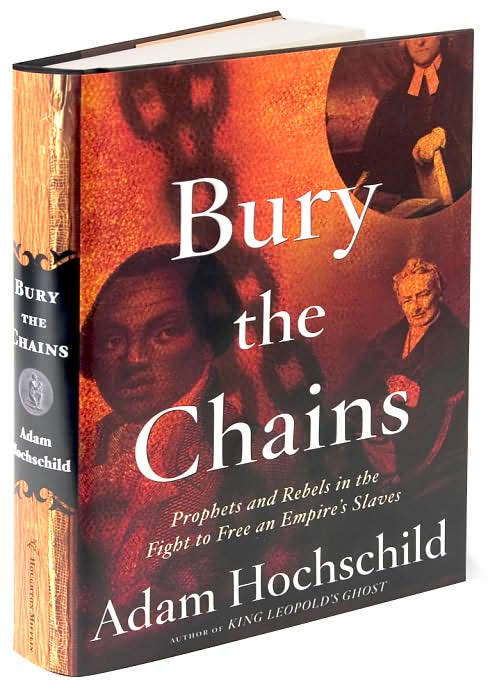
Perhaps because of this horrific experience, I now sometimes have reservations that one purple pansy in a tiny corner of the world can make any difference. I consider myself an idealistic person, and I'm involved in several "causes." But I often despair that my small efforts can have any influence in the world. When John Remy introduced our Book Club selection for this month, Adam Hochschild's Bury the Chains, I was enthralled by his introduction. The book is about a small group of Quakers who started a movement which eventually resulted in the abolition of the trans-Atlantic slave trade. John says, "I’m not selling Quakerism here, folks. I’m selling idealism. In a generation or two, deeply entrenched, unjust attitudes can be reversed by the focused and passionated efforts of a few."
I got my book in the mail last week, and I've read the first three chapters. Although a history book, it is as readable as a novel, with a great story line and fascinating characters. I'm already enamored with John Newton, a man with a great love, great ambitions, and great weaknesses. In the first chapters, I've already encountered the doubts an idealist can experience as they run up against the status quo. Olaudah Equiano, a free black man in England, attempts but fails to rescue a friend of his who is seized and placed on a vessel bound for the West Indies.
"Equiano could paint his face and pass for white, at least in the dark; he could navigate skillfully through the white world's law courts and networks of influential people. But he was powerless to stop a black friend from being plunged back into slavery and tormented to an early death. Only a tiny minority of people in Britain openly oppposed slavery, and he and [Granville] Sharp (a lawyer) were almost alone in having actively tried to help its victims. He sank into a despair so bitter that he went to sea again and resolved "never more to return to England."
I feel deep in my soul that there are things we as individuals have promised the universe we will do. I think though we may try to escape, we will always have a profound interest and investment in these things, and be led to them over and over. I'm hoping as I read this book, it will rekindle within me a greater idealism and desire to discover and accomplish my vocation.
Friday, April 13, 2007
The Magical Transforming Female
Did you notice that the names of all the "magical transforming females" in the three films we have discussed were "Mary?" Carol Lynn Pearson sees this as no coincidence, and says that "Mary seems to be the closest name we have to a whole woman." Maria in The Sound of Music represents the maternal aspect of the Divine Feminine. Mary Lennox in The Secret Garden brings out the Creator/Healer aspect. Mary Poppins shows us the mystical, magical side of the Heavenly Mother. Adding these qualities to a motherless family or society can indeed be transforming.
Carol Lynn Pearson sees herself as a player in the great drama of welcoming back the Heavenly Mother to our culture. She has a much more positive outlook on this process than I do. Carol Lynn says that history is on our side, and we can afford to be gracious. She says that although it is not easy for the patriarchy to watch the transformation, we "need to apply our best most charming most beautiful, most inviting selves into the venture. Because a spoonful of sugar helps the medicine go down in a most delightful way."
In my personal struggle with the Patriarchal Church, I haven't found my most charming, beautiful, inviting self to have much of an influence. I find that this charming self is often discounted and easily overruled. One of the questions asked at the end of Carol Lynn's Sunstone session where she presented this talk was, "Whatever is going on between the sexes involves a lot of mystery and chaos. Why does there have to be so much misery between the sexes?" This is one of my questions. As a woman, I see that I am able to be a calming and healing influence most often by capitulating and apologizing. I am not sure this is the best atmosphere for the Divine Feminine to emerge.
How can we move out of Patriarchy toward partnership?
Saturday, April 7, 2007
Heavenly Mother and Mary Poppins
(Fourth post in the Heavenly Mother series inspired by Carol Lynn Pearson's "Mary Poppins and the Return of God the Mother.")
The Banks family in the film "Mary Poppins" is a very rigid patriarchy. Things are kept shipshape. It’s a man’s world, it's the age of men. Mr. Banks (who works at the bank) is the patriarchal leader of the home. Mrs Banks is not a presence in the household. She is a suffragette, and physically she is gone a great deal. A new nanny is being sought at 17 Cherry Tree Lane. As in the previous films, the children know what is needed. They make an advertisement and it wafts up the chimney like a little prayer. It ascends to heaven and the wind changes. Down from heaven comes the holy magical woman.
Don't worry, readers, Julie Andrews is not really Heavenly Mother in disguise! Perhaps she is a witch. Carol Lynn Pearson tells us that that is what we call any woman who is powerful.
I have known members of the patriarchy to react in fear toward a strong woman. I often wonder if it is fear which motivates the suppression of Heavenly Mother and those who seek to know more about her.
Mary Poppins becomes the new nanny and takes over the household. Carol Lynn notes that from her handbag come things that are rich in symbolism. In her talk she says she has no time to discuss these in detail. This piques my curiosity. It's been a while since I saw "Mary Poppins." Does anyone know what came out of the purse? I'd love to discuss the symbolism of these objects.
Dick Van Dyke is the masculine counterpart to the patriarchy. We have lots of men like him. He is a delight. He is free, extrovertive, uninhibited, supportive. Perhaps he is a bit irresponsible. You will notice that "Bert" is not an overly masculine character. He sings, he dances, he floats in the air. Carol Lynn tells us that our society is out of balance in the masculinity department. She quotes Alan Alda saying that we are suffering from "testosterone poisoning."
Mary Poppins brings warmth, joy, and fun into the Banks family. If feminism is not more fun than patriarchy, Carol Lynn submits, why bother? Mary's activities are noticed. Mr. Banks is not pleased. The female brain produces more cooperation than competition. This is just what the household needs, but patriarchy is losing control. Here is this person with chaos in her wake. Chaos theory is a necessary next step to a different higher order. Mr. Banks calls it moral disintegration. When Michael wants to give his tuppence to the birds and not invest it, Mr. Banks is furious. Bert says, "Your father is a fine gentleman. There he is in a cold bank, I don’t like to see anything caged up." Carol Lynn points out that patriarchy has put a lot of men in cages.
Mary Poppins asks the children, "Do you think father needs our help?" This is the final step in the transformation of the patriarchy in the Banks home. The children come in and give love to him as they can. Our patriarchy is shaken. Carol Lynn advocates this as an important step in revolutionizing the patriarchal system of things. She explains, "I am not saying no marches, no civil disobedience or whatever is your style, but let us not forget the simple gesture of love is important."
Thus it comes to pass that Mr. Banks offends the sour dour patriarchy in all of their extreme. He is cast out, he is excommunicated. He has nothing to say to their reprimands--except “supercalifragilisticexpialidocious.” He sings and dances his way out of the bank. He has given himself over to a new teacher. The wind has come around. Seeing the transformation in the family, Mary has finished her work and ascends.
I am especially interested in the reactions of my readers to the idea of the patriarchy's fear of a strong woman. Are any of you men uncomfortable identifying with the characters of Dicken in "The Secret Garden" and Bert in "Mary Poppins?" Do you feel uncomfortable with a man choosing a supportive and building role to a strong woman's vision?
*Yet to come--Carol Lynn Pearson's questions and conclusions on the subject of the Divine Feminine.
Wednesday, April 4, 2007
Heavenly Mother and The Secret Garden
The Secret Garden was one of my favorite books as a little girl, and I read it to my own girls when I grew up. Carol Lynn Pearson says she first recognized this story as an allegory of the Heavenly Mother when she saw the play on Broadway. Again we have a home that is motherless. Archibald Craven has lost his wife and is desolate. He will not see people, and he leaves his house and his young son every spring because it reminds him of his lost love. Carol Lynn identifies this as the kind of grief the kabbalah reminds us that God is in without the Shekinah. The curtains are closed. Mother nature is banished from the home. A picture of the mother is draped and hidden from view.
An interesting aspect of this home is another female figure, the housekeeper Medlock. She is a woman who is invested in supporting the status quo.
Into this sad patriarchal household comes Mary Lennox, a 10-year-old whose mother was the twin sister of Archibald's wife. She is a troublemaker. She turns the household upside down. Mary laments that the house seemed dead, it seemed like a spell had been cast upon it. She goes into the mother’s room that had been locked and she finds a key. "There are keys you are not supposed to mess around with," says Carol Lynn.
There are some other similarities that Carol Lynn didn't mention that I'd like to bring out. In the Church we have made the Divine Female so sacred that she is to all intents and purposes a "secret." Like any family secret, we all know she is there, but we are told not to discuss her, not to pray to her, not to seek her.
Mary discovers the mother’s private beautiful garden. No one has been in it for ten years. She uses her stolen key which opens the door. I find this remarkably analogous to the knowledge that we have a Heavenly Mother which was brought to us through the lovely song "O My Father" written by Eliza R. Snow. Her words speak of "the key of knowledge" which restores to us our knowledge that we "have a Mother there." In the secret garden, Mary sees one shoot growing. Carol Lynn says, "I looked around and saw the concept of the divine mother dead except for a little shoot here and there. Maybe it’s not completely dead. In my heart, the feminine has not been buried, it has been planted, and it is growing and greening."
Carol Lynn describes how Mary makes friends with Dicken and they tend the garden. Boys have their role to play in these dramas, as we will see when we discuss the next film. Colin comes to life. “Maybe I’m not ill,” he says. A prayer circle is held by the children to call the father back. He hears, and returns home. He finds the son is not in his bed. The portrait is unveiled, light is coming into the room. Medlock says the girl has caused havoc. A girl is out of control, what are we going to do? The father says to Mary, “you brought us back to life. You did something I thought no one could do.”
Carol Lynn's concluding remarks to this story show great enthusiasm. "What a day it will be when our patriarchy looks at the garden we have brought to bloom and they say thank you for making the mother’s garden grow. We will never close it up again," she exults. I wonder how Carol Lynn would feel about this statement today. In the '80's and '90's I too felt that the knowledge of a female counterpart to God was growing and becoming more important in the lives of Latter-day Saints. In my lifetime I have seen this excitement quashed, the key taken, and the garden locked up again.
Tuesday, April 3, 2007
Heavenly Mother and the Sound of Music
In her 1998 talk previously referenced, Carol Lynn Pearson compares several well-known movies to the problem of Heavenly Mother in the LDS Church. She states that people everywhere have a universal longing to know of the Divine Female, and this is reflected in popular culture. In passing, she mentions "Peter Pan"--who "needs a mother so bad that he goes out and steals one!" But the first movie she really analyzes in her talk is "The Sound of Music."
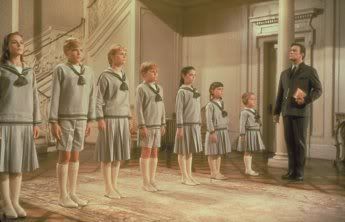
Carol Lynn describes the setting of this film as a sad, militaristic patriarchal household. Discipline is the order of the day, imposed by the “Captain.” Titles and the military are important in patriarchal thought, Carol Lynn observes. Into this situation comes the magical woman. Down from the hills, the holy woman, right out of the convent. She is a troublemaker. The captain is not pleased. She brings a female presence into the household. She sings of very feminine things. She works her magic with the children. The children sing the song that Maria taught them, and Captain is amazed “You brought music back into the house. I'd forgotten. Please stay.” To this Carol Lynn comments, "What a day it will be when our patriarchy says, 'You’ve brought the feminine back into the house, I’d forgotten, please stay.'" In her recounting of this story, Carol Lynn seems to see Maria as symbolic of both the Heavenly Mother and symbolic of those in the Church who work to see her recognized as a valid and vital reality in Mormon theology. These women (and men, sometimes) are troublemakers. Their goal is to bring the Divine Feminine to the forefront, where the entire Church can feel her effect upon them.
Soon the Spirit of the Feminine is banished from the Von Trapp household. Her loss is sorely felt. The children go to the abbey to get her back. Says Carol Lynn: "Children should not be passive when they need their mother back. I have a right to knock on any door and demand my mother back." I am continually surprised and delighted to observe how Carol Lynn gets away with saying things like this. Many others have been disciplined for less. I know I'd never be able to get away with a statement like that. Readers, what do you think protects Carol Lynn from the watchful eye of the patriarchy? Is it a good relationship with local leadership? Is it her admired public persona?
At the conclusion of "The Sound of Music" the organ plays a wedding melody, which segues into “how do you solve a problem like Maria?" We now know that instead of being the problem, Maria is the answer. Carol Lynn asks her audience: "How do you solve a problem like Lavina? Or Janice? You love them, allow them, support them-- helping to transform the patriarchal household into a partnership." I often wonder how this could have been done. How could Lavina's and Janice's and Margaret's ideas been integrated and supported and loved by a patriarchal leadership? What a fascinating era it would be to even today have the voices of these intelligent spiritual women heard in the mainstream Church. Having rubbed shoulders for a small time with each of them, I recognize their strivings to have the Spirit guide their lives and their teachings as much as the majority of male leaders I have encountered.
As the film ends, the "fatherland" calls, but the Captain has now been enlightened. He recognizes the value and power of a combined male/female unit. He has greater resources, and with the help of the Holy Woman, he and his family climb the mountain to freedom. Carol Lynn ends her exposition on this film with these words: "I invite the patriarchy to fall in love with me and I promise to be a devoted and useful partner."
(Succeeding posts will address Carol Lynn's thoughts on "The Secret Garden" and "Mary Poppins.")
Wednesday, March 28, 2007
Life in a Motherless House
This week I received my tape of Carol Lynn Pearson's talk, "Mary Poppins and the Return of God the Mother" from the 1998 Sunstone Symposium. In the talk she speaks of the Church as a "motherless house." Carol Lynn says that she has found that the longing for a Divine mother is a universal hunger which pops up in the collective unconscious often. To illustrate this she mentions several well known films which speak of the transforming of the patriarchal family through the receiving of the divine magical woman. I plan to outline Carol Lynn's conclusions about these films, but first I would like to ask a question of any males that happen across this blog. Do you feel the lack of a mother figure in our Church? We have a Heavenly Father, and we have a "father of the ward" (bishop), both of whom are heavily involved in our daily lives. It is to the Heavenly Father that we pray several times a day. It is the Bishop who gives us the callings which often define us and take up so much of our time. We are told that we have a Heavenly Mother, but that we need not strive to know her personally. We have women who affect us and teach us in Primary, but after the age of 12, males have no further contact with women in the Church as authority figures nor are women Church leaders available to them for guidance or counsel (as men are available to women in the Church). Do you feel that this constitutes a "motherless house?" Do you ever feel longings for a spiritual feminine?
More about Carol Lynn's talk to come!
Tuesday, March 27, 2007
Thinking Blogger Award
I'm so thrilled that Jana tagged me as a "Thinking Blogger."
Now I have to choose 5 (and only 5) blogs that make me think. This is going to be hard because I only visit blogs that make me think.
I Sit and Think
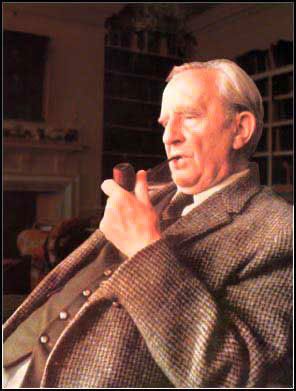
by J.R.R. Tolkien
I sit beside the fire and think
of all that I have seen,
of meadow-flowers and butterflies
in summers that have been;
Of yellow leaves and gossamer
in autumns that there were,
with morning mist and silver sun
and wind upon my hair.
I sit beside the fire and think
of how the world will be
when winter comes without a spring
that I shall never see.
For still there are so many things
that I have never seen:
in every wood in every spring
there is a different green.
I sit beside the fire and think
of people long ago,
and people who will see a world
that I shall never know.
But all the while I sit and think
of times there were before,
I listen for returning feet
and voices at the door.
And now, for the winners....
1. Mind on Fire
John Remy never fails to make me think. I've enjoyed his courage in sharing his spiritual journey, I like his focus on philosophy and theology blended with activism. I agree with his yearnings toward pacifism and environmentalism. One of the things you must check out on this blog is the Wednesday Challenge. This ranges from naming the 192 member countries in the U.N. to taking a shower!
2. The Fire Sermon
I've followed Johnny since I first started blogging. First he was "The Mormon Left," then "Zarathustra and Me," and who knows what incarnation we will find him in next! His existential angst really appeals to my heart and soul, and I want to be there when he finally finds the answer to all things.
3. Mormon Stories
The third John who has captured my imagination is John Dehlin. Always causing a controversy in the Bloggernacle, and apparently, in his Stake! I started reading Mormon Stories after his funny, funny presentation at Sunstone. His interviews are down-home, refreshing, and sensitive. And they make me think! Right now we're all anxiously awaiting the promised "Pink Stories."
4. Zelophehad's Daughters
It didn't say in the rules that I couldn't pick group blogs. This is one upon which I can bestow the great honor of a "thinking blog." I read it daily, and I'm always enriched when there is a new post. Eve is hereby named as the Chosen One to respond to this award! Her poetry and poetic nature always appeals to me.
5. New Cool Thang
This blog not only makes me think, but sometimes I feel I am about to bust a brain cell trying to follow what they are talking about! If you get hooked on this blog, like I am, you'll soon find yourself reading lots of Blake Ostler and Journal of Discourses, and scribbling notes about the theology of the atonement in the margins of your scriptures! I don't know if anyone over there reads me, but if you discover that you have been tagged, I would love for Jacob, a blogger I greatly admire, to write the response.
For those I tagged, please read the following rules...
The Thinking Blogger Award is also a meme. The participation rules are simple:
1. If you get tagged, write a post with links to five blogs that make you think.
2. Link to this post so that people can easily find the exact origin of the meme.
3. (Optional) Proudly display the "Thinking Blogger Award" with a link to the post that you wrote.
Sunday, March 25, 2007
Mormon Dress Code
Last week Jana blogged about how intimidating the LDS men and how worldly the LDS women appeared after not having attended her local ward for some time.
I took stock of my Vernal ward today, to see how well we adhered to the Mormon Dress Code. (see results, comment #29) Here is what I wore to Church:
(the dangly earrings I wore are pinned to the lapel.)
As I commented at pilgrimgirl, the Mormon dress code is not hard to learn. You can do it in one Sunday. For men, conservative dark suits or white shirts, ties, and slacks. For women, skirt suits, skirts and conservative dressy tops, or tent dresses for larger women.
As you can see, my choices of clothing usually represent an attempt to blend in and appear to be conservative and non-threatening. Considering the subtle disapproval one receives for not following this unwritten protocol, it interests me to assess the motivation of one who chooses not to comply. Why do certain Mormon males grow a beard or wear patterned shirts to Sacrament Meeting? Is it mere comfort that prompts a woman to wear pants to Church, or is it a rebellious streak? Is the wearing of clothing that differs from the norm an attempt to show individuality? Do you feel judged or marginalized because of your clothing choices?
What did you wear to Church on Sunday?
Saturday, March 24, 2007
What's on Your Nightstand?
My Nightstand:
Lamp
Clock Radio
Framed Picture of myself at age 18 months
A pencil, pen, and red marking pencil
Picture of my daughter and her date at prom
Sharing time activity
Friend Magazine April 2007
Dialogue Magazine Spring 2007
Notepad with poems
Notepad with Hebrew notes
Sunday School Study Guide
2 Triple combinations
Teachings of Presidents of the Church--Wilford Woodruff
Books: Hannibal, Hannibal Rising, A Deadly Hand, The Plot Against America, Rough Stone Rolling, Harmonizing Isaiah, Patterns of Poetry, A Student's Vocabulary of Biblical Hebrew, Liber Jesaiae (Biblia Hebraica Stuttgartensia), Gileadi's The Apocalyptic Book of Isaiah, Biblical Hebrew Workbook.
A friend's completed manuscript I am editing
List of emails of aerobics ladies
Cinderella playing cards
DH's Nightstand:
Lamp
Three pens, four pencils
Three popsicle sticks & a popsicle wrapper
Tube of Ben-Gay
Watch
Foot massager
Individual flossers
Vernal Temple Schedule
Duracell watch battery
Kool-Aid Chapstick
Lotion
Teachings of Presidents of the Church--Spencer W. Kimball
Replacement Lightbulb
Newspaper clipping of his most recent article
6 Coupons
Lifeguard whistle (that's mine!)
(in the magazine rack): Ensign magazine for the past 6 months, several recent issues of Time, Newsweek, US News & World Report, Sunstone (that's mine!) Better Homes & Gardens garden book, Beautiful Gardens, A Father's Legacy, Preparing to Enter the Holy Temple pamphlet (25 copies), audiovisual cable.
Friday, March 23, 2007
Word of the Day
Insipid
anemic, anesthetized, apathetic, arid, banal, beige, blah, bland, boring, bromidic, characterless, cloying, colorless, common, commonplace, conventional, dead, distasteful, drab, dreary, driveling, drudging, dry, dull, feeble, flat, flavorless, hackneyed, inane, innocuous, insipid, interminable, irksome, jejune, lackluster, lifeless, limp, monotonous, moth-eaten, mundane, namby-pamby, nebbish, nothing, nowhere, ordinary, pablum, pedestrian, phlegmatic, plain, platitudinous, plebeian, pointless, prosaic, prosy, routine, savorless, slight, soft, spiritless, square, stagnant, stale, stodgy, stupid, subdued, tame, tedious, tenuous, thin, tired, tripe, trite, unappetizing, unexciting, unpalatable, unsavory, unimaginative, unmemorable, unpassioned, vacuous, vapid, watery, weak, weariful, wearisome, wiped out, wishy-washy, yawn, zero.
Monday, March 19, 2007
My Monologue
I thought I'd share my Vagina Monologue, written in 2002. I double dog dare you (women) out there to write one!
When I lived in Hawaii, my best friend and next-door neighbor ws 65. "When I look in the mirror, I see this face," she said, "but this is not me. I don't feel any different than when I was 18." My neighbor and I became buddies and confidantes. We talked about the Church, the world, our families, and sex. It was surprising to me that sex was still a big deal when you were 65. I was 29, I had four children ages 4 and under, and sex was low on my list of priorities.
Things hadn't started out that way. When I was growing up in the sixties and seventies, my parents were involved in polyamory. My mother had a long-term relationship with a well-known black minister when I was a child. Then in my teen years, a young divorcee named Linda came to live with our family. My parents also had several shorter relationships over the years. I didn't exactly appreciate sharing my parents' time and emotional energy with other people, and this tended to make me more cautious about forming my own relationships. In college I joined the LDS Church at age 19 and was more determined than ever to save sexual relations for marriage. However, I had grown up with a very open attitude toward sex ad felt that I had healthy feelings about my body and my sexuality.
I served a mission, met my husband at BYU, and married in the Temple. Our intimate relationship was spiritual, loving, and fun. It was also very connected with our religious attitudes. We wanted to have children right away. Although non-member relatives urged us to enjoy each other for a while before we had kids, we felt a great proscription against using birth control of any kind. (year: 1983) Children came quickly, as did Church responsibilities and employment obligations for my husband. Money did not come quickly. We were poor, overcommitted, and stressed-out. My husband, who grew up in an abusive situation, struggled for many years with controlling his temper.
One day my friend and I were lying on the beach in Hawaii, children digging in the sand all around us. She turned to me with anguish on her face. "I can't make love to my husband when we are in a fight," she said. "It makes me feel like a prostitute!" I gazed at her fondly, trying not to laugh. It was impossible to associate that word with her sweet, lined, pixie face. But I understood the feelings behind the words all too well. My husband and I were growing further apart, and with the emotional distance I felt a need to back away physically also. How could he hurt my body one minute, then touch me intimately the next? The dichotomy was incomprehensible.
As I reached my thirties, my conception of myself as a woman began to expand. I began to see a dimension of my spirituality in terms of my sexuality. I noticed that a man's relationship with his Father God was different than that of a woman's. The Mormon male relates to a male Deity as a role model and something to aspire to. A woman does not, though she is told that she will one day be a goddess. Much has been revealed about the characteristics and roles of our Heavenly Father. But we have no clear conception of the attributes of the female aspect of Deity. As a woman, my relationship with my Heavenly Father was one of supplicant, rather than heir.
Because of my early influences outside of the Church, I never saw myself as anything other than an empowered woman. Therefore my struggles to define my relationship with the Father God were efforts to connect and illuminate rather than to cast off any perceived oppression. This paralleled the "marital dance" I was performing with my husband, as we sought to pattern our steps into a pleasing promenade. The years it took to elucidate myself as a feminine being were painful and distressing. A crippling depression following the birth of my fifth child blighted an entire year and threatened the fragile stability of our family. But Medea rose from the sea, water flowing from her shining skin.
As I again became aware of my surroundings, I noticed what I had not perceived since puberty. It was a sexual force flowing from my inner being. I thought of this force as being held tightly in a box inside the center of my body. I could crack open the lid and let a little of it escape. Men began to notice me and make excuses to touch me. I knew this force could become a raging fire and blaze quickly out of control. So after a while, I carefully closed the lid of the box, hugging the secret to myself. Besides, fifteen years of pregnancy and nursing with nary a month between to call my body my own bound my sexuality all up with motherhood.
One day I was in the Temple and I kept catching the eye of a young woman who was watching me. After the session, she approached me and we had a little chat. She asked me how many children I had. I told her I had eight children. She said she knew I had many children, because I radiated "Mother in Zion." I went home and looked at myself in a mirror. Most of my wrinkles were laugh lines, so they didn't look too bad. But my chin was definitely saggier. I held my arms out to my sides and jiggled them. No "Relief Society arms" just yet. My breasts were O.K.--round and soft. Legs were in good shape. No varicose veins after eight children, and despite an hereditary propensity! I was pleased with that. Problem area: my stomach. It was a mess. Stretch marks from my rib cage to my lover abdomen traversed rolls of fat. No wonder we no longer made love with the light on! I knew that my husband liked to look at me, but I couldn't bear for that stomach to be exposed. Yes, I had a "Mother in Zion" stomach.
A couple of years after that, I reached a landmark moment. "sister B.," a missionary said to me fondly, "you're so great. You remind me of my mom." No! His mom?? I reminded a missionary of his mom? I couldn't possibly be his mother. I would have had to have had a baby at age...well, twenty. I guess I could be his mom. In fact, his mother could be younger than I. What a horrifying thought. I was old enough to be the mother of a missionary.
That night, as I lay within the circle of my husband's arms I wondered if he realized that he was holding a woman old enough to be a missionary's mother. He turned to me and gently kissed my lips. I knew that the years had been kind to us. When he looked into my eyes he saw superimposed upon my face, the face of that young girl he had married. I knew that the wrinkles and the stretch marks had become phantoms compared with the stronger, younger spirit within me. Tender feelings stirred me as I held him to my breast. Then heat began to rise between us, for after all, inside I didn't feel ny different than when I was eighteen.
Friday, March 16, 2007
Saying the "V" Word
Last week, a public high school in New York suspended three girls for saying the word "Vagina" during a talent show-type event. The girls were performing exerpts from "The Vagina Monologues." "It wasn't crude and it wasn't inappropriate and it was very real and very pure," one of the students said. I must say I was surprised at the school's reaction to the word. It was very different from my daughter's experience at her Houston high school. In one of the health classes offered there, a teacher was notorious for making the students shout "Penis!" and "Vagina!" at the top of their lungs many many times on the very first day of class. When my daughter first came home with a report of this, I must admit I was taken aback. But as I thought about it I soon realized that the teacher was laying the foundation for the teenagers to be able to have frank, open, articulate discussions about a sensitive topic. Once the teens were able to say the words without embarrassment, they were better able to learn the subject matter.
Sometimes I wonder if I shouldn't stand up in Relief Society during Opening Exercises, and, instead of reciting the RS Declaration, have the Sisters yell the words "Penis!" and "Vagina!" I am concerned that few women know how to talk to their sons and daughters about sex, about issues of birth control, masturbation, or even preparation for married life.
At some point following the production of Eve Ensler's "The Vagina Monologues," a group of Mormon women wrote their own version of the Vagina Monologues and titled it "Sacred Spaces." It was presented at the 2001 Sunstone West Symposium in San Francisco. I'll admit here that I did not attend either the Broadway or the Mormon version, but I have read both. "Sacred Spaces" is a lovely and poignant collection of Mormon women's experiences with sex and discovering their bodies in a religious context. A few quotes from the pieces follow:
"My sexuality (perhaps my experience as a woman) can be summed up as my desire to please."
"I try to reach out to this stranger, my husband, and realize he is far gone. I find I am made of the hardest steel. Nothing to soften me. I crave sweet kisses. I crave the touch of hands caressing my body. I need to be vulnerable somewhere. I am the pivot point for everyone in my life."
"I was not raised Mormon, but it doesn't matter that much. I was raised American. I was raised Christian. I was more than a little embarrassed about nakedness from the time I was old enough to recognize what it was."
"While she had the marriages and the children, I carried around the same reproductive equipment but didn't use it. Sometimes I fantasized that it would be more convenient if I could just detach it, like a computer peripheral, and plug it back in should I happen to need it."
Several days after reading the collection, I wrote my own "Vagina Monologue." In a brave act of consciousness-raising, I brought it with me to my Book Club night. I told the women we should all write our own monologues, even if we didn't share them. None of the women took me up on the offer. One of my friends stated, "I don't think of myself as having those parts. I think of myself as being from the neck up!" I thought this was rather sad for someone who had been married 16 years and had 4 children.
I wonder if the newer generation of Mormon women will be as conflicted about their sexuality. I wonder what they will do with the disconnect between what they are taught at school and through popular culture, and what they are taught at Church. I wonder if they will ever feel the need to say the "V word" at a school talent show.
Thursday, March 8, 2007
Ron Paul on "Just War" Theory
from Ron Paul before the U.S. House of Representatives, 6/29/06. Hat tip to Connor.
"...Policy changes in wartime are difficult, for it is almost impossible for the administration to change course since so much emotional energy has been invested in the effort. That’s why Eisenhower ended the Korean War, and not Truman. That’s why Nixon ended the Vietnam War, and not LBJ. Even in the case of Vietnam the end was too slow and costly, as more then 30,000 military deaths came after Nixon’s election in 1968. It makes a lot more sense to avoid unnecessary wars than to overcome the politics involved in stopping them once started. I personally am convinced that many of our wars could be prevented by paying stricter attention to the method whereby our troops are committed to battle. I also am convinced that when Congress does not declare war, victory is unlikely.
The most important thing Congress can do to prevent needless and foolish wars is for every member to take seriously his or her oath to obey the Constitution. Wars should be entered into only after great deliberation and caution. Wars that are declared by Congress should reflect the support of the people, and the goal should be a quick and successful resolution.
Our undeclared wars over the past 65 years have dragged on without precise victories. We fight to spread American values, to enforce UN resolutions, and to slay supposed Hitlers. We forget that we once spread American values by persuasion and setting an example – not by bombs and preemptive invasions. Nowhere in the Constitution are we permitted to go to war on behalf of the United Nations at the sacrifice of our national sovereignty. We repeatedly use military force against former allies, thugs we helped empower – like Saddam Hussein and Osama bin Laden – even when they pose no danger to us...
How have the 2,500 plus deaths, and the 18,500 wounded, made us more free? What in the world does Iraq have to do with protecting our civil liberties here at home? What national security threat prompted American’s first pre-emptive war? How does our unilateral enforcement of UN resolutions enhance our freedoms?...
Some of the strongest supporters of the war declare that we are a Christian nation, yet use their religious beliefs to justify the war. They claim it is our Christian duty to remake the Middle East and attack the Muslim infidels. Evidently I have been reading from a different Bible. I remember something about “Blessed are the peacemakers.”
My beliefs aside, Christian teaching of nearly a thousand years reinforces the concept of “Just War Theory.” This Christian theory emphasizes six criteria needed to justify Christian participation in war. Briefly the six points are as follows:
War should be fought only in self-defense;
War should be undertaken only as a last resort;
A decision to enter war should be made only by a legitimate authority;
All military responses must be proportional to the threat;
There must be a reasonable chance of success; and
A public declaration notifying all parties concerned is required.
The war in Iraq fails to meet almost all of these requirements. This discrepancy has generated anger and division within the Christian community.
Some are angry because the war is being fought out of Christian duty, yet does not have uniform support from all Christians. Others are angry because they see Christianity as a religion as peace and forgiveness, not war and annihilation of enemies.
Constitutional and moral restraints on war should be strictly followed...
The solution to this mess is not complicated; but the changes needed are nearly impossible for political reasons. Sound free market economics, sound money, and a sensible foreign policy would all result from strict adherence to the Constitution. If the people desired it, and Congress was filled with responsible members, a smooth although challenging transition could be achieved. Since this is unlikely, we can only hope that the rule of law and the goal of liberty can be reestablished without chaos.
We must move quickly toward a more traditional American foreign policy of peace, friendship, and trade with all nations; entangling alliances with none. We must reject the notion that we can or should make the world safe for democracy. We must forget about being the world’s policeman. We should disengage from the unworkable and unforgiving task of nation building. We must reject the notion that our military should be used to protect natural resources, private investments, or serve the interest of any foreign government or the United Nations. Our military should be designed for one purpose: defending our national security. It’s time to come home now, before financial conditions or military weakness dictates it.
The major obstacle to a sensible foreign policy is the fiction about what patriotism means. Today patriotism has come to mean blind support for the government and its policies. In earlier times patriotism meant having the willingness and courage to challenge government policies regardless of popular perceptions.
Today we constantly hear innuendos and direct insults aimed at those who dare to challenge current foreign policy, no matter how flawed that policy may be. I would suggest it takes more courage to admit the truth, to admit mistakes, than to attack others as unpatriotic for disagreeing with the war in Iraq."
Read the entire talk here, and let me know what you think. Connor said that this article convinced his mom that the war in Iraq was wrong and that we should leave. Did it convince you?
Wednesday, March 7, 2007
Mideast Muddle
I'm still considering World Peace today--I read an article from the top news stories of today entitled, "Jordan's King Urges U.S. to Work on Mideast Peace." For a moment I was thrilled, but as my eyes quickly scanned the article, I realized that King Abdullah was calling for the United States to become more involved in the Middle East. I continue to contemplate the wisdom in our continued presence in Iraq as a peacekeeping measure. Abdullah addressed a recent joint meeting of Congress(which has been searching for ways to diminish the U.S. involvement in Iraq). He pled that the U.S. has an "unrivaled" potential to help with the core problem in the area; the Palestinian-Israeli conflict.
Coincidentally, several hours after reading this article I came across the following quotation by Gordon B. Hinckley:
"I have often thought that if great numbers of the women of all nations were to unite and lift their voices in the cause of peace, there would develop a worldwide will for peace which could save our civilization and avoid untold suffering, misery, plague, starvation and the death of millions."
I wish President Hinckley could have been a bit more specific as to what our voices could say or how we could unite together to effect this change. My personal desire would be to send thousands of Americans to the Middle East as a true "peacekeeping force"--without guns or ammunition but with medical supplies, textbooks, love and reason. Just to roam about the country spreading ideals and goodwill. What a dumb plan, right? I would volunteer to do this. I don't know how many others could be persuaded.
Still waiting and watching to be led...
Tuesday, March 6, 2007
Another "I Put on Black"
This poem, written by Rebecca del Rio-Ruso is a stirring protest of war using the same imagery I used in my poem "I Put on Black."
DE LUTO
El dÃa que lanzaron el bombardeo (digo ellos,
porque nosotros no tenemos bombas,)
me vestà de luto.
Doble y metà en un pliegue el rojo, el amarillo, la ira y puse
La esperanza en su lugar. Almacené el verde, el azul, la anticipación,
Y el deseo en un rinconcito lindo.
El dÃa que lanzaron el bombardeo (digo ellos,
Porque nosotros no tenemos bombas,)
apilé el verde oliva, el marrón,
La serenidad y el reposo en el tocador
Y me vestà de luto.
El dÃa que se lanzaron el bombardeo (digo ellos,
Porque nosotros no tenemos bombas,)
me fijé mientras el naranja estalló
en estrellas espectaculares, como chispas de
Una hoguera del desierto. Almacene mis bufandas, mis pulseras,
Los amuletos y la risa.
Y me vestà de luto.
El dÃa que se lanzaron el bombardeo
(digo ellos,
Porque nosotros no tenemos bombas,)
me absorbió del pecho
El aire en tragos tremendos,
tragos turquesa, fucsia,
De doloridos tonos morado.
Lo sentà cuando el aire giraba encima y
Me vestà de luto.
El dÃa que lanzamos el bombardeo
(digo nosotros porque
Por mas que me rehusé lo hicieron en mi nombre)
Doblé la alegrÃa como doblarÃa una tienda de campaña de los Bedoin,
Una carpa reluciente, de flequillo,
que ondula en la brisa del desierto
Y me vestà de luto.
Rebecca del Rio-Ruso
-------------------------------
IN BLACK
The day they started bombing (they, not we
Because we do not have bombs), I put on black.
I folded away red, yellow, rage, and
Hope. I tucked greens, blues, anticipation
And desire in a neat corner
And I put on black.
The day they started bombing (they, not we
Because we do not have bombs) I stacked olive, tan,
Quietude and rest in the cabinet.
And I put on black.
The day they started bombing (they, not we
Because we do not have bombs) I watched orange
Shower up in spectacular sparks like
A desert bonfire. I put away my scarves, silver bracelets,
Amulets and laughter.
And I put on black.
The day they started bombing (they, not we
Because we do not have bombs,) I felt
The air being sucked out of me
In great gulps of teal, fuchsia, pained
Shades of purple. I felt the air wheeling over as
I put on black.
The day we started bombing (we because no matter
How I refused, they used my name anyway)
I folded up joy, like a Bedouin's tent, bright,
Fringed and billowing and put on black.
Rebecca del Rio-Ruso
Monday, March 5, 2007
Prayer for Peace
Whenever something deeply affects me, it always seems to come out in poetry. I was moved by those who participated in fasting for peace on Sunday. I enjoyed the feeling of togetherness it brought. I was especially touched by John's post on the pathology of war. It responded to my concern that my small prayer was not likely to do much good.
A Prayer For Peace
Afar beyond the surging sea
In regions yet unknown to me
The jaws of war gape wild and wide;
A frightful beast.
The troubled, war-torn region lies
In shambles under sinking skies
Another wounded warrior dies
While others feast.
The heads of nations, bickering
Have set my candles flickering.
My heart cannot shut out the cries
Nor take my ease.
I fast, and put aside my meal,
A meager effort--meant to heal.
Will heaven heed my simple sighs?
Let conflict cease.
A pinprick in the conscience of
A nation so devoid of love
Is my petition, small in size:
A Prayer for Peace.
I'm glad that we were able to set aside a time to think about those personally affected by war, the hard decisions of national leaders, and peaceful endeavor. I feel ready to accept a bigger part in working for peace if it comes my way.
Saturday, March 3, 2007
Give Peace a Chance
In a few hours, I'll start my fast for World Peace. I'm praying that leaders of the nations will increasingly consider nonviolent ways to solve conflicts. I'm glad that several people around the Bloggernacle will be joining me in a Vigil tomorrow, Sunday March 4, to promote peace.
I sent out about 50 emails to invite Mormon bloggers to participate in this effort. I was hoping that many of them would put something up on their site to pass the word. Those who posted on peace are featured in my sidebar. (If I missed you, let me know!) I didn't get much of a response among traditional Mormons. Almost everyone I sent emails to who responded to me or put something up on their blog were non-traditional or "post-Mormons." I found this interesting and a little disappointing, and can't help but wonder why.
Perhaps some "traditional" Mormon bloggers associated this effort with non-violent methods of achieving peace. Do Mormons on the whole support military force to defend their countries and keep their families safe? Comments I have received on this blog and read on other blogs seem to suggest this view.
Perhaps some did not respond because praying or fasting for peace seems ineffective. One little person or family and their prayers may not make much of a difference when stacked up against world leaders, nations, and nuclear weapons.
Some may have had more important or more interesting posts to make this week.
Or maybe my emails just went into their junk mail.
___________________
I invite you all to participate tomorrow in whatever way you feel comfortable; to pray, fast, or meditate for World Peace. Send me a comment and let me know how it went.
Sunday, February 25, 2007
Peace Vigil
Readers and Friends, a few concerned citizens would like to announce a peace vigil to be held Sunday, March 4, 2007. We are concerned at the escalating tensions in the Middle East and desire to send positive energy into the universe toward this situation. If you would like to participate, we urge you to pray, fast, or meditate that American and world leaders will be directed to work in peaceful ways for the solutions to political tensions. We hope that many of you will feel directed to write blog posts announcing the vigil and calling for peace and positive solutions.
Book Meme
I found that I had read many of the books on this book meme. I have read the ones in bold, and the ones in italics I read with my book club in Houston (I miss them!)
Which ones have you read? Am I missing anything important?
1. The Da Vinci Code (Dan Brown)
2. Pride and Prejudice (Jane Austen)
3. To Kill A Mockingbird (Harper Lee)
4. Gone With The Wind (Margaret Mitchell)
5. The Lord of the Rings: Return of the King (J.R.R. Tolkien)
6. The Lord of the Rings: Fellowship of the Ring (J.R.R. Tolkien)
7. The Lord of the Rings: Two Towers (J.R.R. Tolkien)
8. Anne of Green Gables (L.M. Montgomery)
9. Outlander (Diana Gabaldon)
10. A Fine Balance (Rohinton Mistry)
11. Harry Potter and the Goblet of Fire (J.K. Rowling)
12. Angels and Demons (Dan Brown)
13. Harry Potter and the Order of the Phoenix (J.K. Rowling)
14. A Prayer for Owen Meany (John Irving)
15. Memoirs of a Geisha (Arthur Golden)
16. Harry Potter and the Sorcerer’s Stone (J.K. Rowling)
17. Fall on Your Knees (Ann-Marie MacDonald)
18. The Stand (Stephen King)
19. Harry Potter and the Prisoner of Azkaban (J.K. Rowling)
20. Jane Eyre (Charlotte Bronte)
21. The Hobbit (J.R.R. Tolkien)
22. The Catcher in the Rye (J.D. Salinger)
23. Little Women (Louisa May Alcott)
24. The Lovely Bones (Alice Sebold)
25. Life of Pi (Yann Martel)
26. The Hitchhiker’s Guide to the Galaxy (Douglas Adams)
27. Wuthering Heights (Emily Bronte)
28. The Lion, The Witch and the Wardrobe (C. S. Lewis)
29. East of Eden (John Steinbeck)
30. Tuesdays with Morrie(Mitch Albom)
31. Dune (Frank Herbert)
32. The Notebook (Nicholas Sparks)
33. Atlas Shrugged (Ayn Rand)
34. 1984 (George Orwell)
35. The Mists of Avalon (Marion Zimmer Bradley)
36. The Pillars of the Earth (Ken Follett)
37. The Power of One (Bryce Courtenay)
38. I Know This Much is True (Wally Lamb)
39. The Red Tent (Anita Diamant)
40. The Alchemist (Paulo Coelho)
41. The Clan of the Cave Bear (Jean M. Auel)
42. The Kite Runner (Khaled Hosseini)
43. Confessions of a Shopaholic (Sophie Kinsella)
44. The Five People You Meet In Heaven (Mitch Albom)
45. Bible
46. Anna Karenina (Leo Tolstoy)
47. The Count of Monte Cristo (Alexandre Dumas)
48. Angela’s Ashes (Frank McCourt)
49. The Grapes of Wrath (John Steinbeck)
50. She’s Come Undone (Wally Lamb)
51. The Poisonwood Bible (Barbara Kingsolver)
52. A Tale of Two Cities (Charles Dickens)
53. Ender’s Game (Orson Scott Card)
54. Great Expectations (Charles Dickens)
55. The Great Gatsby (Scott Fitzgerald)
56. The Stone Angel (Margaret Laurence)
57. Harry Potter and the Chamber of Secrets (J.K. Rowling)
58. The Thorn Birds (Colleen McCullough)
59. The Handmaid’s Tale (Margaret Atwood)
60. The Time Traveller’s Wife (Audrew Niffenegger)
61. Crime and Punishment (Fyodor Dostoyevsky)
62. The Fountainhead (Ayn Rand)
63. War and Peace (Tolsoy)
64. Interview With The Vampire (Anne Rice)
65. Fifth Business (Robertson Davies)
66. One Hundred Years Of Solitude (Gabriel Garcia Marquez)
67. The Sisterhood of the Travelling Pants (Ann Brashares)
68. Catch-22 (Joseph Heller)
69. Les Miserables (Victor Hugo)
70. The Little Prince (Antoine de Saint-Exupery)
71. Bridget Jones’ Diary (Helen Fielding)
72. Love in the Time of Cholera (Gabriel Garcia Marquez)
73. Shogun (James Clavell)
74. The English Patient (Michael Ondaatje)
75. The Secret Garden (Frances Hodgson Burnett)
76. The Summer Tree (Guy Gavriel Kay)
77. A Tree Grows in Brooklyn (Betty Smith)
78. The World According To Garp (John Irving)
79. The Diviners (Margaret Laurence)
80. Charlotte’s Web (E.B. White)
81. Not Wanted On The Voyage (Timothy Findley)
82. Of Mice And Men (John Steinbeck)
83. Rebecca (Daphne DuMaurier)
84. Wizard’s First Rule (Terry Goodkind)
85. Emma (Jane Austen)
86. Watership Down (Richard Adams)
87. Brave New World (Aldous Huxley)
88. The Stone Diaries (Carol Shields)
89. Blindness (Jose Saramago)
90. Kane and Abel (Jeffrey Archer)
91. In the Skin of a Lion (Michael Ondaatje)
92. Lord of the Flies (William Golding)
93. The Good Earth (Pearl S. Buck)
94. The Secret Life of Bees (Sue Monk Kidd)
95. The Bourne Identity (Robert Ludlum)
96. The Outsiders (S.E. Hinton)
97. White Oleander (Janet Fitch)
98. A Woman of Substance (Barbara Taylor Bradford)
99. The Celestine Prophecy (James Redfield)
100. Ulysses (James Joyce)
Friday, February 23, 2007
On Temple Rolls Today
I have been most disturbed about rumors of impending war in Iran. I believe in actively working for peace and finding other solutions to war. Yes, I love my family, home, and country, but if defending them means taking the lives of others, the price to pay is too large. If we truly believe that America is a Promised Land and a Divine Democracy, can’t we trust that the Lord will safeguard this country when our efforts are righteous and focused toward bringing peace?
Wednesday marked the deadline for Iran’s government to suspend their nuclear development plans in compliance with the U.N.’s demand. Now that this sanction has not been met, U.S. and world leaders are considering further measures. Tension in the Arabian Gulf has reached a point where any action by either side could trigger a major escalation of military activities. In his blog, John Dehlin stated, “When I pray, I pray that this won’t happen.” It made me think of my own prayers. I often pray for peace in the world. My own little private rebellion is that when I hear my fellow Church members praying for the troops, I will not add my “Amen” to that prayer. This does not mean that I do not wish for the safety and protection of each individual man and woman who serves in the military. Rather, I cannot in good conscience pray for the success of Americans as military units who are using mortal force to achieve their ends. I’ve especially been bothered when I hear this rhetoric in prayer circles in the temple. Only once have I heard someone pray for peace among the nations. Usually they are praying for the safety and success of our troops.
I’m not always confident of the effectiveness of prayer. It’s one of the things I ponder deeply and continue to practice. Today I plan to go to the temple and write on the prayer roll. This is what I will write, “I pray for peace in Iran and that American leaders will be directed to work in peaceful ways for the solutions to political tensions.” It comforts me to know that if it is aligned with the Lord’s will, the faith of many people will be directed to this prayer as it lies upon the altar of the temple today. Perhaps this isn’t a very large activist gesture. I’ll continue to look for ways to do more. But if prayer really works, who knows what could happen?
Saturday, February 17, 2007
Best Two Years
On Friday, Steve asked if the Mormon Mission was the "Best Two Years" or "A Waste of Time." I was interested to read Mark's response and spent a lot of time today thumbing through old missionary journals of my own.
I have the fondest memories of my mission. I was extremely idealistic. We were able to do many worthwhile projects such as teach English lessons, help build chapels, and give personal service to those in need. Yes, there was plenty of tracting, but I don't think of it as a waste of time. It helped me become disciplined and do tough work for a cause larger than myself.
Much of my mission was a cycle between killing myself working and keeping rules overzealously, then relaxing and letting standards drop, then repenting and another pendulum swing back to zealousness. One of my most shocking entries comes when I was in what was fondly known as "The Red Light District."
"Saturday was the Rev's last P-Day. (Note: we all had nicknames, mine was Tabitha. I forget why.) So we decided to spend the whole day together. We got up and went to the Elders' at 7:30 for a District breakfast of crepes. Then we all got on one bed and covered up with the sleeping bag and talked. It gradually turned into a pillow fight which was worse than our infamous football game. We later went into the country with an investigator, Pierrette, and her roommate. We were going to chop down a Christmas tree. While we were there, Tae (Elder Taetafa) and I were fooling around on a frozen lake. Well, you guessed it, the ice broke and we fell in. Can you imagine? Tae only got his legs wet but I fell all the way in and the Rev had to pull me out. So OK we went back and I put on Prince's jeans and sweater. Then we decorated the tree with the investigators.
For dinner we went to eat at I.P. Looneys. All the elders like to go there on their last P-Day because if you are wearing a tie the waitresses will come around and cut them off. We got there at 6:00 and they told us the wait was about 2 hours. So we thought we would go window shopping in the mall. Rev got in a shopping cart and Sister Fleming and I got in on top of him and the other Elders pushed. Then we went inside and sang Christmas carols in 4-part harmony to all the shoppers. As we walked back to the restaurant the Rev did a Fred Astaire dance up the side of the wall and when he came down he wiped out. He was in pain so the other Elders carried him back to the restaurant. The waitresses helped him to the table--one on each arm. We ordered dinner and finished eating around 12 pm.
The investigators took us back to our car. Then the Rev thought he'd better go to the hospital to get his leg checked. So we're sitting in the hospital at 1 am. Tae and Leggs are sleeping on the couch. Prince is in there with the Rev. Me and Elder Wood are sitting on another couch, talking about how to spiritually change the very material we are made of so we won't be burned as straw in the refiner's fire in the last days. The Rev ended up with crutches and a cast on his broken leg. We got home at 3am.
Then up for Church this morning--it was really strange. The Elders and us both overslept, but their phone rang at 8:00. They called us to see if it was us, and woke us up. We all would have missed Church! After Church we had a District DA (Dinner Appointment) at Tolley's, then back to Church for Brand & Brown's baptism. Brand, Wood and I sang "Look Inside." She was so beautiful and the Spirit was so strong. She was so fresh and pure when she came out of the water. After the baptism RL District stayed at the chapel and played the piano and sang songs until 12:30. I'm tired. Rev goes home tomorrow (with a cast!)"
The next several pages I am so ashamed of myself, I quit talking in English, will only speak in French (anybody remember SYLing?) and refuse to let myself open letters from home during the week (only on P-Day). I write a letter of confession to the Mission President and the ZL's come out to interview us!
My two oldest daughters just left on missions recently. One went to Korea in October and the other just left in January for Italy Rome. I'm glad they decided to serve missions. I have such happy memories of my 18 months, I wish I just had enjoyed the crazy times instead of feeling so much guilt. I felt like I did have opportunities to serve the Lord and my fellow man. The above journal entry to the contrary, I didn't feel it was a waste of time.
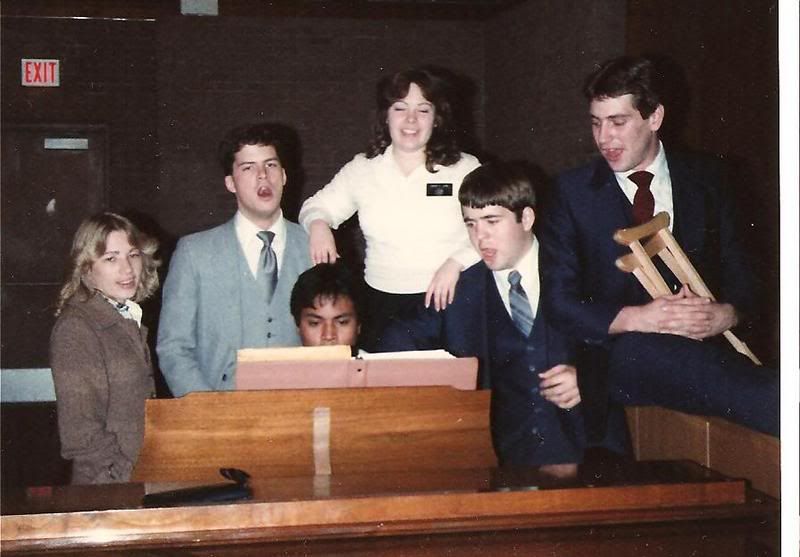
The Red Light District singing--Rev with his crutches
Wednesday, February 14, 2007
More on Valentinus
AmyB at Exponent 2 put up a post this morning entitled "What If?" which introduced me to a fascinating character named Valentinus, a man who narrowly missed being elected Pope in the second century AD. Eminently worthy of Valentine's Day sentiments, he strove for a unification of the Gnostic approach and the message of Christ. I was attracted to his theology by AmyB's statement that he taught that the deity was a dyad consisting of God the Father and God the Mother. My view of the Godhead is similar to this in that I picture an "Elohim" figure composed of unified male and female elements in addition to a Christ and Holy Spirit.
Stephen A. Hoeller writes of Valentinus' world view as the position that
"something is wrong. Somewhere, somehow, the fabric of being at the existential
level of human functioning has lost its integrity. We live in a system which is
lacking in essential integrity, and thus is defective. So-called orthodox
Christians as well as Jews recognize that there is a certain "wrongness" in
human existence, but they account for it chiefly in terms of the effects of
human sin, original or other. Jews and Christians hold that whatever is wrong
with the world and human existence is the result of human disobedience to the
creator. This means, that all evil, discomfort, and terror in our lives and in
history are somehow our fault. A great cosmic statement of "Mea Culpa" runs
through this world view, which permanently affixes to the human psyche an
element of titanic guilt. Valentinus, in opposition to this guilt-ridden view of
life, held that the above-noted defect is not the result of our wrongdoing, but
is inherent in the system of existence wherein we live and move and have our
being. Moreover, by postulating that creation itself is lacking in integrity,
Valentinus not only removes the weight of personal and collective guilt from our
shoulders but also points to the redemptive potential resident in the soul of
every human being."
Without diminishing the importance of Jesus, Valentinus reverences Christ's role as
"indeed Saviour, but the term needs to be understood in the meaning of the
original Greek word, used by orthodox and Gnostic Christian alike. This word is
soter, meaning healer, or bestower of health. From this is derived the word
today translated as salvation, i.e., soteria, which originally meant
healthiness, deliverance from imperfection, becoming whole, and preserving one's
wholeness."
My heart goes out to those I've spoken to recently who hate Valentine's Day. Those who may not get a card, a hug, or a kiss today. For those who live in defective relationships I invoke Valentinus' belief in redemptive potential and strivings toward unification. Beginning this day and continuing through the years, may we combat fear, hate, worldly and unauthentic thinking.
May we be facilitators of wholeness, to bring Gnosis and healing to all we encounter.