Thursday, July 29, 2010

Passing the Mantle

OT SS Lesson #29 -- originally posted on Mormon Matters
The prophet Elisha is introduced for the first time in 1 Kings 19.  Elijah has recently had his encounter with the 400 prophets of Baal and the still small voice of God on Mt. Horeb.  On his way from the mountain to the wilderness of Damascus Elijah finds Elisha plowing in a field.  He passes by him and throws his mantle over Elisha.  And scripture says that Elisha arose and followed Elijah, and became his servant.  Elisha doesn’t receive another mention until the end of Elijah’s ministry — when Elijah’s mantle falls from him as he is translated and is taken up by Elisha — and one can’t help but wonder about the relationship between the two in the interim.  How was Elisha prepared to succeed Elijah, and what relevance does this story have to succession in the Church today?

Saturday, July 24, 2010

Should Mormons in the Diaspora Celebrate Pioneer Day?

Posted at Mormon Matters on July 24, 2010
It has only been in recent years that I have slowly become aware that not every convert to the Church shares my deep identification with the Mormon pioneers. I have loved the epic story of the trek to the Salt Lake Valley. I appreciate its archetypal connotations. My heart thrills with the stories of the pioneer heroes and heroines, and I consider each of their stories part of my legacy as a Mormon, though my LDS heritage begins with myself.
In the last few years there has been some grumbling by members who don’t have Mormon pioneers in their genealogy that it annoys them to celebrate the July 24th holiday, a commemoration of the day the first company of pioneers entered the Salt Lake Valley. I think partly to appease these voices, there has been an emphasis on “modern-day pioneers”–those who lead the way for others to follow and who blaze trails in other ways than traditionally recognized. There’s a relatively new Primary song, “I Can Be a Modern-Day Pioneer,” there are more talks given by General Authorities on the subject, and there are articles such as the latest Mormon Times article “Pioneer Journeys of a Different Era.”  There is a sudden dearth of Pioneer Day activities in wards outside of Utah, and in our ward last Sunday the only talk which mentioned pioneers emphasized modern-day contributions rather than those who crossed the plains.
I just want to register a caution to those who wish to move away from the traditional veneration of these honorable forebears.

Thursday, July 15, 2010

The Divided Kingdom Today

OT SS Lesson #27 -- originally posted at Mormon Matters
“Take an old piece of clothing,” our SS lesson advises, “or a piece of paper that is cut in the shape of a piece of clothing and tear it into 12 pieces. Explain that toward the end of Solomon’s life, the prophet Ahijah prophesied that Jeroboam, one of Solomon’s 12 superintendents over taxes and labor, would take over much of the Israelite nation. To illustrate this, Ahijah seized the garment from the back of Jeroboam, tore it into 12 pieces, and gave 10 of the pieces to Jeroboam.”  The lesson teaches that the influence of wicked leaders was instrumental in dividing the kingdom of Israel after Solomon’s death.
The Savior taught that “every kingdom divided against itself is brought to desolation” (Matthew 12:25).
I read this with some consternation, because lately I have been perusing a very interesting website.  It is a wiki collection of groups belonging to the Latter-day Saint movement put together by Alan Unsworth.  Does it surprise you to learn that there are at least 116 active groups and denominations which trace their history back to Joseph Smith, as well as 204 “Restoration Branches” and 154 defunct denominational groups?  And because many of these are secretive and insular, I don’t believe that this list includes them all.

Saturday, July 10, 2010

The Question Solomon Couldn't Answer

OT SS Lesson #26 -- originally posted at Mormon Matters
Our Sunday School lesson this week attempts to deal with the conundrum with which we are faced when considering that Israel’s King Solomon, who was a paragon of wisdom having received this gift from the Lord, could make the decidedly unwise decision of marrying foreign wives and following them into idolatry.  
The lesson asks the following questions (answers provided):

Thursday, July 8, 2010

Latter-day Morality

from a post on Mormon Matters


You may not be aware of this if you grew up Mormon, but the LDS definition of morality is rather different than that which is generally accepted. Morality is very easily defined to Mormons — it means not having sex. That’s all. End of discussion. Immorality means having sex. That’s what we teach our teenagers, and that is the definition we carry with us from our church meetings into our daily lives.
Today I’d like to talk about some of the nuances to the word “morality.” The meanings that we don’t get in Mutual or Seminary or Sunday School. For purposes of this discussion, I would prefer to define “morality” as a system of ideas of right and wrong conduct.

Sunday, July 4, 2010

When the Fourth of July Falls on the Sabbath

Originally posted at Mormon Matters
Yesterday’s activities began with a Pancake Breakfast over at the Church, followed by a softball game.  We loaded up several of the kids from the Ward, my children’s friends, and hauled them all to the beach in both of our vans.  Arriving home at 5:00, we joined some neighbors for a potluck and barbecue.  There were even some small fireworks lit out in the field behind our house.  I enjoyed the day very much.  It was a lot like what we’ve done on the Fourth of July in years past — but this was on the third.  As I read some of the facebook pages of friends from around the country, I saw that a lot of Mormons were doing what we had done.  I suppose that celebrating Independence Day in the U.S. a day early this year was an effort to keep the Sabbath Day holy.
But why is a celebration of our country’s freedom considered a non-Sabbath avocation?

Thursday, July 1, 2010

Approaches to Psalms

OT SS Lesson #25 -- originally posted at Mormon Matters
The Book of Psalms is one of the most beautiful and meaningful books of the Bible, and it is agonizing to realize that our Sunday School schedule only allows one lesson to cover the entire oeuvre.  In this post, I’d like to outline several possible ways to approach a one-hour lesson on the Psalms, and to request your input as to which appeals to you personally.

Thursday, June 24, 2010

King David and the Doctrine of Blood Atonement

OT SS Lesson #24 -- Originally posted at Mormon Matters
The following statement was made by the LDS Church last Wednesday in conjunction with the execution of Ronnie Lee Gardner by firing squad in Utah.  I see this as a misunderstanding or a misrepresentation of what was taught in the past regarding the doctrine.

Thursday, June 17, 2010

Homosociality and the Friendship Between David and Jonathan

OT SS Lesson #23 -- Originally posted at Mormon Matters
The story of David and Jonathan is one of the most inspiring examples of true friendship anywhere.  Our LDS SS manual firmly places this lesson within the mainstream view of Biblical exegesis, presenting the two as strong personal and platonic friends.  As I studied the covenant made between these young men in 1 Samuel 18, I was touched by the loyalty shown by the young Jonathan, because he “loved [David] as his own soul.”  Because of this love, Jonathan relinquishes his hopes for his father’s throne in deference to God’s choice.  In a symbolic and ceremonial gesture, Jonathan strips off his robe, which represents the authorityhe holds to succeed his father, King Saul, and gives it to David.  He also gives David his sword and his bow, representing his military prerogative; and his girdle, which symbolizes spiritual truths and the kingdom of God.
But other writers, beginning with Homer and continuing to the present day, have noted the strong elements of intimacy and eroticism within the relationship.

Thursday, June 10, 2010

You Can't Ride Two Donkeys With One Ass: Saul and Spiritual Rebirth

OT SS Lesson #22 -- Originally posted at Mormon Matters
Ever since I was introduced to the word “liminal,” I have claimed it as my own. This word describes a threshold or a transitional position — a balancing point between two states of being. For many years I have felt poised on the threshold between two totally different ways of viewing the world. One is scientific and rational. The other is a place where angels materialize and shake your hand, where dreams have meaning, where God’s words come out of men’s mouths when they lay their hands on your head. Many members of the Church seem easily able to slip between both of these worlds. But I see a fundamental difference between the two world views. In the naturalistic view of the universe, events do not violate natural laws and are subject to the principles of empirical investigation. In the mystical view, divine intervention is possible outside of natural law.
Striving to make sense of my world has been like trying to ride two donkeys with one ass.

Thursday, June 3, 2010

Patriarchal Hierarchy and the Kingship Model

OT SS Lesson #21 -- Originally posted at Mormon Matters
When we lived in Saudi Arabia a few years ago, I obtained a faculty position in the fairly newly-formed department of Health and P.E. at a university which was strictly segregated by gender.  The women’s side of the university operated independently, with our own female custodians, technical staff, professors and administration,  and very little oversight from the male president.  Our department consisted of five women, and we made all decisions collectively, with no titular head.  After the first semester I was there, one of our staff meetings was dedicated to the question of whether we should have a department head.  Being the newest addition to the faculty, I had little say in this decision, but I did bring up the point that we had successfully administrated the department jointly, and I questioned the necessity of one department head.  It would completely change the group dynamics that we had experienced as a body of women removed from a patriarchal hierarchy and which I very much enjoyed.  The reply from all of the rest of the women, though there had been no problems thus far, was that “you HAVE to have a leader,” that one person MUST be in charge of any organization.
At the time I was struck by how much this assertion resembled the one I have heard from many Mormons justifying the hierarchical, patriarchal system in place in the Church, both within the institution and within our individual families.

Thursday, May 27, 2010

A Closer Look at that Virtuous Woman

OT SS Lesson #20 -- Originally posted at Mormon Matters
Sometimes I wonder how women in the Judeo-Christian tradition got stuck with the gender role identifications they have. The Old Testament doesn’t include many detailed descriptions of women, but when they do appear, they are not what you’d think. To prove my point, I’m going to investigate two women featured in this week’s Sunday School lesson, plus Deborah the judge/prophetess, and the ubiquitous “virtuous woman” of Proverbs 37.

Saturday, March 20, 2010

Brothers: Tarot Randomizer #4

It was rather a synchronicity that the Tarot card picked for today's group creativity experiment was "The Devil." Last night my daughters and I attended a play at the Covey Center for the Arts, "Brothers," about the human side of two famous siblings, Lucifer and Jesus.  I'm planning on reviewing the play for the Mormon Matters readers, but for now I did a quick sketch to put up for our group.  I'm always lamenting my lack of artistic ability, but in this one I was trying to capture the moment in LDS doctrinal tradition where God the Father presents the plan of salvation to his children in the premortal existence.  Satan's face is supposed to represent his disdain for the plan, his inner thoughts that he can come up with a better one, and a bit of sadness foreshadowing his eventual downfall.  Jesus' face came out more beatific than I really intended, but I had difficulty capturing the feeling I wanted to express, of complete acceptance and excitement to put the plan in action.

Thursday, March 18, 2010

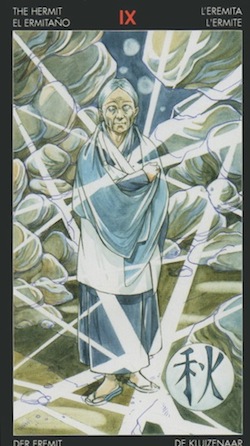
L'Ermita Aki: Tarot Randomizer #2

Today's Tarot creativity project  -- The Hermit: which has the key words of introspection, searching, guidance, and solitude.  The card that was drawn for today also had the Kanji character "aki" meaning "autumn."  I used a picture from a photo shoot my daughters and I did yesterday, and we had some fun with photoshop.  Even though this was a spring St. Patrick's Day shoot of my daughter, I like how we came up with an autumn-like feel here.

PS Gigi: the name of the card is no reflection on your social standing!


inspired by the Hermit card from the Manga Tarot deck: 

Wednesday, March 17, 2010

Knight of Swords Tarot Randomizer #1

There's something about a Utah sky--
Overarching canyons and clouds,
Framing mountains and mornings--
That clears the confusion in sinus-blocked nostrils
A breath of freshness
To the unbalanced wanderer.

There's something about a Utah day--
Manifesting seedlings and springtime,
Teasing flowers with flurries--
That promises newness, fresh starts, and cleansing
Purging the old and ungainly
In the jaded heart.

There's something about a Utah ward--
Bustling with baby blessings and boundaries,
Tangling holiness and hypocrisy--
That slices the errant knight to the heart
Focusing sword-bright censure
Upon the unanchored soul.

This post a response to John R's Tarot Randomizer group creativity experiment, and a reaction to my visit to the Salt Lake/Provo area, where I am visiting for a couple of weeks.

Wednesday, March 3, 2010

Jacob's Ladder: More on Faith vs. Works

OT SS Lesson #10 -- originally posted at Mormon Matters
Though it’s only an “additional teaching idea” in Lesson 12, Jacob’s ladder has captured my imagination due to some conversations I’ve recently had with Christian evangelicals.

Wednesday, February 24, 2010

Putting an Edge on Abraham

OT SS Lesson #9 -- originally posted at Mormon Matters
This story is so very, very familiar to us that I think it’s important to look at it with a fresh perspective.  So in this post I am including some pieces from media and the arts that force us to think about Genesis 22.  I promise you in advance that some of these might be disturbing to you.  Probably you will disagree with the portrayal of Abraham’s sacrifice in at least one, if not all, of these pieces.  I hope you will share your reactions in the comments.

Wednesday, February 17, 2010

Where the Lord Annihilates all the Gays

OT SS Lesson #8 -- originally posted on Mormon Matters
“The Genesis passage is very clear, that the sin of Sodom that brought on the destruction of the city was indeed linked to homosexuality.” (R. Albert Mohler Jr., president of the Southern Baptist Seminary)
“Saying that the last recorded acts of the Sodomites — the demands for same-gender sex — are proof that they were destroyed for homosexuality is like saying that a condemned man cursing his guards on the way to his execution is being executed for cursing the guards. Sodom was judged worthy of destruction before the incident with Lot and the angels.” (Inge Anderson, “Sins of Sodom“)
One of the prominent themes in this week’s Sunday School lesson is the story of Lot and the destruction of Sodom and Gomorrah. But in Christian thought there has been some controversy over how closely the story should be linked to homosexuality, as the quotes above indicate. There are several points that are up for grabs, and I’m not sure either side has a complete understanding yet. Read on, and let me know what you think!

Wednesday, February 10, 2010

Sod, Seed, Salvation: Abrahamic Covenant and the Claim to Palestine

OT SS Lesson #7 -- Originally posted at Mormon Matters
Sod, seed, and salvation — it’s how I like to describe the Abrahamic Covenant. There were three promises in the covenant. The first was a land promise, where the Lord gave Abraham and his descendants the land of Canaan for an everlasting possession. The second was the promise of a great and numerous posterity. And the third was the blessing of the everlasting Gospel: the priesthood and the promise of exaltation, to come to the world through Abraham’s lineage. (see Genesis 17)  But just look at how often the covenant was renewed!

Saturday, February 6, 2010

Joseph Smith Didn't Believe in Watchers

OT SS Lesson #6 -- Originally posted at Mormon Matters
Hidden in our scripture reading for this week is a strange little passage which many modern Biblical scholars say was originally intended to explain the rise of the giant race of antiquity by the union of angelic beings with human wives.  These verses in Genesis stirred a lively debate among early Christian theologians as they struggled to explain why God felt it necessary to cleanse the Earth with a worldwide Flood.  It all starts with this odd passage inserted in the account before Noah built his vessel, the great ark.

Wednesday, February 3, 2010

From Patriarchy to Eternity

Originally posted at Mormon Matters
I am going to put this as simply as possible, and let’s start with a definition.  Patriarchy is a social system in which the father or eldest male is head of the household, having authority over women and children. Patriarchy also refers to a system of government by males, and to the dominance of men in social or cultural systems.  I know that this is a true definition, having found it on Wikipedia. However, if you disagree, scroll down and I will include definitions from as many dictionaries as I can google.  Patriarchy by its very definition is not compatible with equality.

Monday, February 1, 2010

Female Priesthood and The Black Widow Spider

Over at BCC today implications of the Fall were vigorously debated on Mark Brown's post Women, Men, and the Fall.  Mark invited readers to consider a quote by Elder Packer extolling the superior divine attributes of woman and whether her natural virtue mitigates the effects of fall and her proclivity to sin.

Sunday, January 31, 2010

Virgins and White Raisins

Those of us who have studied ancient Middle Eastern languages know how difficult it is to arrive at an exact translation of ancient texts.  There are several words in the Hebrew Bible which are used only once and which have no modern counterpart.  Even after making such efforts as comparing them to Akkadian, or examining numerical clues, they remain a puzzle.

Thursday, January 28, 2010

A Short Stay in Hell

Can you imagine a worse hell for a Mormon than to wake up on the Other Side and to realize we were wrong about EVERYTHING? No three degrees of glory, no families are forever, no anthropomorphic God--not even an outer darkness as we picture it. That's what happens in Steven L. Peck's provocative, self-published novella, A Short Stay in Hell.

Wednesday, January 27, 2010

Why I Want to Live the United Order

OT SS Lesson #5 -- Originally posted at Mormon Matters
I have often thought that had I not joined the Church at age 19 I would have liked to have joined a kibbutz in Israel, or to have lived on “the Farm” in Tennessee (back when it was more hippie-like), or at least to have been a part of an intentional community. As I began investigating the LDS Church, and in particular reading the passages in Moses under consideration in our Sunday School Lesson #5, I was drawn to the strong emphasis on cooperative community which began under the direction of Joseph Smith and continued in Utah under Brigham Young and survived even to the present day.  I expected to be instructed in the principles of consecration and called upon to live them more and more as the “latter day” rolled on.
Thirty years later, I’ve been disappointed.